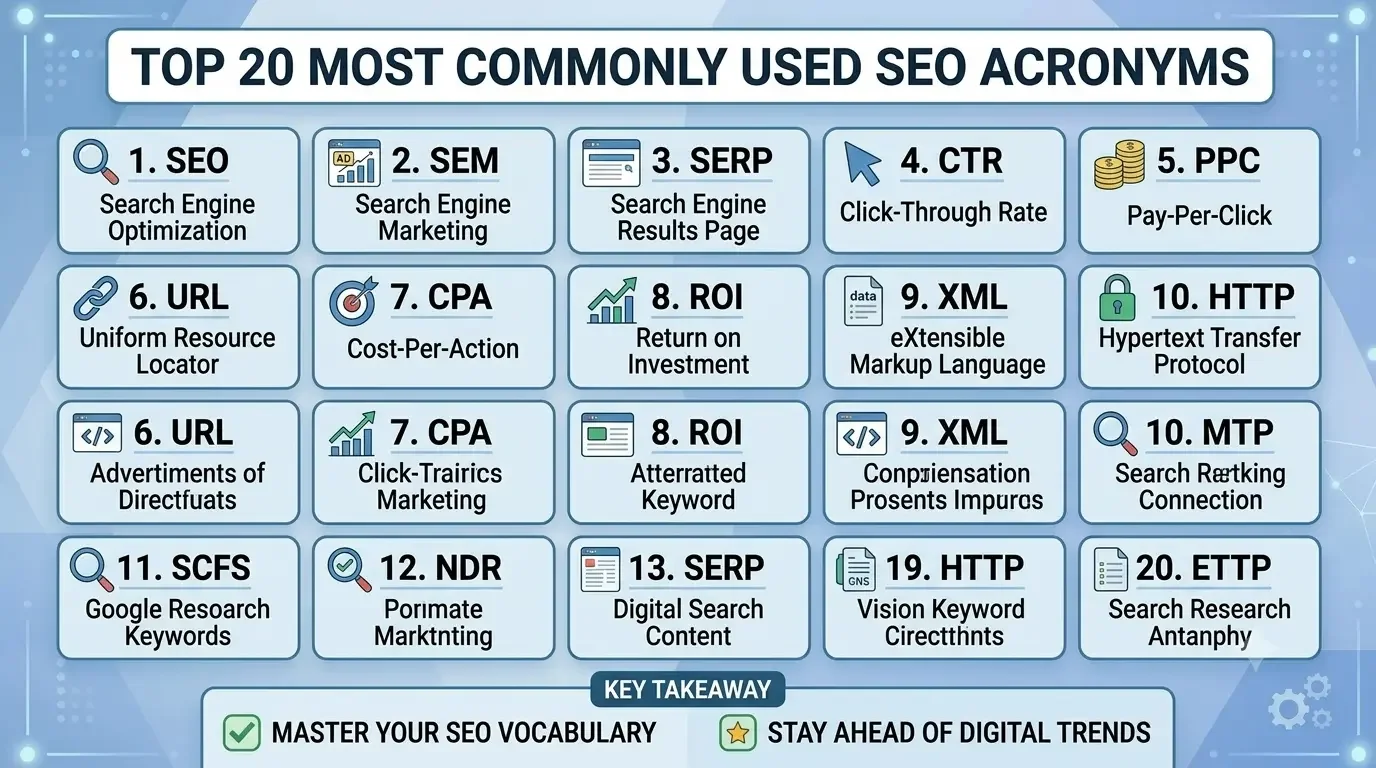
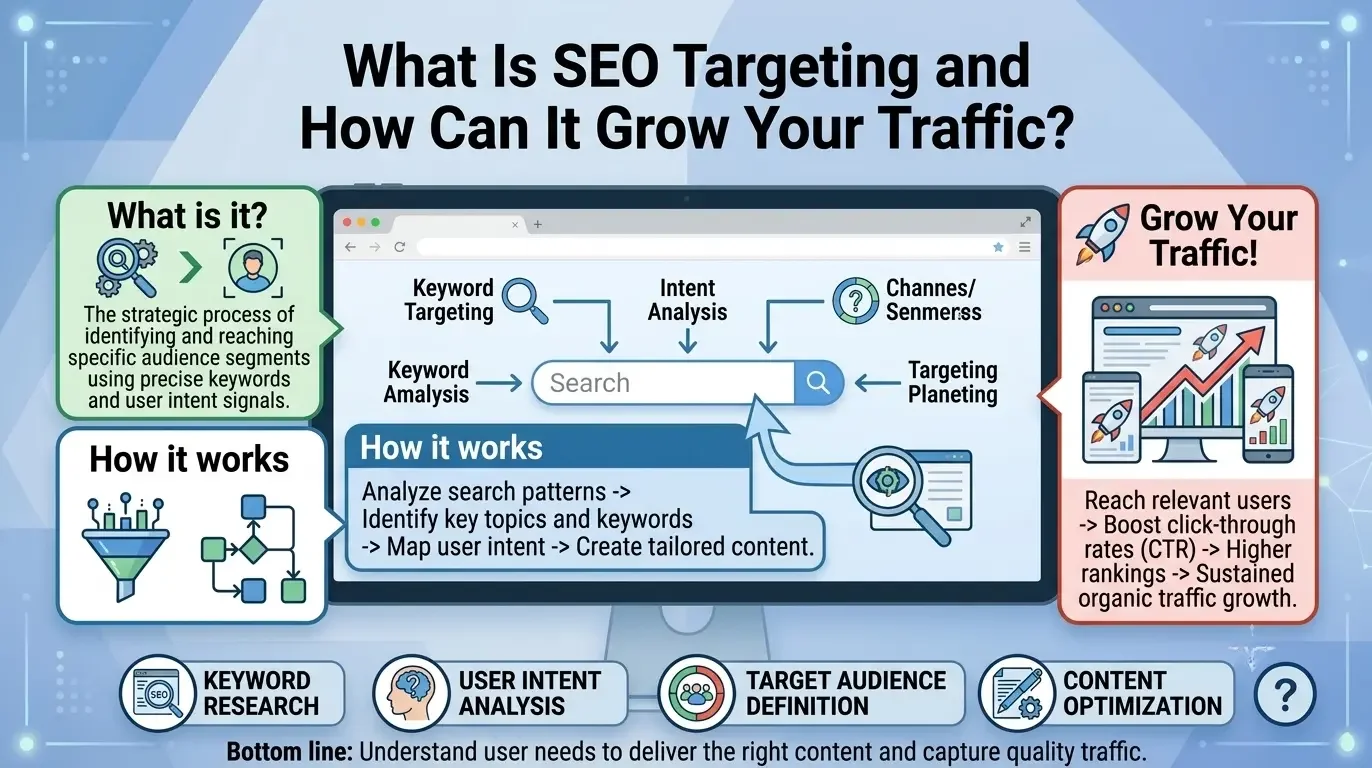
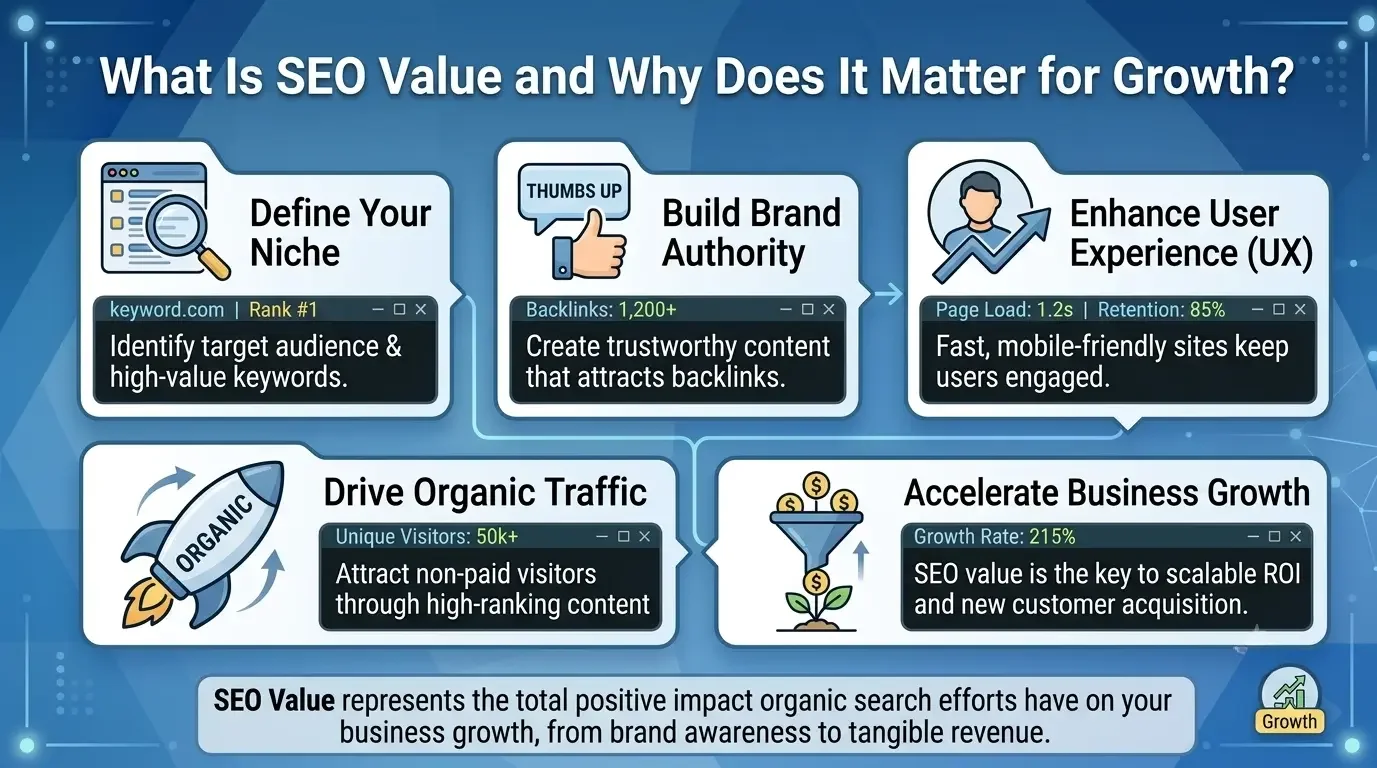
What Are Search Engine Optimization Terms for Beginners?
Start to understand the key Search Engine Optimization Terms such as keywords, crawling, indexing, backlinks, meta tags and basic technical SEO.
Quick Summary
- SEO can get websites to show up in organic search results by enhancing the quality of the content, site architecture, technical optimization, and content relevance for search queries.
- Keywords and search intent are the pillars of SEO, as they define the purpose of a search and the information users are looking for.
- Three important search engine functions are crawling, indexing, and ranking. The three most important functions of the search engine are crawling, indexing and ranking.
- On-page, technical and off-page SEO all work together to enhance page clarity, site health, user experience, authority and search visibility.
- For beginners, it is best to concentrate on helpful material and good optimization, such as writing clear titles, using headings correctly, adding internal links, optimizing page speed, and not stuffing keywords.
What Is Search Engine Optimization?
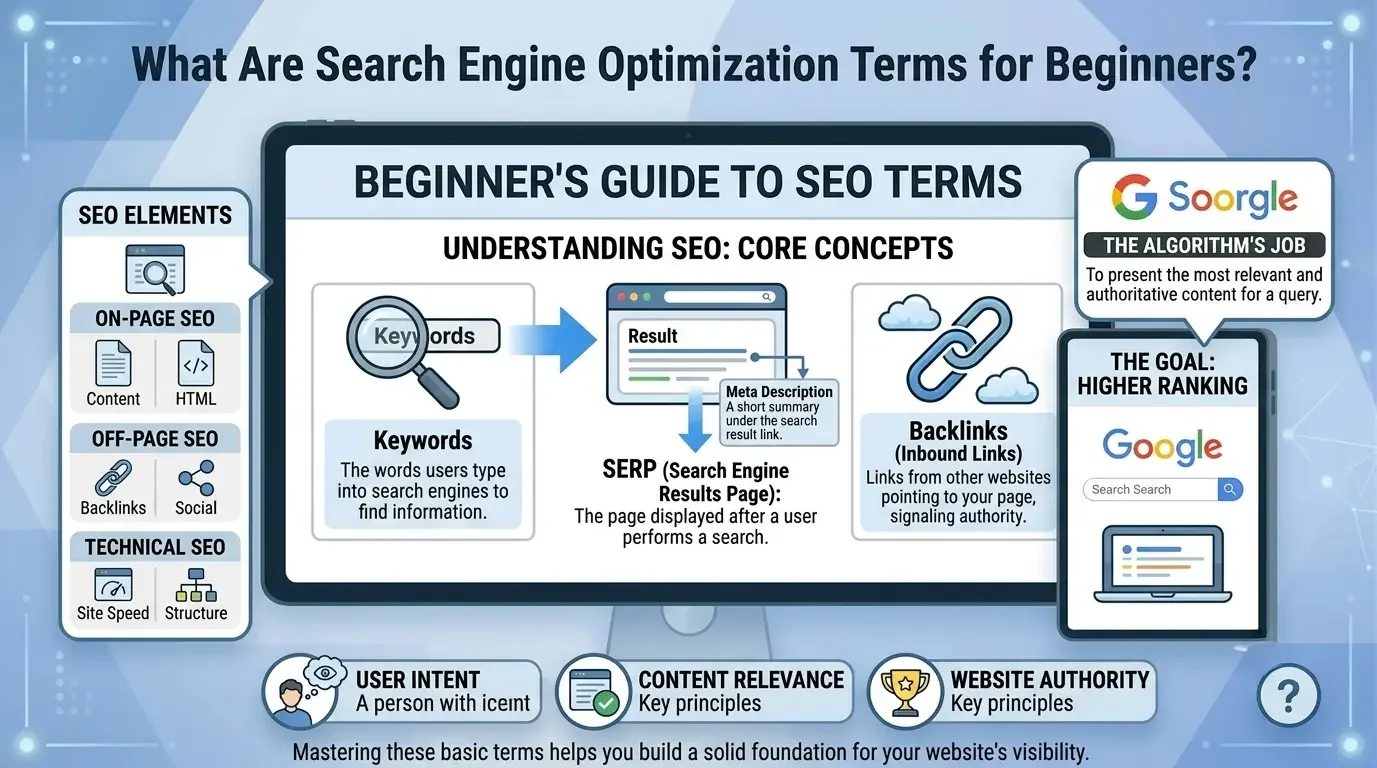
SEO or search engine optimization refers to the practice of optimizing a Website for search engines and users so that it can be found more easily and understood by search engines. SEO aims to boost organic visibility, drive targeted traffic, and get pages to appear for queries related to your products, services, or information.
SEO isn't just about being ranked higher. It's also about aligning with users' goals, making content useful, enhancing site architecture, establishing trust, and making pages search engine-friendly.
Why SEO Terms Matter for Beginners?
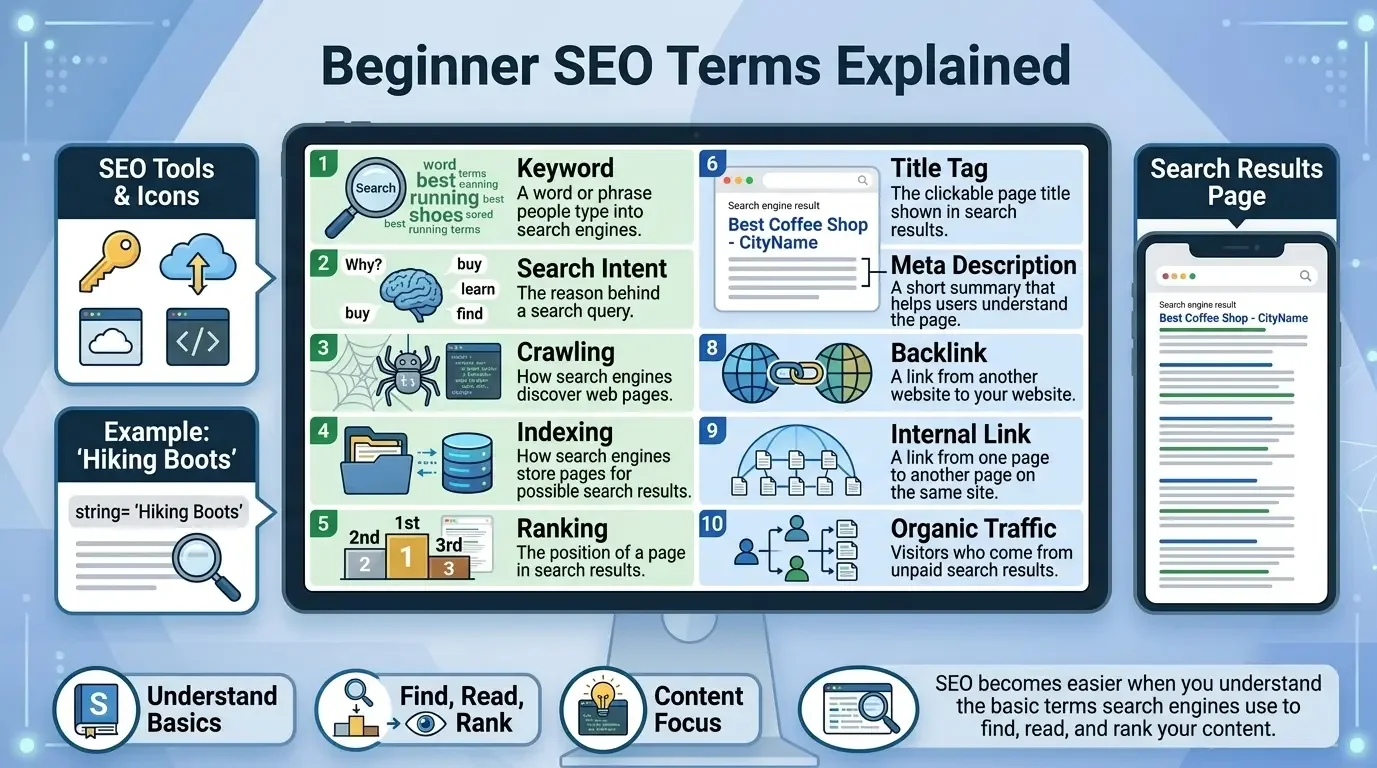
By knowing SEO terms, you can avoid guesswork. Once you understand a few of the key words and phrases of SEO, you'll be able to interpret reports, utilise SEO tools, speak with marketers, and make better sense of your website.
For Example, if you know the difference between crawling, indexing and ranking, you can understand why a page may not show up in search results. Knowing your search intent will help you develop content that matches your users' needs and desires. With the knowledge of backlinks, internal links, and anchor text, you can design a better website structure.
SEO Terms Explained
1. Search Engine
A search engine is a platform to help people find information on the internet. Examples of search engines include Google, Bing, Yahoo, and DuckDuckGo.
A search engine finds web pages, indexes them and returns relevant pages when a query is entered by typing it. The objective in SEO is to ensure that your site is discoverable, comprehensible, and visible in search suggestions for relevant topics and queries.
2. SERP
Search Engine Results Page (SERP). The page a user will see after submitting a search query.
The results that appear in a SERP may be organic listings, paid ads, featured snippets, videos, image results, local map listings, People Also Ask boxes, and shopping results. The main objective of SEO is to increase visibility in organic search results, but the results from SERP features are also vital for driving clicks.
3. Keyword
A keyword is a word or phrase that users search for in search engines. For Example, the keywords are: "best running shoes", "how to start a blog" and "SEO terms for beginners".
A page's keywords provide search engines with information about the subject of the page. But today's SEO isn't about overstuffing keywords. It is about the natural use of the relevant terms and the development of content that aligns with the user's search intent.
4. Search Query
A search query is the exact set of words a user types into a search engine. In most cases, a keyword refers to the word or phrase a marketer targets, and a query refers to the term or phrase a user types.
For Example, if you are targeting the keyword "SEO tools", users may be searching for phrases such as "best free SEO tools for small business" or "SEO tools for keyword research". Real search queries will help you formulate content that is more helpful.
5. Search Intent
Search intent is the reason behind a user's search. Describes what the person wants to do or learn.
Search intent can be broken down into the following categories:
Informational: The user's goal is to find out something.
Navigational intent: user is looking for a particular website or brand.
Commercial: To choose a product or service for purchase.
The user is ready to make a transaction, such as buying, booking or signing up.
One of the most fundamental pieces of information for SEO is search intent. A page that offers the kind of answer that users are looking for is likely to perform well.
6. Keyword Research
Keyword research is the process of identifying the words and phrases your audience uses in search engines. It assists you in determining your subject areas and keyword research.
Some key factors to consider in good keyword research are search volume, keyword difficulty, relevance, competition, and intent. For beginners, it's essential to get keywords that are not just competitive and high-search-volume but also highly specific and practical.
7. Long-Tail Keyword
A long-tail keyword is a longer and more specific search term. For instance, SEO is a long keyword, and search engine optimization terms for beginners is a long-tail keyword.
Long-tail keywords typically have lower search volume but higher intent. They're typically easier for new websites to target because they answer a specific question and attract more qualified traffic.
8. Search Volume
Search volume is the estimated traffic of a given keyword over a given timeframe (typically monthly).
A high search volume can equate to more traffic opportunities, but also more competition. Low-volume keywords can be useful if they are for a specific intent and the right kind of user is interested in them.
9. Keyword Difficulty
In SEO, keyword difficulty is a metric that helps gauge a keyword's difficulty.
A tough keyword typically has a lot of competition coming from well-known websites. It is good for beginners to start with easy keywords related to their niche and then work up to more difficult ones over time.
10. Organic Traffic
Organic traffic is traffic that comes to your website from unpaid search results. If your page is visited by clicking the link from Google or another search engine, but not by clicking an ad, they are an organic visitor.
Organic traffic is important because it can help generate steady traffic in the future. Good SEO can help drive traffic through natural search engine results pages, which helps reduce reliance on paid advertising.
11. Ranking
Ranking is the process of handling a page so that it appears in the search results for a particular keyword or query.
If your page shows up in the third position for a particular query, For Example, "beginner SEO glossary", then you are in position #3 for that query. Though higher-ranking sites may get more clicks, ranking is only beneficial if the traffic is relevant and interested in your content.
12. Crawling
Search engines discover web pages through crawling. The software that automates search engines' ability to follow links and find content on the Web is known as a crawler, bot, or spider.
Search engines may not be able to find and evaluate the page if it cannot be crawled. Navigation and internal links, XML sitemaps, and crawlable URLs are good ways for search engines to find important pages.
13. Indexing
After discovering and processing a page, a search engine will perform an index. When a web page is added to a search engine's index, it can appear in search results.
A page may be "crawled" but not "indexed". This can be due to duplicate content, weak content, technical issues, noindex tags, blocked resources, or other signals indicating the page shouldn't be shown in search results.
14. On-Page SEO
On page seo optimization works on optimizing a web page. This is related to content, headings, title tags, meta descriptions, images, URLs, internal links, and keywords.
On-page SEO will make a page easy to understand, helpful, and relevant to users and search engines. The foundations of good on-page SEO are good content and a well-thought-out structure.
15. Technical SEO
Technical SEO focuses on the back-end and structural components that affect a website's search engine crawling, indexing, and user experience.
Technical SEO involves site speed, mobile-friendliness, structured data, secure (HTTPS) connections, XML sitemaps, robots.txt, canonical tags, redirects, crawl errors, and website architecture. The beginner need not master all the technical details at once; he should possess a certain element of understanding.
16. Off-Page SEO
Off-page SEO also refers to a number of activities that occur outside your site but impact your visibility, reputation, and authority. Link building is the most popular aspect of off-page optimization.
High-quality sites linking to your content can help convey trust and relevance. Digital PR, brand mentions, reviews, guest posts, and local citations are also types of off-page SEO. 17. Local SEO
Local SEO helps businesses show up in searches targeted to a specific geographic location. For businesses that have customers in a city, region or other "real" place, it is important.
Local SEO terms are Google Business Profile, local citations, reviews, map pack, NAP consistency and location pages. Local intent is indicated with a search such as a "dentist near me" or "best bakery in Lahore".
18. Title Tag
The HTML title of a web page is the title tag. It's frequently displayed on search results as the clickable headline.
The best title tag should describe the page and include the primary keyword naturally, while encouraging users to click it. It should be specific, accurate and should not be keyword-stuffed.
Example:
So, what are the search engine optimization terms for beginners?
19. Meta Description
A brief description of a page. It may show underneath the title of the search results.
The meta description is not a direct ranking factor, but it can help ensure a high click-through rate by informing users of what to expect when they click on the link. Good meta descriptions should be clear, relevant and engaging.
Example:
Discover the key vocabulary in search engine optimization that will help you to grasp the basics.
20. Header Tags
HTML headings that are used to structure content are header tags. Typically, the main heading will be an H1, and the subheadings will be an H2, H3, and so forth.
Content is easier to scan with header tags. They also aid search engines to comprehend a page structure and primary topics.
A simple structure is represented as follows:
H1: Main page title
H2: Main sections
H3: Supporting points under each section
21. URL Slug
The part of a Web address that identifies a specific page is a URL slug. For Example, "example.com/seo-terms-for-beginners" has the slug as "seo-terms-for-beginners."
The URL slug should be short, easy to understand, and descriptive of the page content. Don't use unnecessary words or long strings of numbers.
22. Internal Link
Link between two pages of the same website.
Internal links lead users to find related content. They are also crucial for helping search engines navigate your website and understand the relationships between pages. A blog post about the terms of SEO, for instance, might have hyperlinks to other blog posts, such as those about keyword research, technical SEO, and content optimization.
23. External Link
Linking outwards from your site is a link from your site to another website.
When used to connect to helpful, reliable sources, external links can enhance the user experience. They need to be pertinent and natural. Connecting to trustworthy sources can help enhance your material, but overloading it with links or links that are not pertinent might draw readers away.
24. Backlink
A backlink is a link from another website to your website.
One reason backlinks are valuable is that they can serve as indicators of trust, authority, and relevance. But it is not just about the numbers, it's about quality. It is generally better to have one high-quality, relevant backlink than many low-quality or irrelevant ones.
25. Anchor Text
Anchor text is the 'linkable' text in a link.
In the example of "read our keyword research guide," the words that are the link anchor text are "keyword research guide." Descriptive anchor text enables search engines and users to understand the content of the linked page.
Don't use vague anchor text like "click here"; use a more specific phrase instead.
26. Alt Text
Alt text is a text alternative to an image. It aids search engines and accessibility devices in interpreting an image's meaning.
This article doesn't contain any pictures, but alt text is a key SEO term nonetheless. Effective alt text will be descriptive, but natural. It shouldn't be stuffed with keywords.
27. Structured Data
Structured data is code that provides search engines with information about a specific piece of information on a particular page. Can be used to explain products, reviews, recipes, articles, events, FAQs, and more.
Structured data can sometimes enable search engines to return rich results, such as star ratings, prices, dates, event listings, or FAQ-style results. It's not necessarily a way to improve search engine appearance, but it does help search engines understand what you're doing with the information.
28. Schema Markup
Another commonly used vocabulary for structured data is schema markup. It aids in labelling information on a page in a manner that search engines can understand.
The schema is beneficial for beginners to be familiar with, since it aligns SEO and better data organisation. Some common schemas include Article, FAQ, Product, LocalBusiness, Review, and BreadcrumbList.
29. XML Sitemap
An XML sitemap is a file that lists important pages on your site. It improves search engines ' ability to index pages faster.
A sitemap does not guarantee indexing, but it can help search engines locate crucial URLs, particularly for large, new, or complex websites.
30. Robots.txt
A robots file instructs search engine spiders about what content on a website can and can't be indexed.
It can be helpful for controlling the behaviour of crawlers, but it should be used with caution. When it is important to block a page in robots.txt, it can block search engines from crawling that page appropriately.
31. Noindex Tag
A noindex tag tells search engines not to include a page in search results.
This can be helpful on pages you don't want visible in search, such as thank-you pages, internal search results pages, duplicate pages, or low-value pages. Noindex should only be used by advanced users who are familiar with its impact.
32. Canonical Tag
When multiple pages contain similar or duplicate content, a "canonical" tag is used to signal to search engines which version is preferred.
If a product can be accessed from several URLs, a canonical tag can help search engines recognise the main product page. It helps prevent confusion and index the site more effectively.
33. Redirect
A redirect is a process that redirects users and search engines from one URL to another.
A 301 redirect is the most common type of SEO redirect that tells search engines that a page has been permanently moved. Redirects are crucial when you have to change the URL of your site, delete a specific page, merge content, and/or move your site to a different domain.
34. Broken Link
A broken link is a link to a page that no longer exists or cannot be reached.
Not only does a website with broken links look abandoned, but it's also a bad user experience. It is a basic yet helpful SEO maintenance task to regularly check and fix any broken links.
35. Page Speed
Page speed is the time it takes a web page to load.
Faster pages typically lead to a better user experience. Slow pages can cause users to bounce, reduce engagement, and make it difficult to take action. Page speed is of particular concern on mobile devices.
36. Mobile-Friendly Website
A mobile-friendly website functions properly on mobile devices such as smartphones and tablets. It should contain readable text, be easy to tap and use, have a responsive design, and be easy to navigate.
Mobile usability is an integral part of modern SEO, as many users search from mobile devices. If your site isn't mobile-friendly, you can lose visitors, leads, and conversions.
37. Core Web Vitals
Core Web Vitals are metrics pertaining to the user experience. They keep track of loading speed, stability in visuals, and responsiveness.
The basic concept for beginners is that your website should have fast loading times, be responsive, and not abruptly change layout as people interact with the site.
38. Duplicate Content
Duplicate content is content that exists more than once in the web (or on more than one URL in the same website).
Duplicate content can confuse search engines about which page to index or rank. Where similar pages are needed, it's better to develop fresh, valuable content and employ canonical tags or redirects.
39. Thin Content
Thin content is content that has little to no value for readers. It can be too short, too general, plagiarised, or written to answer a question without providing any real answer.
Write in depth, clarity, originality and usefulness to avoid thin content. A page should help to solve a real problem or answer a real question.
40. Content Optimization
Content optimization means optimizing content to be useful and understandable for readers and search engines.
This includes adapting to the intent of the search, incorporating the keywords naturally in the text, optimizing headings, responding to questions related to the search, providing internal links, refreshing content, and ensuring readability.
41. Semantic SEO
Semantic SEO involves optimizing content for its meaning, context, and relevant themes rather than just the specific keyword.
A page explaining what is meant by the term "SEO" can also include related terms like search intent, crawling, indexing, ranking, backlinks, title tags, structured data, and technical SEO. This helps search engines better grasp the subject and assists users in obtaining a comprehensive answer.
42. Topical Authority
Topical authority is when you have robust and solid topical coverage of a certain subject area on your website.
Topical authority can be established on a website by providing valuable content on related subtopics. For instance, an SEO website for beginners may delve into keyword research, on-page optimization, technical optimization, link building, analytics, local SEO, and content marketing.
43. E-E-A-T
E-E-A-T is an acronym for Experience, Expertise, Authoritativeness, and Trustworthiness.
A concept that has been used to assess the quality of content, particularly for topics where trust and accuracy are important. For beginners, there is a need to show that they have real experience, that the written content is accurate, that the sources used are reliable where necessary, and who is responsible for the content.
44. Click-Through Rate
CTR or Click-through Rate is the percentage of people who click on your result when they see it in search results.
You can boost CTR with a clear title tag, a useful meta description, a solid brand name and relevant search results. The more users click on your page from the results page, the higher your CTR.
45. Bounce Rate
Visits that result in a bounce are often referred to as 'bounce rate.
Not a bad bounce rate is not a good bounce rate. A user, for instance, could find the solution he/she is looking for and exit satisfied. The pages are slow, have confusing information, or are not relevant to the user, but users leave quickly because of this; then there might be a problem.
46. Conversion
A conversion occurs when a visitor takes an action that is the goal of the website. This may be a purchase, a form completion, a newsletter sign-up, a file download, or booking a call.
SEO is not meant to just drive traffic. It should attract the right visitors. The optimal way to implement an SEO strategy is to link the visibility to business objectives.
47. Google Search Console
Google Search Console is a free tool to help website owners view how their website is doing in Google Search.
It displays search queries, clicks, impressions, indexing problems, sitemap status, page experience details and technical issues. It is one of the most useful tools for tracking the performance of your SEO efforts, especially for beginners.
48. Google Analytics
Google Analytics is a tool that helps you understand website traffic and user behaviour.
It can provide insights into where visitors are coming from, the pages they visit, the amount of time they spend on the site, and the actions they take. It can provide more insight into SEO performance when used with Search Console.
49. Impressions
When someone searches for your page but doesn't click it, this is an impression.
Impressions reveal the frequency of viewings of your content. If you have a lot of impressions but few clicks, it may be necessary to optimize the title tag, meta description, or content angle.
50. SEO Audit
An SEO audit is an analysis of a website's SEO health. Identifies issues and opportunities for content, technical, user, links, keywords, and indexing.
A basic SEO audit could involve verifying that pages are indexed, titles are unique, meta descriptions are clear and informative, internal links are functional, page load times are acceptable, and the content reflects the purpose of the search.
How do these SEO Terms Work Together?
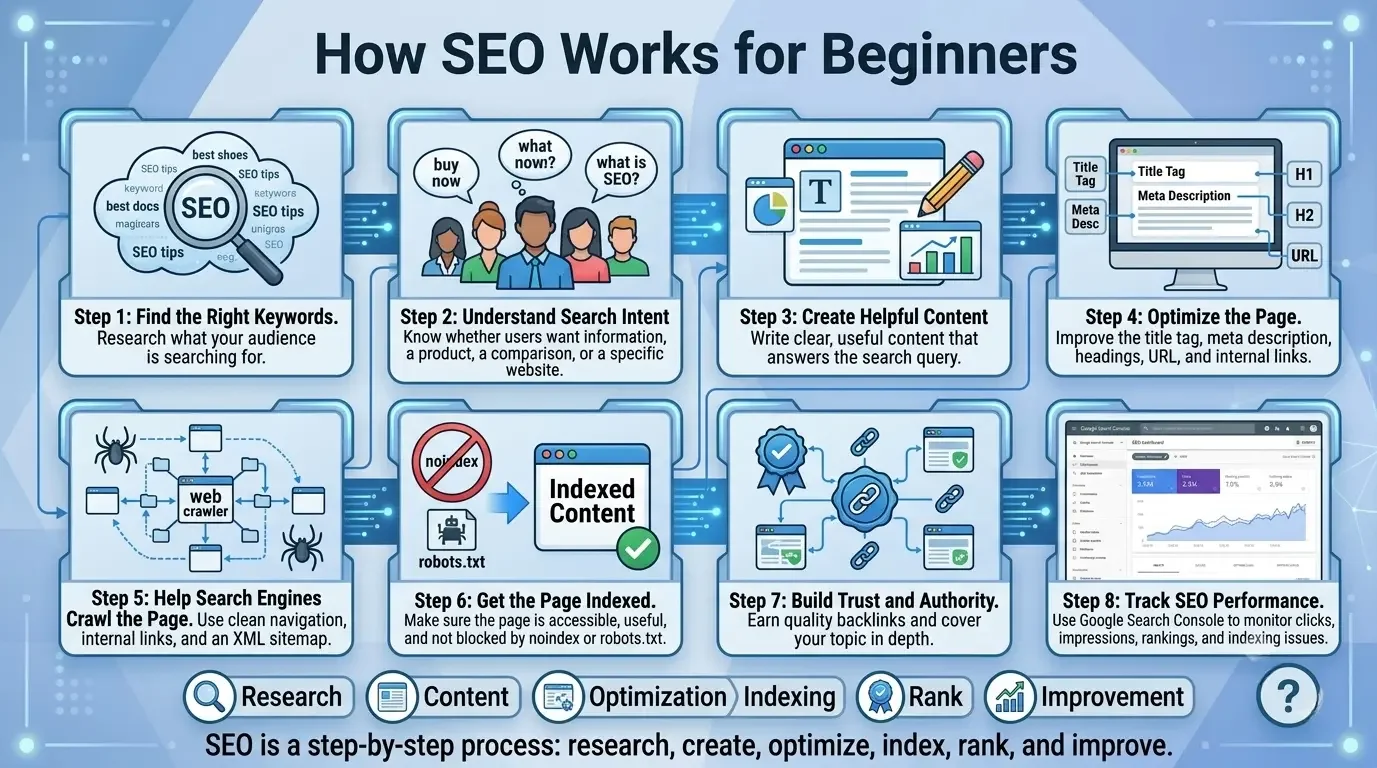
Understanding how SEO terms relate to each other makes them more familiar.
Search engines start crawling your site and find pages. They then index the pages they know and think are useful. A search engine will rank relevant pages based on a lot of factors, such as the quality of the content, the relevance, the usability, the links and overall usefulness when the user types in a search query.
Your task is to provide valuable information, structure it nicely, incorporate keywords in a natural way, optimize technical aspects and establish trust over time.
Beginner SEO Checklist
The following is a simple checklist to follow when optimizing a page:
- Select a primary keyword and some related keywords.
- Know your searcher's intent for the keyword.
- Create an attention-grabbing title tag and meta description.
- Organise sections using H2 and H3 headings, use one H1.
- Develop useful, original information that answers the question.
- Link relevant pages together by using internal links.
- Only include external links when they enhance the reader's understanding.
- Keep your URL short, readable and relevant.
- Ensure that the page is crawlable and indexable.
- Optimize page speed and mobile user-friendliness.
- Utilise structured data if applicable to the page type.
- Monitor performance in Google Search Console.
Common SEO Mistakes Beginners Should Avoid
SEO can be more difficult for beginners to do than it should be. These are some of the common pitfalls to steer clear of:
- Using the same phrase or word repeatedly in a non-natural manner.
- Writing for search engines, not for humans.
- Ignoring search intent.
- Posting low-quality or plagiarised material.
- Takes care to use broad headings and titles.
- Forgetting internal links.
- Disallowing important pages from crawling.
- Trying to rank for competitive keywords that are too early.
- Ignoring mobile users.
- Never update old content.
SEO is most effective when your website is helpful, easy to understand, technically sound, and offers value to your audience.
Interesting Research Facts
Full citations are in Sources below.
SEO improves visibility and traffic
The meta-analysis on SEO and its effects on website traffic and rankings in 2024 reported a large effect size (d = 1.049), indicating a strong positive relationship between SEO and both traffic and rankings.
Source: ResearchGate — SEO effectiveness meta-analysis, 2024
First-page rankings matter most
Users pay attention to the top 10 pages on a search engine, and most don't venture past the first page.
Source: ResearchGate — SEO effectiveness meta-analysis, 2024
CTR drops sharply by position
A lower position on the first page of Google results can bring in a much lower amount of CTR, while higher positions can bring in a much more significant amount of CTR.
SEO has four core pillars
Niche differentiation, valuable content, targeted keywords, and scalable link building.
Source: PMC — SEO marketing research
Quality content attracts backlinks
Quality content generates backlinks: With quality, useful content, users will all find it useful and naturally tend to link back to it, thus aiding your SEO over time.
Source: PMC — SEO marketing research
Frequently Asked Questions
1. What are the most important SEO terms to know?
Begin by focusing on keywords, search intent, crawling, indexing, ranking, title tags, meta descriptions, internal links, backlinks, and organic traffic. These terms define how search engines can discover, comprehend and present your pages.
2. Which is better between indexing and ranking?
When Google indexes your page, it will have it stored in its database. Ranking is the process of getting your page to be shown in the search results for a particular query. A page that doesn't rank well can also be indexed.
3. Is it possible to achieve a high rank on a website without any backlinks?
Yes, but in competitive niches, it is typically more difficult. New sites can target specific, less-competitive keywords if they're writing helpful, on-topic content that satisfies search intent.
4. Are keywords still important for SEO?
Yes. Keywords can link your content to people's search queries. The aim is not to overuse keywords but to incorporate them sensibly with relevant keywords and appropriate answers.
5. Does SEO really only involve meta tags?
While Meta titles and descriptions are important for SEO, there are other factors, such as content quality, page structure, internal links, site speed, mobile-friendliness, indexing, backlinks, and user experience.
6. On average, SEO takes a year to work?
SEO can take weeks or months to work, depending on the competition, site authority, content quality, and the site's health. Individual pages with low competition might speed up, but it may take some time for consistent results.
7. Should each page of a site use a different title tag?
Yes. The titles of the important pages should be descriptive and different. It helps users and search engines comprehend the page's content.
8. Why is my webpage being listed in Google search results, but not being visited?
Your page may not be what people are searching for, not use the right keywords, not have the authority, or not be ranked high enough to get clicks. See impressions, queries and average position in Google Search Console.
9. Can Low Search Volume Keywords be ignored?
Yes. Low-volume keywords can be useful if they come from the right set of people. These are typically more straightforward to rank for and can attract visitors who have a more direct intention.
10. Which is the top free SEO software for novices?
Google Search Console is one of the best free beginning SEO tools. It displays the search queries, clicks, impressions, indexing issues, crawl issues, and page performance.
How we reviewed this article:
Share this article