What Are the Top 20 Most Commonly Used SEO Acronyms?
Understand the most important 20 SEO acronyms, their definitions and importance in SEO, traffic, analytics, content and conversions.
Quick Summary
- Acronyms such as SEO, SERP, CTR, GSC, and CWV can help marketers, writers, developers, and business owners to use the search space with a greater understanding and sophistication.
- Some acronyms are related to visibility and traffic: SEO, SERP, SEM, PPC, CTR, CPC and CPM describe the appearance of websites in the search results, and how visitors interact with the organic or paid listings.
- Many of the acronyms associated with analytics are used to measure metrics such as clicks, impressions, rankings, conversions, and business value from SEO activities, including GSC, GA4, KPI, ROI, CPA, and CTR.
- The technical SEO acronyms (URL, HTML, XML, CMS, CWV) support the health of your website, including its crawlability, indexing, page speed, responsiveness, and user experience.
- Content quality acronyms bring SEO, helpful content, trust and credibility, usability, and better conversion to the discussion.
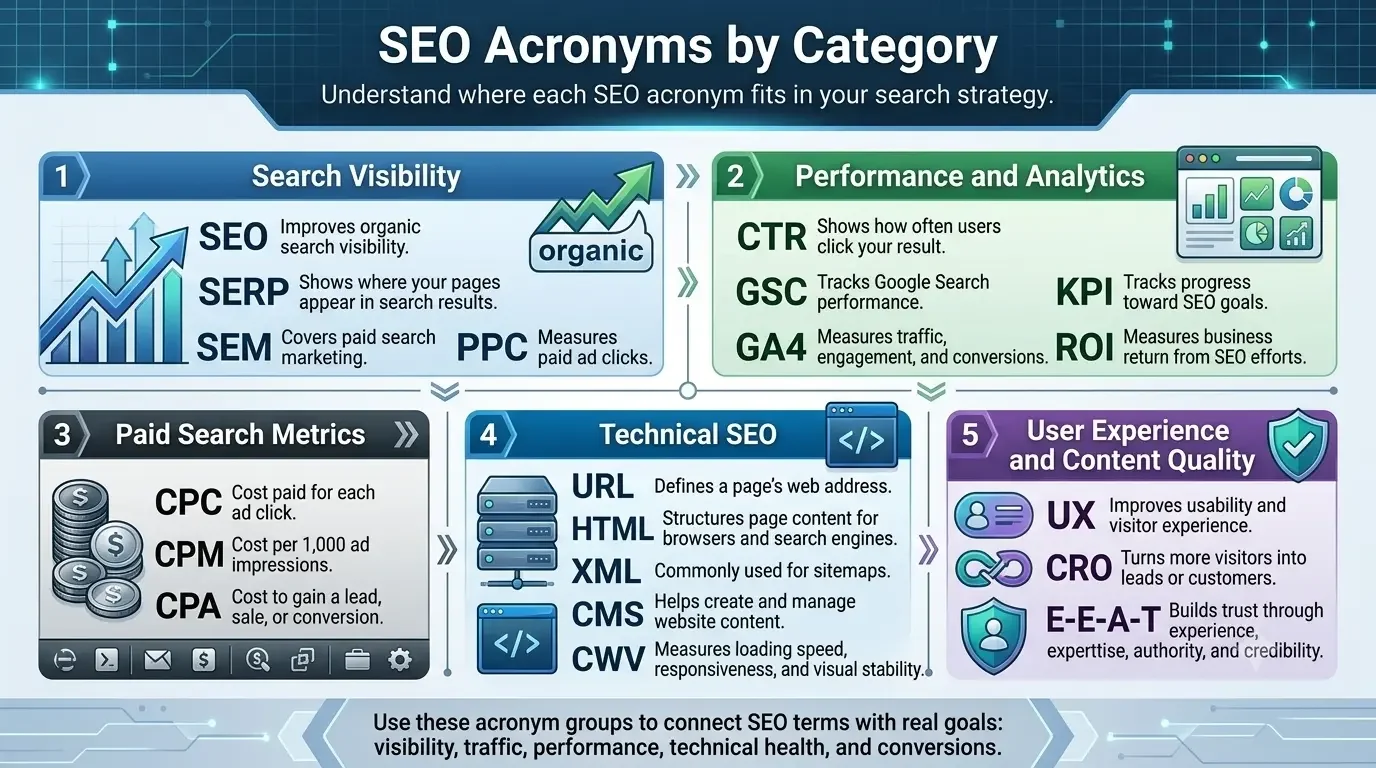
Now, let's take a look at the top 20 most commonly used SEO acronyms.
1. SEO: Search Engine Optimization
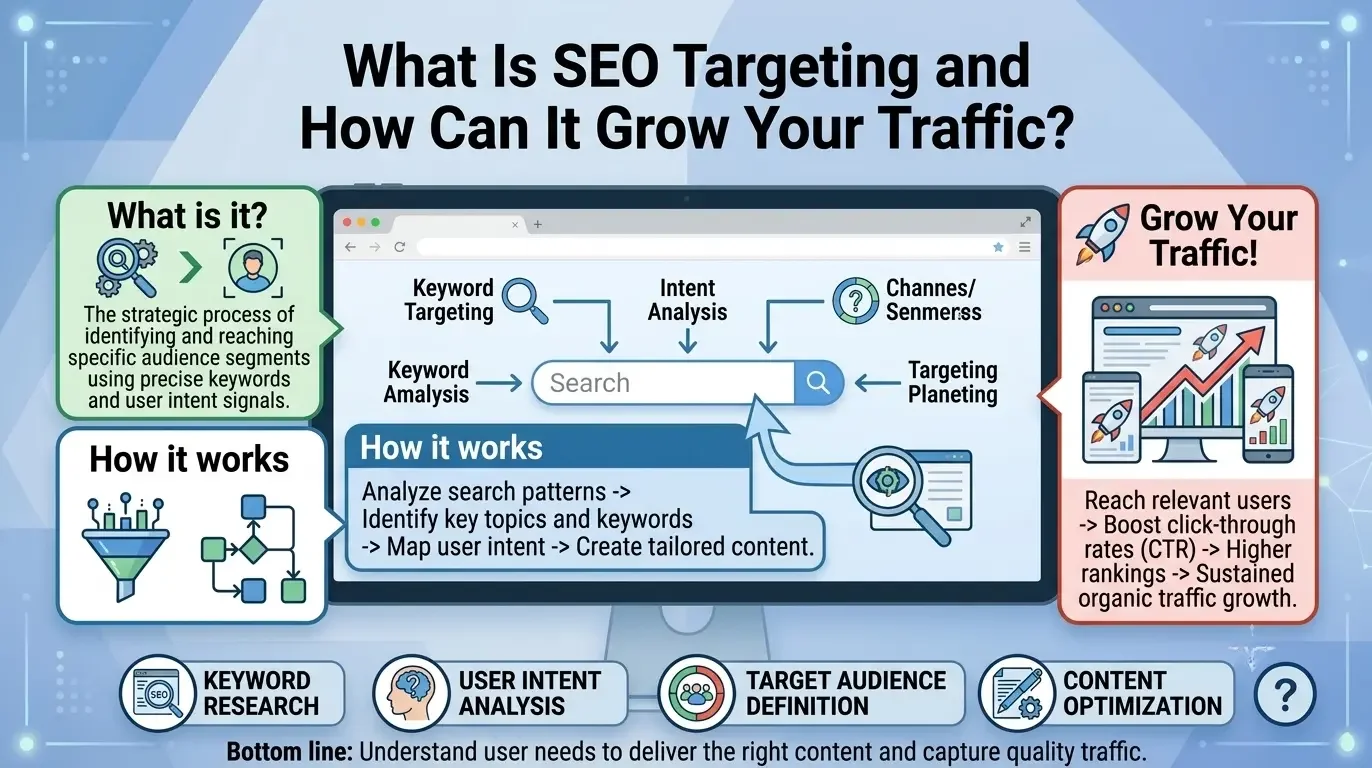
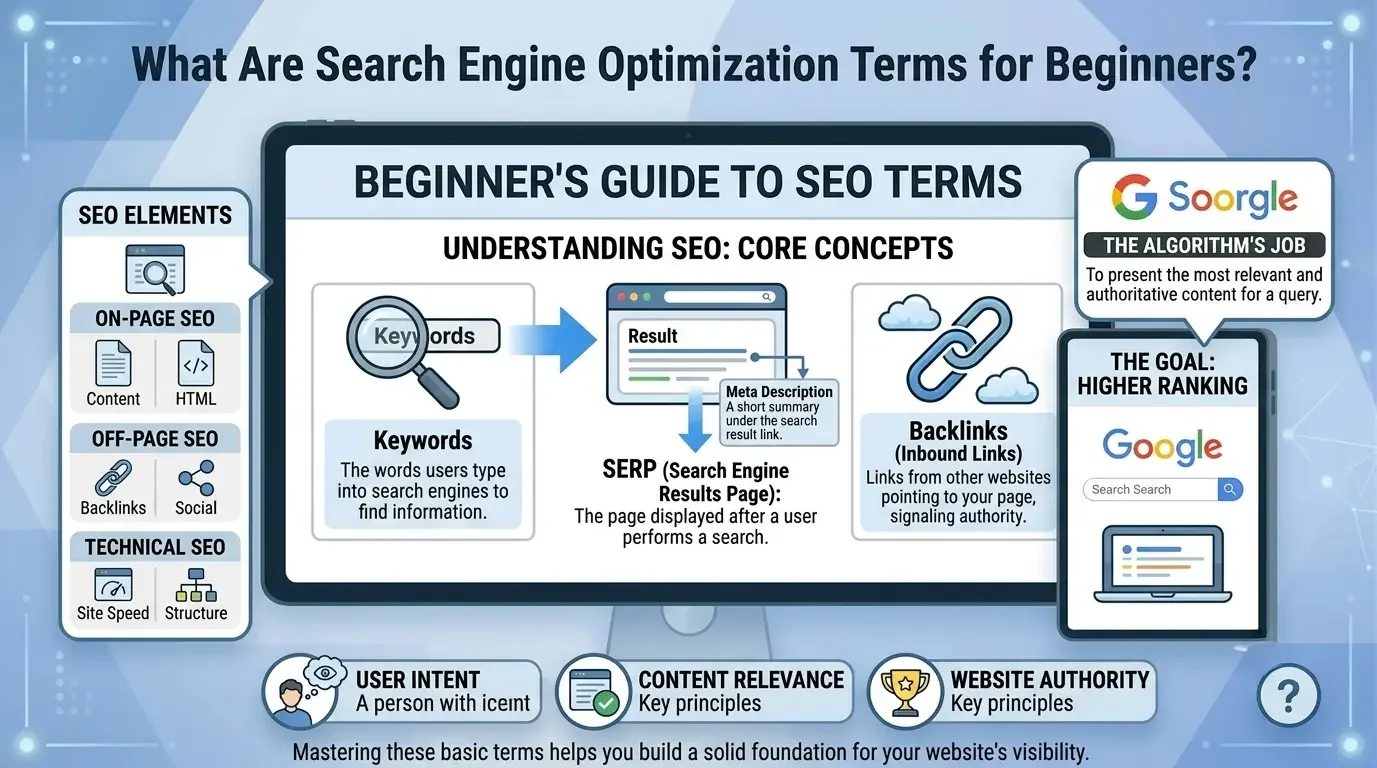
The term SEO refers to Search Engine Optimization. It is actually the technique of optimizing a website to boost its visibility in search engine results.
SEO involves keyword research, content optimization, technical optimizations, internal linking, user experience and authority building. The idea is to target the right kind of organic visitors, without paying for each click.
2. SERP: Search Engine Results Page
The search engine results page is known as SERP. The page that will appear after a user types a query into Google, Bing or any other search engine.
Organic, paid, featured snippets, local packs, videos, images, People Also Ask, and other search features can appear in a SERP. These SERP components are usually targeted in SEO strategies.
3. SEM: Search Engine Marketing
The term SEM is short for Search Engine Marketing. It typically refers to paid search advertising, but some marketers use it more broadly to include both paid and organic search.
Actually, SEM is frequently the use of paid campaigns on sites like Google Ads. SEO is about organic visibility, SEM is about paying for visibility.
4. PPC: Pay-Per-Click
PPC means Pay-Per-Click. Digital advertising model in which advertisers pay when their ads are clicked.
While PPC isn't the same as SEO, it's a part of search marketing. SEO helps build organic traffic over time, PPC can provide instant visibility with paid placements.
5. CTR: Click-Through Rate
CTR is the acronym for click-through rate. It is the percentage of people who click a search result, ad, email or link after viewing it.
In the field of search engine optimization (SEO), CTR is a metric that is often utilized to assess the performance of a page in search results. Optimizing title tags, meta descriptions and having the right search intent can help increase organic CTR.
6. CPC: Cost Per Click
The acronym CPC stands for Cost Per Click. It indicates the amount that an advertiser has to pay for every click of their ad in a paid search campaign.
CPC is typically examined when keyword research during SEO as higher CPCs may mean a commercial value. If advertisers are willing to pay a higher price to display a keyword, it's possible that it has great business value.
7. CPM: Cost Per Mille
CPM means Cost Per Mille (i.e., Cost Per Thousand Impressions). It's primarily applied in advertising to determine the price to view an ad 1,000 times.
CPM is more frequently used in the paid media space than SEO, but is valuable when comparing the visibility of organic search with the performance of paid media.
8. CPA: Cost Per Acquisition
Cost Per Acquisition (CPA) is what it's called. It is the cost of acquiring a customer, lead, sale, signup or conversion.
SEO teams use CPA to measure the performance of the organic traffic against the paid traffic. An effective SEO strategy can lower CPA in the long run because it can deliver conversions without requiring high spend per click.
9. ROI: Return on Investment
ROI stands for Return on Investment. It calculates the return on investment from expenditures associated with a campaign, tool, service, or strategy.
ROI is a useful metric in SEO for measuring whether organic search activities contribute to business value. These can be more leads, sales, subscriptions, booked calls or qualified traffic.
10. KPI: Key Performance Indicator
KPI is a Key Performance Indicator. It is a quantifiable measure that reflects a person's development toward an objective. It is a measurable measure that shows a person's progress towards an objective.
Some of the most common SEO KPIs include organic traffic, keyword positions, conversions, indexed pages, backlinks, CTR, bounce rate, and revenue from organic traffic.
11. CRO: Conversion Rate Optimization
The term CRO means Conversion Rate Optimization. It is a process of optimizing a page that brings more visitors to take a desired action.
This may involve filling out a form, purchasing a product, subscribing to a newsletter, downloading a guide, or scheduling a consultation. SEO attracts traffic to the website, and CRO converts visitors into leads or customers.
12. UX: User Experience
UX stands for User Experience. It is the ease, usefulness and pleasure a website provides for its visitors.
Good UX contributes to SEO by keeping people on the page, engaging with the content, and converting them into customers. Bad UX can kill engagement and impact the overall performance.
13. CMS: Content Management System
A content management system (CMS) is a system that manages content. Website Content Editor is software for creating, editing, organizing and publishing website content.
CMS options include Drupal, Wix, Webflow, Shopify and WordPress. The ideal CMS will provide clean URLs, provide title tags, meta descriptions, image alt text, 301 redirects, structured data, and manage sitemaps.
14. URL: Uniform Resource Locator
The term URL stands for Uniform Resource Locator. It is the URL of a webpage.
SEO optimized URLs are brief, easy to read and descriptive. For instance, /seo-acronyms/ makes more sense than /post?id=4829. A clean URL structure helps users and search engines identify what the page is about.
15. HTML: HyperText Markup Language
HTML is the acronym for HyperText Markup Language. It's the usual code for organizing web pages.
Search engines utilize HTML components like headlines, title tags, meta descriptions, links, image ALT text, and structured data. Clean HTML makes it easy for search engines to understand what the page is about and the order in which it appears.
16. XML: Extensible Markup Language
XML: Extensible Markup Language. XML is most commonly related to XML sitemaps in SEO.
An XML sitemap is a file that provides search engines with valuable information about a website's content. It is not a guarantee of indexing, but it can enhance crawl discovery when the site has a complex architecture, is new, or is large.
17. GSC: Google Search Console
GSC is an acronym for Google Search Console. It is a free Google tool to help website owners track and enhance their Google presence.
SEO experts utilize GSC for various search performance metrics such as search queries, clicks, impressions, indexing status, sitemap submission, Core Web Vitals issues, manual actions and more.
18. GA4: Google Analytics 4
GA4 is Google Analytics 4. Google Analytics is a Google service that is designed to track user behaviour on websites and apps.
For SEO, GA4 is employed for analyzing organic traffic, landing pages, engagement, conversions, revenue, and user journeys. Used in conjunction with GSC, it provides a more comprehensive picture of the performance of organic search traffic after it arrives on the site.
19. CWV: Core Web Vitals
Core Web Vitals is the term used for the three metrics. These are measures of actual user experience, particularly loading times, interactivity and visual stability.
The Core Web Vitals are:
LCP: Largest Content Paint – loading performance.
A responsive measure called INP (Interaction to Next Paint).
CLS: Cumulative Layout Shift – Visual stability.
Enhancing Core Web Vitals can make the website experience faster and smoother for users and, in general, improve SEO performance.
20. E-E-A-T: Experience, Expertise, Authoritativeness, and Trustworthiness
E-E-A-T is Experience, Expertise, Authoritativeness, and Trustworthiness. It is a quality principle employed in Google's search quality ranking system.
E-E-A-T is particularly relevant for content that emphasises accuracy, credibility, and trust. Creating helpful content, establishing author expertise, citing authoritative sources where appropriate, keeping content up to date, and making trust signals easily accessible are all ways to boost E-E-A-T.
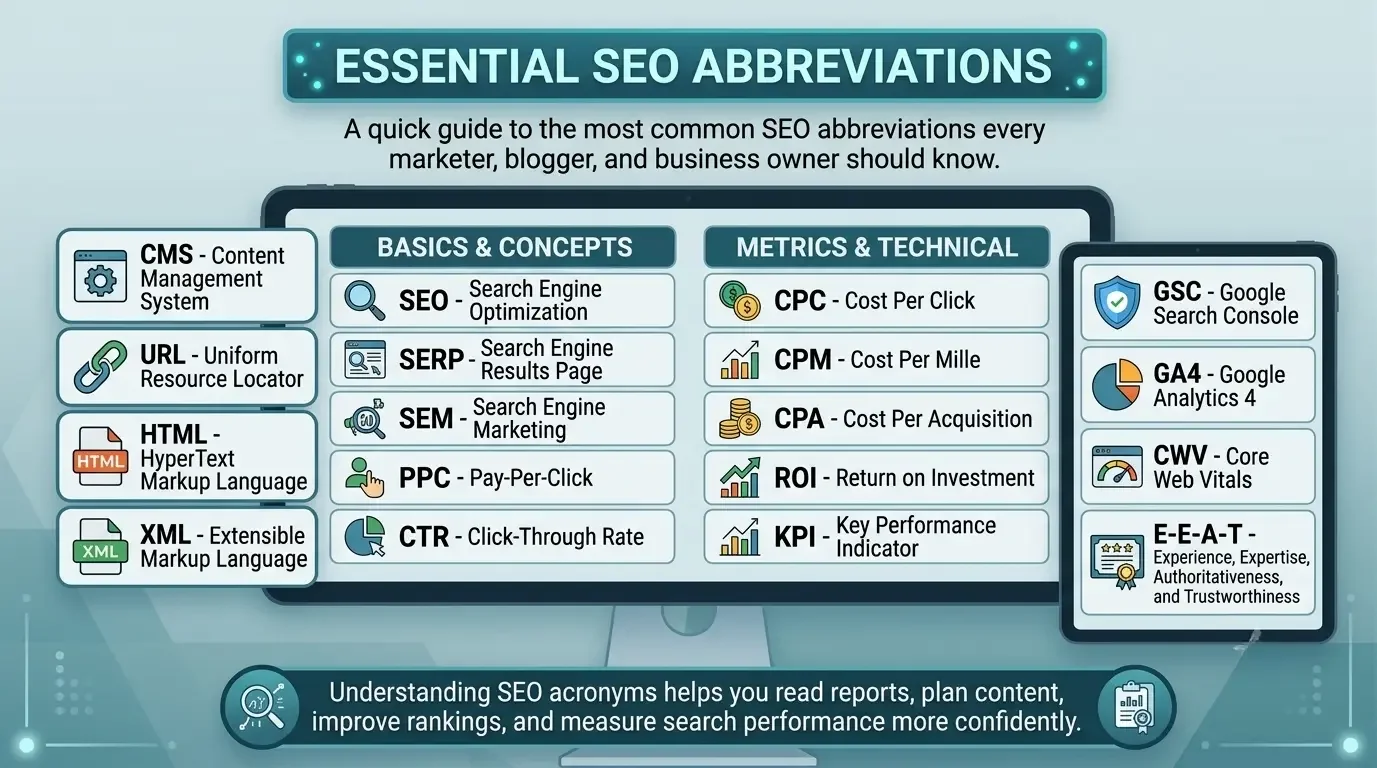
Quick Comparison Table of Common SEO Acronyms
| Acronym | Full Form | Why It Matters |
|---|---|---|
| SEO | Search Engine Optimization | Improves organic visibility |
| SERP | Search Engine Results Page | Shows where pages appear in search |
| SEM | Search Engine Marketing | Covers paid search visibility |
| PPC | Pay-Per-Click | Measures paid ad click costs |
| CTR | Click-Through Rate | Tracks how often users click |
| CPC | Cost Per Click | Shows paid keyword cost |
| CPM | Cost Per Mille | Measures cost per 1,000 impressions |
| CPA | Cost Per Acquisition | Tracks cost to gain a conversion |
| ROI | Return on Investment | Measures profitability |
| KPI | Key Performance Indicator | Tracks SEO goals |
| CRO | Conversion Rate Optimization | Improves lead and sales performance |
| UX | User Experience | Impacts engagement and usability |
| CMS | Content Management System | Helps manage website content |
| URL | Uniform Resource Locator | Defines page address structure |
| HTML | HyperText Markup Language | Structures page content |
| XML | Extensible Markup Language | Used for sitemaps |
| GSC | Google Search Console | Tracks Google Search performance |
| GA4 | Google Analytics 4 | Measures traffic and conversions |
| CWV | Core Web Vitals | Measures page experience |
| E-E-A-T | Experience, Expertise, Authoritativeness, Trustworthiness | Supports content credibility |
Why SEO Acronyms Matter?
SEO acronyms are far from just a trade secret. They facilitate more efficient team discussions on strategy, performance, technical problems and business results.
If you have a low CTR, For Example, you could have more effective title tags and meta descriptions. If your CWV scores are weak, you might need to make tweaks to your website's performance. If ROI is low, your SEO strategy may need improved content targeting to drive conversions.
These terms will help marketers, business owners, writers, developers, and SEO specialists understand what's happening.
Interesting Research Facts
Full citations are in Sources below.
CTR & SERP: Top organic rankings drive the most clicks
Top organic rankings drive the most clicks: approx. 30% CTR for #1, 16% for #2, and 10% for #3. Any content after the first page of results has a CTR of less than 2%.
Source: MDPI — Future Internet, 2019
ROI & UX: Higher spend correlates with satisfaction
ROI campaigns spending more than $500/month are 53.3% more likely to be extremely satisfied with their results.
SSL & URL: Keywords in URLs and HTTPS correlate with rankings
There is a strong correlation between the use of target keywords in URLs, HTTPS security, and better rankings on Google.
Source: MDPI — Future Internet, 2019
SEO vs. SEM: Organic vs paid traffic longevity
SEO provides long-term organic traffic and authority, SEM provides immediate paid traffic that ends when the ad budget is gone.
Source: ResearchGate — SEO effectiveness meta-analysis, 2024
Core Ranking Factors
There are a number of Core Ranking Factors that impact the performance of SEO, such as strong content, optimized meta titles, backlinks, mobile-friendliness, and page speed.
Source: Azra Media Indonesia — Journal of Information Management
Frequently Asked Questions
1.The first acronyms to learn as a beginner in SEO?
For beginners, get started with SEO, SERP, CTR, GSC, GA4, URL, CMS, UX, KPI, and CWV. They're frequently used in SEO audits and reports, and in content briefs and performance conversations.
2. Are SEO and SEM are not considered to be the same?
No. SEO involves an organic search, and SEM typically means paid search. They both help to boost visibility on search engines, however, in different ways.
3. So what does SERP stand for in SEO?
Search Engine Results Page (SERP) is the page shown when a user clicks on a search engine result. This is the page users will see when searching on Google or another search engine.
4. Why have deep impressions and low clicks?
If you're getting impressions and not clicks, chances are your site is showing up in Google search results, but you're not getting many visitors. This may be due to poor rankings, weak titles, the poor meta description, irrelevant queries, ads, featured snippets, or AI search features stealing attention.
5. Is GSC an acronym for Grade School Counsellor?
Google Search Console is referred to as GSC. It offers click tracking, impression tracking, CTR, average position, indexing problems, sitemap status, and search performance tracking.
6. Is the information Google Search Console gives us accurate?
While GSC is one of the best and most useful of SEO tools, it shouldn't be assumed to be perfect. You can leverage it to recognize trends, compare pages, discover keyword opportunities, and recognize indexing or performance problems.
7. What does the “average position” in GSC refer to?
Average position is the average ranking position of your website or page on search queries. It may differ due to the different devices, locations, queries, personalization and SERP layout.
8. In SEO, what is the meaning of CWV?
Core Web Vitals refers to the measurement of website performance. These metrics gauge how fast a page loads, how responsive it is and how stable it is visually.
9. Is E-E-A-T definitely a ranking factor?
Yes, E-E-A-T is definitely a ranking factor.E-E-A-T is an acronym for Experience, Expertise, Authoritativeness, and Trustworthiness. It doesn't simply exist as a single ranking factor, but that's an important quality guideline to build useful, trustworthy, people-first content.
How we reviewed this article:
Share this article