What Is the Best Abstract Word Count Guide for Papers?
Discover the ideal word count for essays, research papers, journals, scientific papers, APA papers, theses and dissertations.
Quick Summary
- Your abstract should be no longer than 250 words (or your instructor's or university's or journal's or conference's preferred length), unless the abstract is truly longer.
- Abstract should include the background, the purpose, the method, the results, and the conclusion enough to enable the reader to understand the paper without reading the original text first.
- The length of the abstract varies depending on type of paper: short essays may need an abstract of 100–150 words, theses, dissertations, systematic reviews and meta-analyses may require an abstract of up to 250–350 words.
- Journal and scientific abstracts require greater precision because readers rely upon these for the decision to read and cite the full paper, or not.
- The best abstract is not only long or short, it is also clear, complete, accurate and brief and focused on the main contribution of the paper.
Best Abstract Word Count by Paper Type
The safest general rule is this:
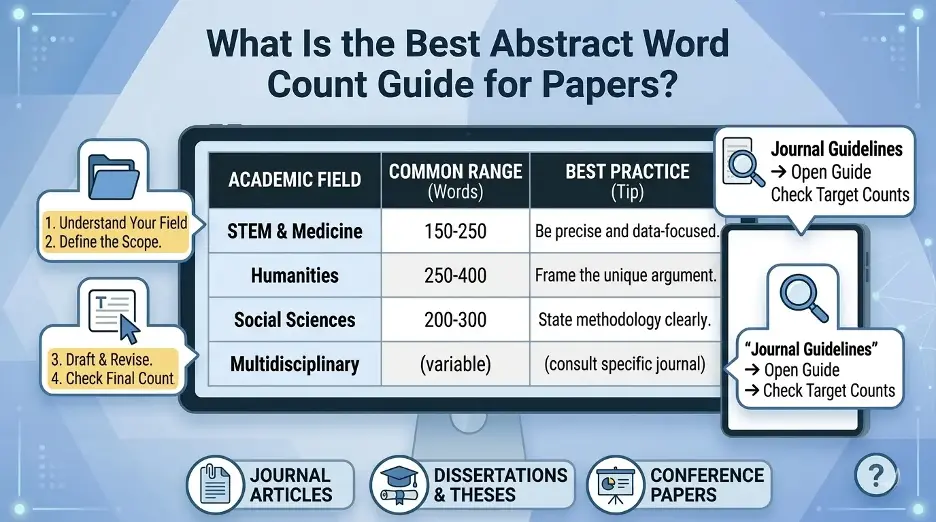
Use 150–250 words unless your instructor, university, conference, or target journal gives a different limit.
Here is a practical guide:
| Paper Type | Recommended Abstract Word Count |
|---|---|
| Short academic essay | 100–150 words |
| Undergraduate research paper | 150–200 words |
| Graduate research paper | 200–250 words |
| Journal article | 150–300 words |
| Scientific paper | 200–300 words |
| Medical or clinical paper | 250–300 words |
| Conference paper | 150–250 words |
| Thesis or dissertation | 250–350 words |
| Systematic review or meta-analysis | 250–350 words |
These ranges are helpful guidelines, but always the official requirement takes precedence. If a journal requires an abstract of 150 words or less, do not submit an abstract of 180 words or more. For a dissertation abstract, if a university permits 350 words, then that is the amount of space you have to use. These word count ranges are used as guidelines only and not rules. The abstract length of your instructor's, university's, conference's, or journal's is always to be followed first.
Why 150–250 Words Works Best?
The abstract should provide the main value of the paper to the reader in an expedient manner. A typical abstract length of 150-250 words includes 5 key elements:
- Introduction: What is the focus of the paper or what is the problem?
- Purpose:What is the goal of the research?
- Method: What was the process used to conduct the study?
- Results: What did you discover?
- Discussion/Conclusion: What do the results show?
Short abstracts tend to miss out key details. Extended abstracts can be repetitive, too descriptive or too close to an introduction.
The perfect abstract word count isn't a count of how many words you can put in. It's about providing the reader with the bare minimum necessary summary of the paper.I have found that the longer the abstract the better. It's the one that unambiguously explains what the paper investigates, how it was investigated, what it discovered and why it's important.
Abstract Word Count for Journal Articles
The optimum length of the abstract for journal articles is generally considered to be 150-300 words. Many journals have strict limits because abstracts go into the databases, indexing platforms and search results.
The aim of a journal abstract is to be informative but brief. There is no need to put a great deal of background, literature review, citations or minor findings. Editors and reviewers respect the abstract to be an accurate representation of the paper, but without hyperbole.
Before submitting to a journal always DO the following:
- The maximum number of words for abstracts is 150.
- The question of whether there is a structure to the abstract or not
- Background, Methods, Results and Conclusion headings are required.
- If keywords are counted individually or collectively.If keywords are counted separately or together.
- Abbreviations, citations or references are permitted or not.
An abstract that does not follow the formatting guidelines will give reviewers a bad start.It is important to review the official guidelines prior to writing the paper. If a different word count is recommended by your journal or university, use that word count instead of any general recommendation.
Abstract Word Count for Research Papers
The standard research paper length is anywhere from 150-250 words.
When writing a research paper abstract, be sure to include the study's general scope. It should include the research problem, method, main findings and conclusion. The abstract should not be a description of all variables, all sources, or of the entire argument, step by step.
A good research paper abstract addresses four questions:
- What was studied?
- Why was it studied?
- How was it studied?
- What was found?
The typical undergraduate paper size is 150-200 words. 200–250 words is more appropriate for graduate level research, as the methodology and results often are more complex.
Abstract Word Count for Scientific Papers
In general, scientific abstracts require more information than humanities or general academic abstracts. A well written scientific abstract typically contains 200-300 words, particularly if it contains methods, data and measurable results.
Abstracts should be concise, specific. Do not use the word "the results were significant" but instead state the primary result. Do not use the phrase "various methods were used," specify the study design, experiment, dataset, or analytical technique.
Clarity is more important than style for scientific writing. People tend to read abstracts to determine if the full paper is relevant to them. A clear abstract will save time and allow for a greater likelihood of being read and cited.
Structured vs. Unstructured Abstract Word Count
Typically, there are two formats for abstracts: structured and unstructured.
Structured Abstract
A structured abstract has headings like:
- Background
- Objective
- Methods
- Results
- Conclusion
In the Medical, Health Science, Psychology, Education, and Social Sciences, it is common to have structured abstracts. They tend to be longer at around 250-300 words long, since each section should include sufficient detail.
Unstructured Abstract
An unstructured abstract is composed in one paragraph (no headings). It is frequent in humanities papers, literature papers, philosophy papers, history papers, and in some social science papers.
Abstracts are typically shorter, and often abstracts are only 150–250 words in length. They have a definite direction but don't sound like a series of disconnected points.
How to Divide the Abstract Word Count?
A simple method for dealing with abstract length is to allot an approximation of words for each section.
When writing an abstract for a 250 word limit:
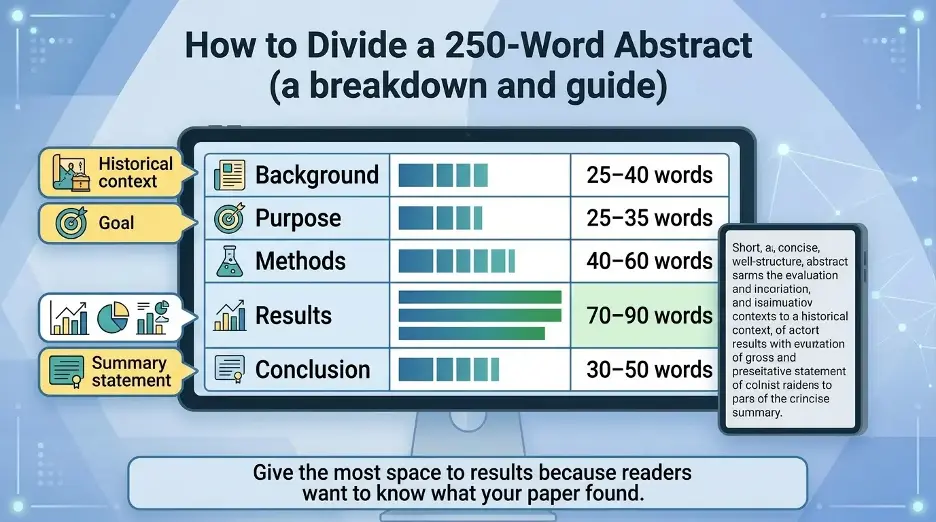
| Abstract Section | Suggested Word Count |
|---|---|
| Background or context | 25–40 words |
| Purpose or research question | 25–35 words |
| Methods or approach | 40–60 words |
| Results or main argument | 70–90 words |
| Conclusion or implication | 30–50 words |
The results section will typically be the longest section of the paper as readers want to know what the paper actually found. The background should be short and snappy. One of the most frequently given causes of long abstracts is having too much context.
What to Include in an Abstract?
An effective abstract will contain only the information that the readers require in order to understand the main contribution of the paper.
Include:
- The focal point of the research or the problem being addressed
- The aim of the research
- The way in which the research is conducted
- The most significant results.
- The key finding or take-home message
- The relevant keywords of the paper
Avoid:
- Long definitions
- Literature review details
- Citations
- Tables or figures
- Vaguen beginning sentences
- A claim that is not substantiated by the paper.
- Minor results
- Repeat of title(s)
The abstract should be self-explanatory, and it should not be used as the paper. It is not the role of her to present the entire argument.
How Long Should an Abstract Be for APA Papers?
While there are no official word limits or length requirements for abstracts, there are general guidelines that are followed. Abstracts are typically limited to 250 words or less for APA-style papers. Most of the APA abstracts are a single paragraph and are on a separate sheet of paper following the title page.
An APA abstract must be to the point and objective. Typically it contains the research problem, participants/materials, method, main findings, and conclusions. If necessary, keywords can be provided below the abstract.
For student papers, use of an abstract is not always required; follow the instructions of the Assignment given by the instructor.
How Long Should an Abstract Be for a Thesis or Dissertation?
The abstract of a thesis/dissertation is typically longer than a journal article abstract. The number of words is typically between 250 and 350, but may exceed that limit for some universities.
The abstract may be used to outline a thesis or dissertation, which is a larger project, and may include:
- Research background
- Study objectives
- Theoretical framework
- Methodology
- Key findings
- Original contribution
- The implications of these findings for practice and/or theory.
The abstract should not be overly broad anyways, even if the limit is extended. Avoid using the dissertation abstract as a mini introduction. Provide a brief overview of the project.
How to Reduce Abstract Word Count?
If your abstract is too lengthy, don't just chop out words at random. Edit for purpose.
Start by removing:
- Opening statements that are very vague.
- Repeats words from the title
- Extra details about the literature
- Secondary findings
- Any details that are not essential to the methodological discussion may be omitted.
This paper seeks to explore" is too wordy when it should just be "This paper examines".
For example:
Weak:
This paper seeks to analyse how online learning could potentially affect engagement in higher education classrooms.
Stronger:
The aim of this paper is to describe the impact of online learning on student engagement in higher education.
The more robust version is shorter, more straightforward, and more to the point.
How to Expand an Abstract That Is Too Short?
If you have a short abstract, but it still lacks body, throw in some substance instead of fluff.
You can add on to the expansion:
- This research gap is described in more detail below.
- The study design
- The sample, dataset, or materials
- The main result
- The importance of the discovery
Don't include ambiguous sentences like This is a very important topic in today's world. Rather, talk about the contribution you make in your paper.
A good abstract makes the paper more understandable before one gets to the introduction.
Common Abstract Word Count Mistakes
The most frequent error is writing abstract first, followed by the main body. This frequently results in general statements or in results that are missing. The abstract is usually written last after the body of the paper is written.
Some other common errors are:
- Exceeding word count (for the official word count)
- Too much background information is written"
- Including citations
- Using undefined abbreviations
- Please do not make claims that are not described in the paper.
- Knowing the main outcome but failing to remember it.
- If you're promoting a book, be sure to write in a promotional style.
- Quoting sentences verbatim from the introduction
An effective abstract is accurate, balanced and succinct. It shouldn't hype the paper up or obscure the key results.This guide was last updated in June 2026 to ensure that the information is accurate and relevant to students, researchers, and academic writers.
Interesting Research Facts
Results section is the strongest abstract section
Research on structured abstracts highlights the Results section as especially powerful because it carries the key findings readers want first.
Source: https://www.tandfonline.com/doi/full/10.1080/08164622.2025.2579176
Journal abstract limits often stay below 250 words
Guidance for titles, abstracts, and keywords notes that writers often need to use nearly the complete abstract word requirement when strict journal limits are below 250 words.
Unstructured abstracts are typically shorter
Studies comparing abstract formats show that unstructured abstracts are typically shorter than structured abstracts.
Structured abstracts use more allotted word count
Evidence from editing research reports that structured abstracts tend to use more of the available word count, while unstructured abstracts use less.
Source: https://www.escienceediting.org/journal/view.php?number=234
Scientific abstracts commonly use 200 to 250 words
Scientific abstract guidance commonly keeps abstracts around 200 to 250 words and recommends keeping the background or introduction short.
Frequently Asked Questions
1.What is the length of an abstract?
The length of the abstract should be between 150-250 words, for most abstracts. Depending on the type of paper, less or more may be required for short papers, and more for theses, dissertations and detailed research papers.
2.Is there any limit to how long an abstract can be?
No. I suggest making the abstract as complete as necessary, but not as long as it can be. It should include no detail in summary; just purpose, method, results and conclusion.
3.How many words are in an abstract?
Yes, 150 words is acceptable for a short essay, college paper or basic research paper. If the study is more complex, then a maximum of 200–300 words may be required.
4.If your abstract is under the word limit, what do you do?
If you have a short abstract, include helpful information like research gap, method, main finding or conclusion. Avoid the use of filler sentences.
6.If my abstract is too long, will they operate on my computer?I
Trim out wide, repeated title phrases, minor findings, and irrelevant method details. Don't include all the details first.
7.Can the abstract be included in the word count of the paper?
It is based on the assignment, journal and/or university rules. Abstracts are counted separately by some or with the total word count by others.
8.What is the Maximum/Minimum length of an APA abstract?
Typically the APA abstract is no longer than 250 words. When creating a student paper, always follow your instructors' guidelines.
9.What is the best length for an abstract of a thesis or dissertation?
Typically, an abstract for a thesis or dissertation will be between 250–350 words, with some universities permitting more. Be sure to review your department's formatting guide.
How we reviewed this article:
Share this article