What Is the Complete Dissertation Word Count Guide?
Plan your dissertation word count by academic level and chapter with clear examples, section breakdowns, and tips to stay within university limits.
Quick Summary
- A dissertation word count is a total number of words that your university allows or requires in your dissertation, typically referring to the main chapters (introduction, literature review, methodology, findings, discussion, conclusion).
- The length of a dissertation will vary based on your academic level. There are times when undergraduate dissertations will be shorter, and master's, MPhil and PhD dissertations will be longer and more in-depth in research, analysis and word count.
- A balanced dissertation is more elaborate in important chapters such as the literature review, findings, and discussion and is brief and to the point in the introduction and conclusion.
- Many sections, such as references, appendices, tables, figures, footnotes, and abstracts, have a different word count limit than the rest of the paper, so be sure to check the university requirements.
- To ensure that you keep to the word limit, you will need to formulate a plan before writing each chapter, minimize repetition, direct your discussion toward your research questions, and transfer additional data and information from your text to the appendices.
What Is a Dissertation Word Count?
Dissertation Word Count refers to the number of words that you must include or may have in your dissertation. Typically contains the body text, e.g., introduction, literature review, methodology, results, discussion, conclusion.
Many universities do not count the number of words on the tables, figures, footnotes, title page, abstract, bibliography, acknowledgements, appendices or references. There is, however, a variation in rules and it is always advisable to have a look at your university handbook before finalizing your dissertation.
The word count is important as it demonstrates the depth of the research, the focus of the research and the suitability for the academic level.We have developed this guide to help you better plan your dissertation word count. These ranges have been included here as a guide to what is actually possible rather than as a set of rules laid down by the university and you are expected to have read the dissertation handbook before.
Typical Dissertation Word Count by Academic Level
Dissertation length varies widely, but the following ranges are commonly used as general guidelines.
| Academic Level | Typical Word Count |
|---|---|
| Undergraduate dissertation | 8,000 to 12,000 words |
| Master’s dissertation | 12,000 to 20,000 words |
| MBA dissertation | 12,000 to 15,000 words |
| MPhil dissertation | 20,000 to 40,000 words |
| PhD dissertation | 60,000 to 100,000 words |
These figures are approximate. Dissertations in science, engineering and mathematics may be shorter due to the increased amount of data, formulas, tables and figures. Humanities and social science dissertations tend to be longer, as they require more written analysis, theory, and discussion.Students tend to lose marks not due to the length or shortness of their dissertation, but rather due to imbalanced chapters, in our experience. We have subdivided the word counts by academic level and chapter
Dissertation Word Count Breakdown by Chapter
Typically, a dissertation should have five major chapters:
- Introduction
- Literature Review
- Methodology
- Results or Findings
- Discussion and Conclusion
In some universities, the discussion and conclusion are separated into two chapters, in others, the results and discussion are merged. Structure is subject to discipline and institutional needs.This breakdown should be used as a guideline prior to speaking with your supervisor. The official guidelines of your university should be your final source.
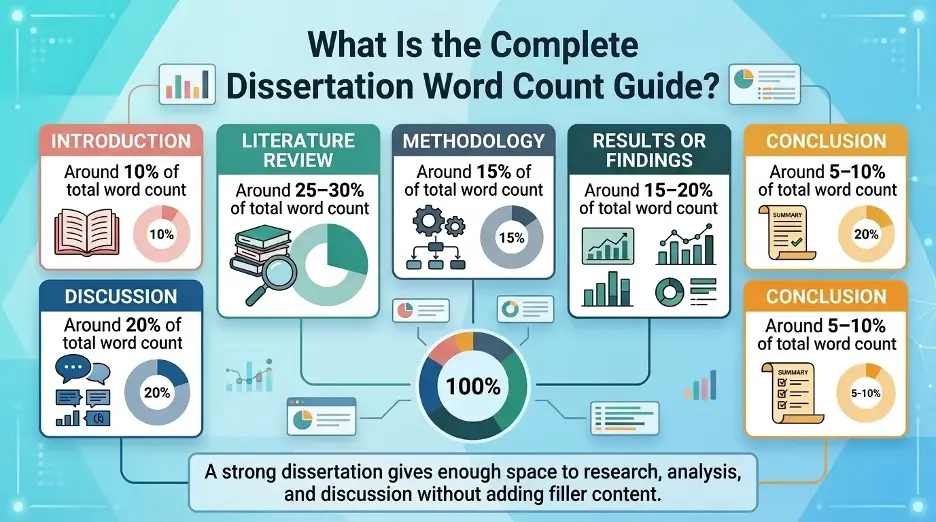
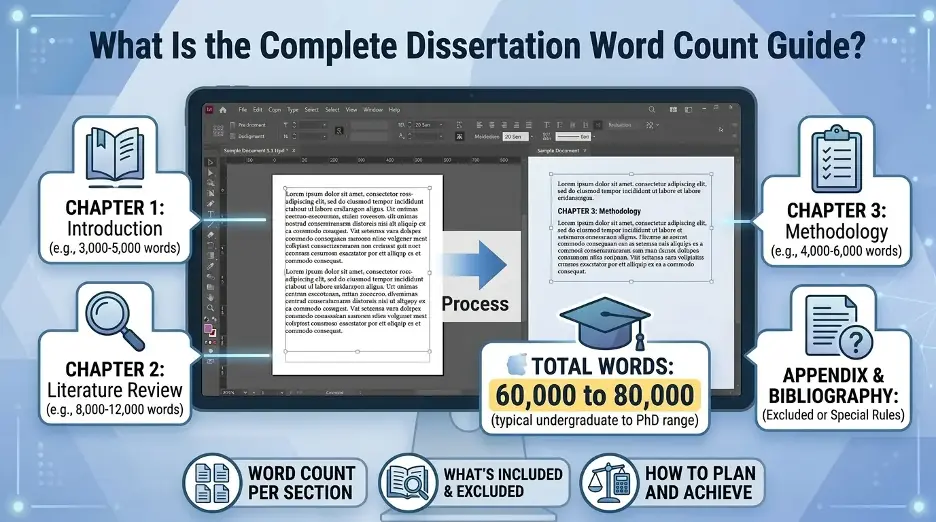
This is a practical word count guide for the dissertation chapter-wise, considering a dissertation of 15000 words.
| Dissertation Chapter | Suggested Percentage | Word Count for 15,000 Words |
|---|---|---|
| Introduction | 10% | 1,500 words |
| Literature Review | 30% | 4,500 words |
| Methodology | 15% | 2,250 words |
| Results or Findings | 20% | 3,000 words |
| Discussion | 20% | 3,000 words |
| Conclusion | 5% | 750 words |
This breakdown is not fixed, but it gives you a clear starting point for planning your dissertation.
Introduction Word Count
The introduction usually takes around 10% of the total dissertation word count.
For example:
| Total Dissertation Length | Introduction Word Count |
|---|---|
| 10,000 words | 1,000 words |
| 15,000 words | 1,500 words |
| 20,000 words | 2,000 words |
| 80,000 words | 8,000 words |
The introduction should explain the research topic and background and the problem statement, research aims and objectives, research questions, and research dissertation.
A good introduction should contain:
- A clear overview of the topic
- The problem to be addressed in the research or gap in knowledge.
- The objectives and aims behind the research.
- Formulate research questions or research hypotheses
- The relevance of the research.
- A sketch of the structure of the dissertation.
Don't make the introduction too extended. It is used to get the reader interested in the study, NOT to give them all your arguments.
Literature Review Word Count
The literature review is typically one of the longest sections of the paper and typically consumes about 25% - 30% of the word count.
For example:
| Total Dissertation Length | Literature Review Word Count |
|---|---|
| 10,000 words | 2,500 to 3,000 words |
| 15,000 words | 3,750 to 4,500 words |
| 20,000 words | 5,000 to 6,000 words |
| 80,000 words | 20,000 to 24,000 words |
A literature review critically analyzes previous research on your topic. It should not just be a list of the sources in turn. Rather, it should make comparisons, point out trends, point out debates, and demonstrate the gap you are filling with your dissertation.
A good literature review should consist of:
- Theories and concepts to consider
- Relevant academic studies
- The resources provide a discussion of key topics in the field.
- There are gaps in existing research.Existing research is limited.
- Direct reference to your research questions
- A coherent overall organization.
The literature review should be sufficiently developed to demonstrate understanding of the academic setting of your topic. But, don't add irrelevant sources just so you have more words.
Methodology Word Count
The methodology chapter usually takes around 15% of the dissertation word count.
For example:
| Total Dissertation Length | Methodology Word Count |
|---|---|
| 10,000 words | 1,500 words |
| 15,000 words | 2,250 words |
| 20,000 words | 3,000 words |
| 80,000 words | 12,000 words |
In this chapter, you will describe the process of your research. It should argue the methods you selected and demonstrate that your research design is appropriate to answer your research questions.
Typically, a methodology chapter contains:
- Research philosophy
- Research approach
- Research design
- Data collection methods
- Sampling strategy
- Data analysis methods
- Ethical considerations
- Reliability and validity
- Limitations of the methodology.
The method used should be described in detail so that another researcher can replicate the study. Be precise and refrain from explaining basic research terms unless they are pertinent.
Results or Findings Word Count
The results or findings chapter is typically around 15%-20% of the total word count.
For example:
| Total Dissertation Length | Results Word Count |
|---|---|
| 10,000 words | 1,500 to 2,000 words |
| 15,000 words | 2,250 to 3,000 words |
| 20,000 words | 3,000 to 4,000 words |
| 80,000 words | 12,000 to 16,000 words |
In this section you will share the results of your research. For a quantitative dissertation, this could be statistical findings, charts and tables. It can consist of themes, interview answers, observations, or case study results in a qualitative dissertation.
The results chapter should consist of:
- Well-presented results
- The relevant tables or figures.
- Themes or patterns from the data
- The results related to research questions
- If your university permits, combined results and discussion, otherwise minimal interpretation
Don't dump a lot of numbers on this chapter. Interview transcriptions, survey responses, and additional tables typically are located in the appendices.
Discussion Word Count
The discussion chapter typically accounts for about 20% of the word count of the dissertation.
For example:
| Total Dissertation Length | Discussion Word Count |
|---|---|
| 10,000 words | 2,000 words |
| 15,000 words | 3,000 words |
| 20,000 words | 4,000 words |
| 80,000 words | 16,000 words |
The interpretation is in the discussion, so you give a meaning to your results and explain them. In this chapter, you tie your findings to your literature review and research questions and to your overall argument.
A discussion chapter should:
- Interpret and report key findings
- Compare results to other research.
- Explain unexpected results
- Respond to each enquiry question
- Talk about theory or practice implications
- Acknowledge limitations
- Explain the importance of the study
This is one of the most significant chapters as it is a showcase of critical thinking. Don't copy the results without analysis.
Conclusion Word Count
Typically the conclusion will make up 5-10% of the total length of the dissertation.
For example:
| Total Dissertation Length | Conclusion Word Count |
|---|---|
| 10,000 words | 500 to 1,000 words |
| 15,000 words | 750 to 1,500 words |
| 20,000 words | 1,000 to 2,000 words |
| 80,000 words | 4,000 to 8,000 words |
The conclusion should summarize the overall study and give the answer to your research question. Should not introduce new theories, new evidence, new arguments.
Typically, a dissertation conclusion will contain:
- The aim of the research is presented.A statement of the research purpose.
- Summary of key findings
- Create an analysis and answer to the research question
- Main contribution of the study
- Practical and/or academic recommendations
- Limitations
- Recommendations for further studies
End the essay with a brief conclusion. It should make the reader clear about the outcome of your dissertation.
Abstract Word Count
Typically, the abstract should be 150-350 words long, though some universities may have a 500-word limit.
It summarizes the entire dissertation – its topic, aim, method, results and conclusion.
The following should be in a good abstract:
- Research background
- Research aim
- Methodology
- Key findings
- Main conclusion
The abstract is placed at the end, but is typically prepared last as it summarizes the work done in the dissertation.
Dissertation Word Count by Section
Here is a general dissertation word count breakdown for different total lengths.
10,000-Word Dissertation
| Section | Approximate Word Count |
|---|---|
| Introduction | 1,000 |
| Literature Review | 3,000 |
| Methodology | 1,500 |
| Results | 2,000 |
| Discussion | 2,000 |
| Conclusion | 500 |
15,000-Word Dissertation
| Section | Approximate Word Count |
|---|---|
| Introduction | 1,500 |
| Literature Review | 4,500 |
| Methodology | 2,250 |
| Results | 3,000 |
| Discussion | 3,000 |
| Conclusion | 750 |
20,000-Word Dissertation
| Section | Approximate Word Count |
|---|---|
| Introduction | 2,000 |
| Literature Review | 6,000 |
| Methodology | 3,000 |
| Results | 4,000 |
| Discussion | 4,000 |
| Conclusion | 1,000 |
80,000-Word PhD Dissertation
| Section | Approximate Word Count |
|---|---|
| Introduction | 8,000 |
| Literature Review | 20,000 to 24,000 |
| Methodology | 10,000 to 12,000 |
| Results/Findings | 16,000 to 20,000 |
| Discussion | 16,000 to 20,000 |
| Conclusion | 4,000 to 6,000 |
For a PhD dissertation, the structure may be more complex. It may include multiple findings chapters, a theoretical framework chapter, or separate chapters for different studies.
What Is Included in the Dissertation Word Count?
The primary academic body of the dissertation is included in the count of words in most universities. This usually means:
- Introduction
- Literature review
- Methodology
- Results or findings
- Discussion
- Conclusion
- In-text citations
- In some instances, footnotes
However, policies vary. Footnotes and tables may or may not be counted in the word count.
What Is Usually Excluded from the Dissertation Word Count?
The following sections are usually omitted:
- Title page
- Abstract
- Acknowledgements
- Table of contents
- List of figures
- List of tables
- Reference list
- Bibliography
- Appendices
- Ethics forms
- Interview transcripts
- Raw survey data
It would be wrong to take these exclusions for granted. For all dissertations, always check with your department.
Why Does Dissertation Words Count Matters?
The number of words in a dissertation is not an arbitrary measure. It impacts the quality, structure and clarity of your research.
An overly short dissertation might be shallow, under substantiated, or under critical. Too long a dissertation may indicate lack of focus, lack of repetition or poor editing.
Using an appropriate word count will enable you to:
- Organise chapters according to the plan.
- Describe and analyse balance
- Avoid unnecessary detail
- Meet university requirements
- Maintain the focus of the argument.
Make reading easier and improve the quality of students' academic work.
Planning also helps you avoid last minute editing issues with word count.
How to Stay Within the Dissertation Word Count?
It is difficult to come up with an essay that is within the word limit when you have gathered substantial research. The secret is to write structure and to write with purpose.
1. Create a Word Count Plan Before Writing
Before you begin, split up the word count amongst your chapters. This makes each section stand out from the rest and does not allow a chapter to get too long.
2. Focus on the Research Questions
All paragraphs should relate to your research purpose, objectives or questions. A section that is not relevant to the research question might not be required.
3. Avoid Overloading the Literature Review
Too much time is spent on the literature review by many students. Only choose the most relevant sources and arrange them thematically.
4. Move Extra Material to the Appendices
Interview transcripts, survey questions, raw data and detailed tables typically belong in the appendices. This will help to maintain a main body focus.
5. Edit for Repetition
One of the most prominent reasons for over word count is repetition. Eliminate redundant definitions, multiple arguments, and irrelevant context.
6. Use Clear Academic Language
You can't make your dissertation more academic by using long sentences. Employ specific vocabulary and refrain from using filler words.
7. Keep the Conclusion Concise
The conclusion should not be a summary of the dissertation. Aim for the key results and culmination.
Can You Go Over the Dissertation Word Count?
Some universities will permit a few words more or less from the specified word count (e.g., 10% more or less). Others impose severe fines for any breaches of the limit.
For Example, if you have a 15,000 word limit for your dissertation, but your university permits 10% leeway, you could write between 13,500 words and 16,500 words.
However, not all universities permit this. There are maximum limits in some departments, so please refer to your dissertation handbook.
Can a Dissertation Be Under the Word Count?
If a dissertation still conforms to the academic standards, it can be under the word count. If you are much below the limit, however, it could indicate that your research is lacking in depth.
If your dissertation is too brief, try to determine whether you need to:
- Make your literature Review more comprehensive
- Make more critical analysis.Include additional critical analysis.
- Describe your procedure in greater detail.
- Strengthen your discussion
- Link results more directly to questions of investigation
- Add additional evidence from data
Avoid adding content that has nothing to do with the essay for the sake of length. It's not the length of the story, it's the quality of the story.
Common Dissertation Word Count Mistakes
Many students find it difficult to stick to a word limit because they don't think about it too early in the planning stage.
The following are the most typical errors:
- Creating an introduction that is too long.
- Including irrelevant literature
- When dealing with the sources, it is important to describe rather than analyse them.
- Repetitive explanations of basic concepts
- Describing the same idea again in other chapters
- If you don't have information that is raw, you should include it in the main body of the text.
- Leaving too few words for the discussion
- In conclusion, adding new arguments.
By avoiding these pitfalls, you will preserve your dissertation to be clear, balanced and within the word count.
Final Dissertation Word Count Checklist
Before submitting your dissertation, check the following:
- Does the total word count follow university guidelines?
- Do the chapters have an even weighting?
- Does the literature review make sense and is it critical?
- Does the method used to collect data, analyze the data, and draw conclusions make sense and is it brief?
- Is the results data easily understood?
- Is the interpretation of the results correct for the discussion?
- Is the conclusion a response to the research question?
- What are the rules with regards to references and appendices?
- Have you taken out the repetition?
- Do you follow formatting and submission guidelines?
This checklist may assist you to identify word count concerns before submitting.
Interesting Research Facts
Postgraduate dissertations averaged 5,163 words
One study found an average word count of 5,163 words for postgraduate dissertations and 2,959 words for published academic articles in the same subject area.
PhD theses can exceed 100,000 words
Because doctoral research can involve years of literature review, data, analysis, and writing, traditional PhD theses can exceed 100,000 words.
Source: https://www.tandfonline.com/doi/full/10.1080/08164622.2024.2413706
Dissertation length depends on field of study
Research on dissertation texts shows that field of study affects length and style, with humanities and social sciences often involving longer written expression.
Source: https://journals.plos.org/plosone/article?id=10.1371/journal.pone.0335035
Dissertations are often 10,000-15,000 words
Undergraduate and postgraduate dissertations are commonly much longer than standard essays, often sitting around the 10,000-15,000 word range.
Source: https://www.tandfonline.com/doi/full/10.1080/87567555.2024.2352762
Dissertation abstracts must remain short
Even when dissertations are long, dissertation abstracts have their own shorter limits; one example notes a maximum abstract limit of 550 words.
Frequently Asked Question
1.What if I exceed the number of words in the dissertation?
Penalties may be applied by your university if you exceed the limit. Some universities will let a few over, others will have definite caps.
2.Are references part of the word count for the dissertation?
Typically, you don't include references or a bibliography, but this will vary by university. Always refer to the dissertation handbook.
3.Do appendices count towards the word count of the dissertation?
Typically the word count does not include any appendixes. They should, however, only contain supporting material, not essential arguments.
4.What is the optimal distance from the dissertation word count?
Keep to the word count; avoid extra verbiage. Short dissertations can be too superficial, long ones can be too broad.
5.Are there any instances when a 10% word count allowance would not be permitted?
No, 10% allowance is NOT a right. Do not use it unless your university explicitly states that it is permitted.
6.How many words are there in each dissertation chapter?
A typical structure is 10% for the introduction, 25-30% for the literature review, 15% for methodology, 15-20% for results of the investigation, 20% for discussion, and 5-10% for the conclusion.
7.Must I fill in more words if I don't?
No. Adding more analysis, explanations, or evidence that are more strongly related to the content is better than filler content.
How we reviewed this article:
Share this article