Does Word Count Include Citations, References, and Footnotes?
Understand how citations, references, footnotes, bibliographies and appendices are treated in word count; clear rules for students.
Quick Summary
- Typically, citations within the body of an essay, report, or research paper are counted as an in-text citation.
- You do not include references or bibliographies because they help you to present your argument or discussion but they do not form part of it.
- The footnotes depend on the use: Only citation-only footnotes are rarely counted, but explanatory footnotes are often counted.
- Different word count systems may count citations and footnotes differently, so there may be more or fewer words than what is listed here.
- Your assignment rules are paramount. If it is to be done with references, footnotes, tables, or appendices, do as the instructions call for—don't adhere to the general guidance.
What Is Included in a Word Count?
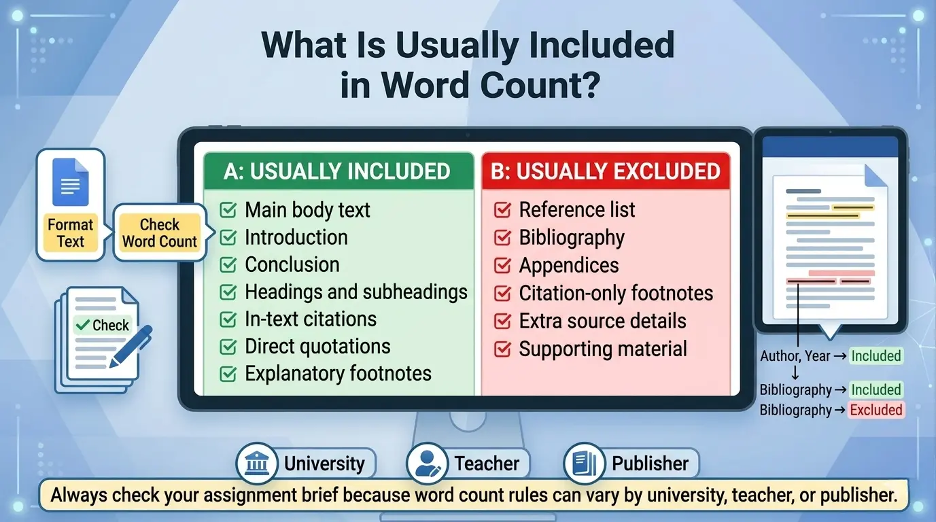
Typically, a word count applies to the body of your work. All words that make up the main argument, explanation, analysis or discussion.
The word count generally does not count the following:
- Introduction
- Main body paragraphs
- Conclusion
- Headings and subheadings
- In-text citations
- Direct quotations
- Tables, if the words are part of the main discussion
For example, in the sentence below, the citation is usually counted:
Climate change has increased the frequency of extreme weather events (Smith, 2022).
Although it is not a part of the sentence's main idea, the citation will still be included in the body of the paper, and many word processors and universities will count it.
Are In-Text Citations Included in Word Count?
Generally, a word count includes in-text citations. My rule of thumb is that in-text citations will typically be considered since they are embedded within the body of the text. If you cite a text, such as “(Smith, 2022)”, then this is counted towards the word limit.
Commonly used citation styles include:
- APA
- MLA
- Harvard
- Chicago author-date
- IEEE numbered citations
- For example: “Research shows that sleep affects memory and concentration (Brown, 2021).” — the author's name, year, brackets, and punctuation may all be counted by your word processor as part of the total word count.
- Similarly, numbered citations are often counted too: “Sleep quality has a direct effect on academic performance [1].” — it may not look like a word, but many word-counting programs count it according to how the document is formatted.
Why Are In-Text Citations Counted?
- In-text citations count as they are part of the main text. They back your argument(s) and are a component of the reading. If not original argumentation, there is still space they take up in the document.
- However, there are institutions which permit students to exclude the citations from the final word count. Not all of this is the case, however, so always refer to the brief for your assignment.
Are References Included in Word Count?
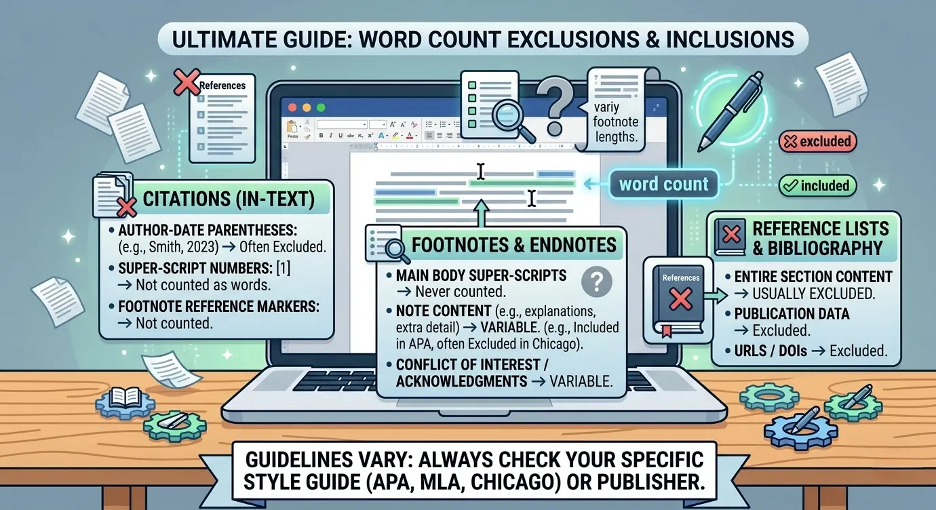
Typically, references don't count toward the word count.
The reference list, bibliography or works cited page is at the end of the paper and is typically not considered part of the argument.
For example, the following would normally be excluded:
Smith, J. (2022). Climate policy and public health. Oxford University Press.
The reference section of your paper is usually not counted toward the word limit whether you are using APA, MLA, Harvard or Chicago style. I typically don't count the word count for the references list unless the directions indicate otherwise. This is because references help to back up your argument, and not contribute to it.
Reference List vs Bibliography
- A reference list contains only sources that are cited in your work.
- A bibliography includes all the sources you consulted even if you did not quote them in your text.
- As a general rule, both are not included in the word count. Some assignments may require an annotated bibliography, however. If so, the annotations can be added as they may contain original written analysis.
Are Footnotes Included in Word Count?
- Footnotes are more complicated than references or in-text citations.
- Depending on the purpose and your guidelines, the word count may or may not include footnotes.
- Citation-only footnotes (where the source is the only thing provided) are usually omitted.
- If a footnote clarifies or contributes to your argument, it is typically counted.
Footnotes Used for Citations
Frequently, footnotes that contain only citations are not included in the word count
- Example: “John Smith, History of Modern Europe (London: Routledge, 2020), 45.”
- This kind of footnote just provides source information. Not many universities and publishers consider it part of the main content.
Footnotes Used for Extra Explanation
Footnotes containing further explanation, analysis and/or commentary may be considered in the word count.
- Example: “This debate became more important after the 2008 financial crisis because it changed how governments approached banking regulation.”
- This footnote enhances the discussion that follows — it is included in the count because it is part of the argument.
Best Rule for Footnotes
A practical rule is this:
- Citation-only footnotes are typically not included in the word count. Footnotes are usually provided to explain the writing.
- Nevertheless, it is essential to always adhere to your university's, journal's or publisher's specific guidelines.
Are Endnotes Included in Word Count?
- Endnotes follow the general guideline of footnotes.
- Endnotes are typically not used with citations, but rather for content. If they include explanations, extra arguments, or commentary, they may be included.
- The main difference between footnotes and endnotes is placement — footnotes are located at the bottom of the page and endnotes are found at the end of the chapter or document.
How Microsoft Word Counts Citations, References, and Footnotes
Normally, most of the text visible in the paper, such as the text in in-text citations, headings, footnotes and endnotes will be counted.Most of the visible text in the paper, including citations, headings, footnotes and endnotes, is normally counted. It may also show the total number of textboxes, footnotes and endnotes depending on your settings.
Use the following steps to count your word number in Microsoft Word:
- Open your document.
- Click on the “Review” tab.
- Click “Word Count.”
- Make sure that footnotes and endnotes can be included along with the boxes.
Note that if your university does not allow footnotes or references, then the total found by Microsoft Word may be more than your official word count.
How Google Docs Counts Citations, References, and Footnotes
Google Docs will count how many words are in your document—including most of the words that you can see. Typically include in-text citations and headings. Depending on the structure of the document, footnotes may be used.
To check your word count in Google Docs:
- Open the document.
- Click “Tools.”
- Select “Word count.”
- Check the overall number of words.
Google Docs might not have your institution's official word count limit exactly as does Microsoft Word.
Common Word Count Rules by Document Type
Essays
Word count typically applies to essays, including quotation and in-text citations, introduction, body, and conclusion. Typically, the reference list is not included.
Dissertations and Theses
In dissertations and theses, typically the main chapters are included. References, appendices and, sometimes, footnotes are omitted. There may be different rules for abstracts, acknowledgements and tables.
Journal Articles
The Word Count requirements vary by the publisher for journal articles. Some journals count the references, tables, captions and footnotes in the word count, others do not.
Reports
For reports, executive summary, main sections, headings and conclusions or recommendations could be included. Typically, references and appendices are not included.
Annotated Bibliographies
Annotated bibliographies generally do not include the citation details but do include original summary, evaluation, or analysis.
What to Do If the Guidelines Are Unclear
If the directions do not explicitly specify what is counted in the word limit, then follow these steps:
- First, look at the assignment brief, marking rubric or style guide. These typically will include the official rule.
- Second, check to see if it says “excluding references,” “including footnotes,” or “word count includes all text.”
- Thirdly, consult your instructor, supervisor, editor, or department. When in doubt, a few words of explanation now can save you a few points later.
- Lastly, if you still cannot obtain an answer, follow the most applicable academic guidelines — include the main text and in-text citations, but exclude the reference list and appendices.
How to Reduce Word Count Without Removing Citations
Do not take away required citations in order to make the text shorter if it is over the word limit. Citations keep your work from plagiarism and indicate that you've backed up your claims.
Rather, cut down on word count by:
- Cutting repeated ideas
- Taking away unwanted background noise
- Using paraphrased quotations instead of long quotes
- Combining short sentences
- Deleting weak phrases such as “it is important to note that”
- Removing non-essential material to an Appendix (where permitted)
- Incorporating less explanatory footnotes
Your writing should be shorter, not clearer.Your writing should be clearer, not shorter.
Quick Answer: What Is Usually Counted?
Here is the general rule:
| Element | Usually Included in Word Count? |
|---|---|
| Main body text | Yes |
| Introduction | Yes |
| Conclusion | Yes |
| In-text citations | Yes |
| Direct quotations | Yes |
| Headings and subheadings | Usually yes |
| Footnotes with citations only | Usually no |
| Footnotes with explanation | Often yes |
| Endnotes | Depends on content |
| Reference list | Usually no |
| Bibliography | Usually no |
| Appendices | Usually no |
| Abstract | Depends on guidelines |
| Tables and captions | Depends on guidelines |
Simply follow the instructions of your assignment first, my advice is so simple. If they do not know, then count the main text and in-text citations but not the reference list.
Interesting Research Facts
Full citations are in Sources below.
References can take up 20%–25% of a manuscript’s word count
The space available for the main text is reduced by adding the 30–40 references that appear in medical and scientific journals, with each reference equating to about 1000 words. That's why many journals will not allow references to exceed word count.
Source: NCBI PMC
Citation volume differs by discipline
There are many different variations of reference lists, depending on the discipline. In some disciplines, for example, social sciences, theses are more likely to include citations than literature reviews or applied sciences, which can result in more words being devoted to citations.
Source: Lancaster University
In-text citations helped reduce printing space
One reason for the move away from long footnotes in academic publishing was the length of print journals. Brief in-text citations were used to conserve space.
Source: Brill
Journal word-limit rules are not consistent
Some journals count references as part of the word limit.Some journals have specific word limits for abstracts, tables, figures and bibliographies. It is essential, always, to check the author guidelines of the journal.
Source: AME Groups
Footnotes can be used strategically in academic publishing
When it comes to citations, in certain disciplines authors might over-extend footnotes, literature reviews or citations to please reviewers and make citations more visible, which is classified as academic “gaming.”
Source: Stuart Macdonald
Frequently Asked Questions:
1.Are references included in my word count?
Usually, no. In general, the reference list does not count toward the word limit of assignments or journals, unless the assignment or journal specifies otherwise.
2.Are in-text citations included in the word count?
They most often do. In-text citations are not necessarily tools that are counted, as they are included in the main text.
3.Count footnotes in word count?
It depends. Citations are typically omitted from my footnotes if they are the only information contained there. They can be counted if they include explanation or analysis.
4.Does the bibliography need to be included in the word count?
Typically, the bibliography is not counted. Typically, it will be used to support the body of the essay, rather than as a substantive.
5.May I eliminate some of the citations to shorten my word count?
No, I would not take away a reference I deemed important just to save a few words. It's preferable to condense ideas, lengthy quotations, or unessential explanations.
6.Are footnotes included in the URLs?
They can count if footnotes are included in your word count. Alternatively, if your style guide doesn't require this, you can include full citations in the bibliography.
7.In Microsoft Word, are there references and footnotes?
Depending on how you have it set up, Microsoft Word might contain footnotes or endnotes. This is why you may have a different Word count than your actual word count for your official assignment.
8.If my teacher doesn't describe the rule, what do I do?
I would count the main text and in-text citations but not the reference list. However, it is best to consult your teacher or department.
Need to verify your word count before submitting? Use our free word counter. For essay-specific length guidance, see our essay word count guide.
How we reviewed this article:
Share this article