What Is the Ideal Personal Statement Word Count Guide?
Discover the perfect word count for a personal statement for 250 words, 500 words, 650 words, and 1,000 words and learn some clear tips to keep you focused.
Quick Summary
- The word count for a personal statement is not insignificant because it demonstrates your ability to follow directions, structure your thoughts and communicate effectively within a specific limit.
- A strong personal statement tends to be about 80%-95% of the word count; use every word, but don't be afraid to leave out unnecessary words.
- With shorter limits (250 words or 500 words), stick to one clear idea, one strong example, and a direct connection to the opportunity or prompt.
- When writing longer answers (650 words or more): Reflect, experience, academic goals, program fit: add without repeating yourself in the extra word count.
- Check the official instructions for every application before submitting as some applications count word size, some count character size, some count spaces, and others have a limit on the size of the portal itself.
Why Does Personal Statement Word Count Matters?
The admissions committee reads hundreds or thousands of applications. Short statements can sound underdeveloped and long statements can be unfocused and careless. Word count is important because it demonstrates how well you can follow instructions, prioritize information and communicate clearly.
The personal statement should have three main purposes:
- Answer the prompt directly, without detours.
- Demonstrate personality, motivation and appropriateness.
- Avoid using general statements, use specific examples.
Each sentence must have a clear function. If a sentence does not communicate something important about your goals, experience, values, and/or fit, then it likely shouldn't remain.This guide is designed to assist applicants in understanding the length of a personal statement and how to effectively make use of the word count.
What Is the Ideal Personal Statement Word Count?
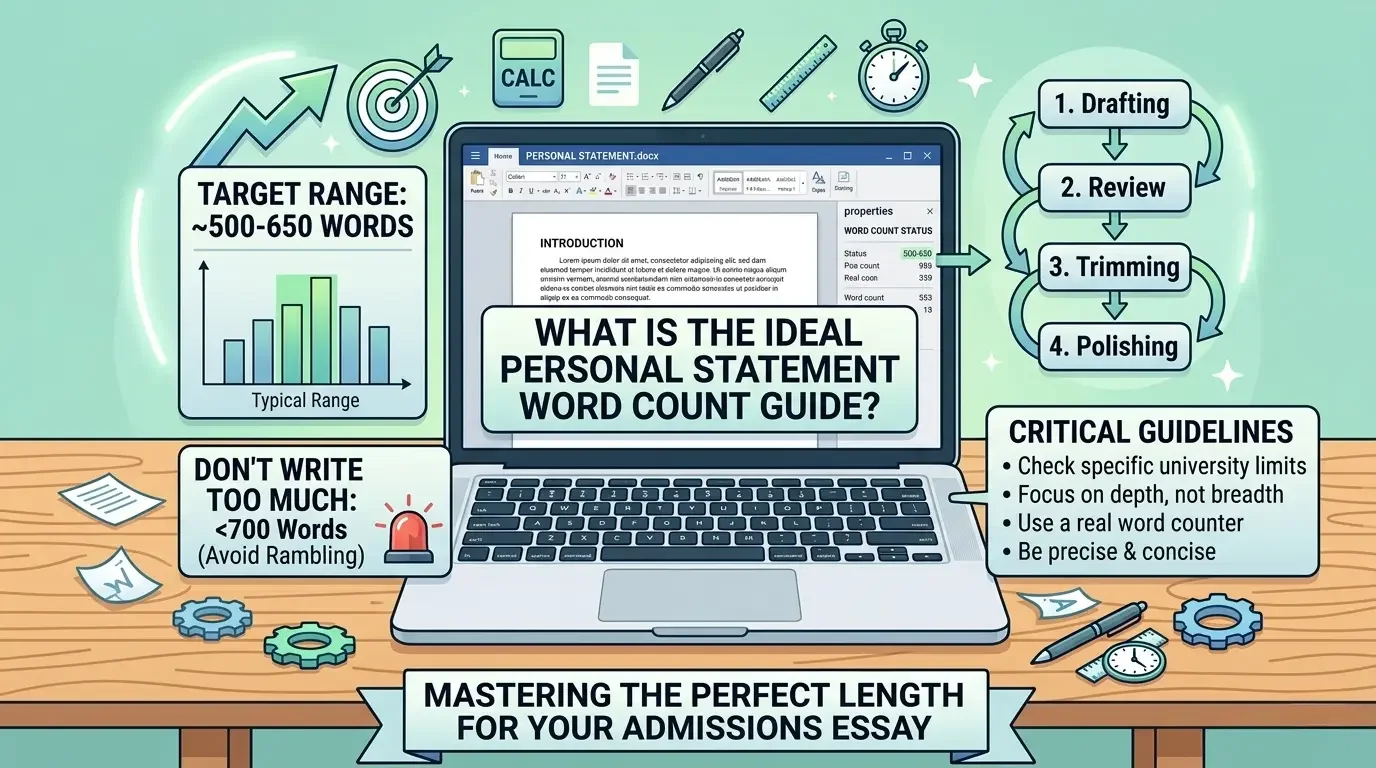
Typically, a personal statement will be about 80% to 95% of the word limit. This leaves you room to build out your thoughts without padding.
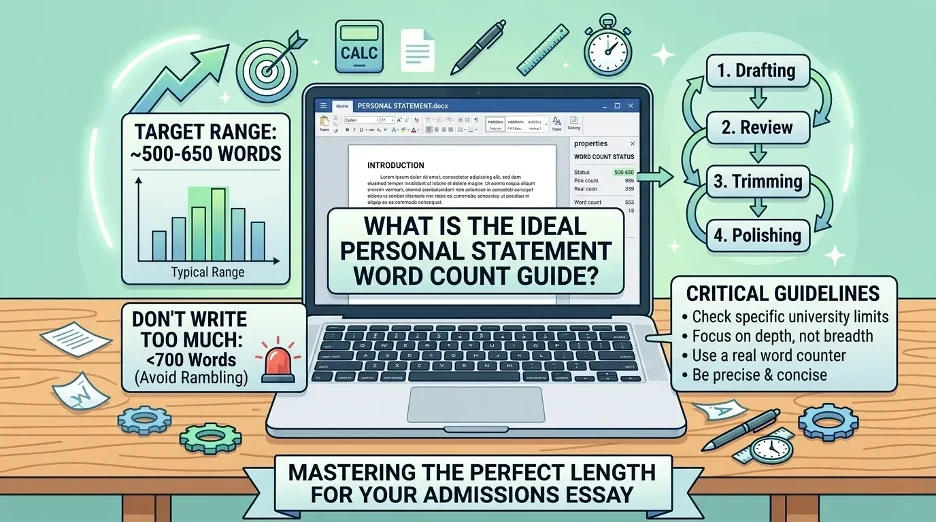
If the word count is 650, For Example, a good word count is typically 550 to 650 words. If the limit is 1,000 words, aim for roughly 750 to 950 words. If a maximum of 500 words is allowed, aim for somewhere between 400 and 500 words.
It's not necessary to reach the max exactly. A clear 575-word essay is better than a repetitive 650-word essay. It's about quality, not necessarily using all the available words.I have witnessed that length is not always the key characteristic of a strong personal statement. They are typically the ones that respond to the prompt with clarity and with specific examples.
Personal Statement Word Count by Application Type
| Application Type | Typical Word Count or Limit | Best Target |
|---|---|---|
| Undergraduate personal statement | 500–650 words | 550–650 words |
| Common college application essay | 250–650 words | 500–650 words |
| UCAS personal statement | 4,000 characters including spaces | Use most of the limit without repeating ideas |
| Graduate school personal statement | 500–1,000 words | 700–900 words |
| Statement of purpose | 500–1,000 words | 750–950 words |
| Medical school personal statement | Character-based limit, often around one page | Use the full space strategically |
| Scholarship personal statement | 250–750 words | Follow the exact prompt |
| Supplemental essay | 100–400 words | Be direct and specific |
These ranges are guidelines, not universal rules. The official prompt always comes first.
If the Limit Is 250 Words
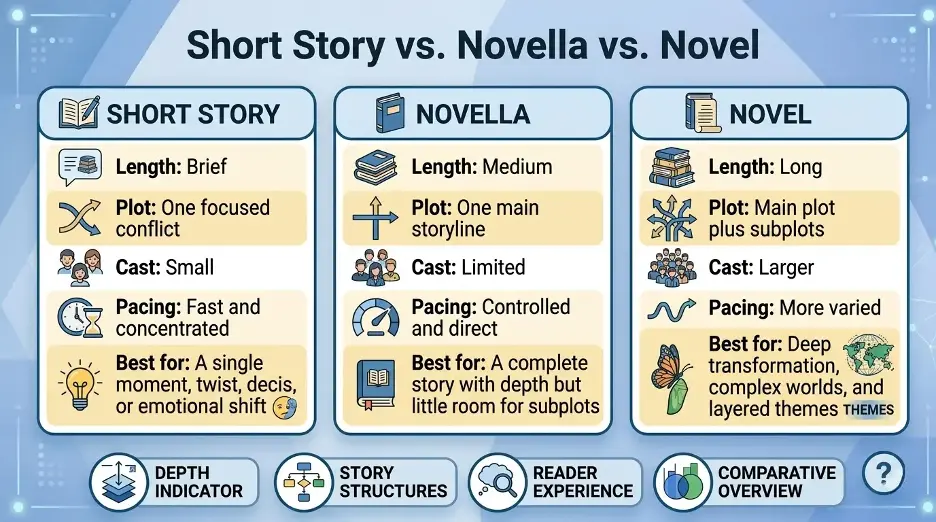
The personal statement should be a minimum of 250 words but no more than 500 words and must be extremely focused. There's no room for a long introduction, several stories or a wide background. Select one sentence to make a point, and use one clear example to back it up.
A well organized 250-word paper is organized in this way:
- 40–50 words: direct opening
- 120–150 words: one experience or achievement
- 50–70 words: reflection & connection / opportunity.
Try not to give a summary of your life. In a personal statement, depth is more important than breadth.For me, the 80% to 95% range works well as a practical goal to ensure there is enough room for detail, but not so much that there is a necessity to use filler.
If the Limit Is 500 Words
Here, a 500 word personal statement will provide sufficient space for a short story, some key points, and a succinct conclusion. This is one of the most frequently used personal statement lengths for scholarships, post graduate applications and program specific essays.
It's helpful to have a structure like:
- 10 words: closing and ending 75 words: Opening and main theme.
- 500 words: experience, challenge, achievement, motivation
- The skills, growth, and fit of 125 words.
- 50 words: closing statement
If you are this long, don't duplicate the resume. You don't have to write down all your accomplishments. Your aim is to make it clear why you are relevant.
If the Limit Is 650 Words
College admissions are typically in 650 word personal statements. This is a long enough length to create a personal story that is memorable.
The best 650-word essays tend to concentrate on a single story rather than a number of unrelated successes.
The strong structure may have:
- An opening scene or idea which has defined the theme of the film.
- A pivot point, dilemma, interest or insight
- Rethinking the change
- A link to future ideas or future studies
For a 650-word essay, aim for 550 to 650 words. The length of the essay can be shorter, but only if it is satisfying.
If the Limit Is 1,000 Words
For graduate school, professional, and statements of purpose, it is generally advised that you write a 1,000-word personal statement. This length will allow you to discuss academic background, professional experience, research interests, career goals, and program fit.
A typical 1000 word structure is:
- Introduce the topic and give reasons for their article.100-150 words: Introduction and motivation.
- Use 3-4 sentences to answer questions about academic or professional background (250–300 words).
- 250-300 words: applicable experience and abilities
- Why this program or opportunity fits: 150–200 words.
- 100 words: future plans and ending
Just to use 1,000 words does not mean that you have to. If your statement is stronger with 850 words, then so be it.
Word Count vs. Character Count
For some apps, the number of characters is used and not the number of words. This is because spaces and punctuation can be treated as characters.
As a rough guide:
- 500 words is usually around 2,500 to 3,000 characters.
- 650 words is usually around 3,250 to 4,000 characters.
- 1,000 words is usually around 5,000 to 6,000 characters.
These are just approximate figures. Submit with your final draft always into the application portal or a reliable character count.
Should You Use the Full Word Count?
If the prompt requires a personal, reflective, or detailed response, you should include most of the word count. When writing an admissions essay, an author's voice is likely to be one of the last things a reader hears, so making the space count can make a difference.
But, avoid padding a statement with filler. Avoid:
- Receiving the same award again in other words.
- Overexplaining obvious points
- Incorporating quotes that don't give any personal information away
- The long childhood story is not generally necessary and should be avoided unless it has a direct bearing on the story.
- Rephrasing information that is already expressed in transcripts or resumes.
A personal statement shouldn't be garbled or blown out of proportion.
What Happens If Your Personal Statement Is Too Short?
If you don't have a personal statement long enough, it can seem like you didn't think long enough. It can also fail to provide answers to other important questions, such as why you selected the course, what kinds of experiences were necessary for you to be prepared for, or how the experience relates to your future plans.
If it is specific and powerful, a short statement may do. However, if there are 650 words and your draft has 300 words, you may want to consider whether you have provided sufficient evidence, reflection, and context.
To extend a brief personal statement, include:
- A concrete example
- A short description of what you learnt
- Greater connection with the program/institution.
- Share more about the reasons for your involvement.
- A stronger conclusion
Make sure not to fill in the count with generic sentences.
What Happens If Your Personal Statement Is Too Long?
If your personal statement is too long it will be terminated by the application system or it may be rejected. If the system specifies the number of words that are allowed and this is ignored, it can create a bad impression.
If your statement is longer, shorten it in the following order:
- Repeated ideas
- Generic introductions
- Overly detailed background
- Resume-style lists
- Long quotes
- Weak adjectives and fillers phrases
Use more concise language to convey the same meaning in longer phrases. For instance, "I was given the opportunity to participate in" may be changed to "I participated in. It's easy for little tweaks to accumulate.
How to Choose the Right Word Count?
There are four factors to consider so that you can determine the appropriate personal statement length.
1. The Official Limit
The instructions for the application are the final rule. Don't send 900 words to the university that is asking for 500. Do not write 600 words if the question is 300 words long.
2. The Prompt
If you have a broad question, for example, "Tell us about yourself," it might need further elaboration. Any narrow prompt, like “Describe one leadership experience” should be more focused.
3. The Application Level
Typically, undergraduate statements are more personal and story-like. More academic, research or career detail may be required for graduate and professional statements.
4. The Strength of Your Content
If there are words that can be added to the essay that enhance meaning, a longer essay is better. If the content that is added is general, repetitive, and disjointed, remove it.
Personal Statement Editing Checklist
Before submitting, check the following:
- Does the statement fall within the word/character limit?
- Is the first sentence interesting?
- Do the main idea and supporting details make sense together?
- Have you fully responded to the prompt?
- Do your examples give specific details?
- Is there a sufficient amount of reflection?
- Do you have repetition gone?
- Is the statement true for you?
- Does the conclusion focus?
- Are there any spelling, grammar, and formatting errors?
Typically, a good personal statement will go through multiple revisions. Once the story is found in the first draft. The final draft brings it into focus.
Common Word Count Mistakes to Avoid
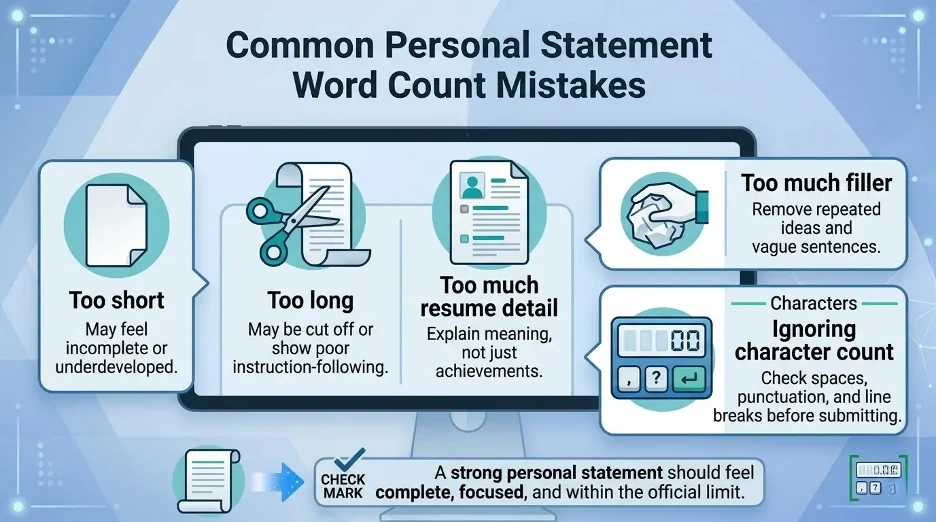
Writing Too Broadly
Attempting to include all of the achievements makes the statement weaker. Attention to most salient information.
Repeating the Resume
Your personal statement should be meaningful and not repeat facts that are already included in the statements above.
Ignoring the Prompt
The best essay in the world does not mean it will be the best essay if it does not address the question.
Saving Reflection for the Final Sentence
The statement should contain reflection not just at the end.
Using Filler to Reach the Limit
Pad is evident to admissions readers. Impressiveness of clear and concise writing.
Interesting Research Facts
Typical length: around 535 words
The average length of medical-school personal statements in England was found to be 535.5 words, meaning the mid-500s mark is realistic.
Graduate-level target: around 1,500 words
A graduate admissions application essay of 1,500 words is recommended by an AAS working group.
Source: https://arxiv.org/abs/2605.00992
UCAS limit: 4,000 characters
The maximum length of personal statements in the UK UCAS system is 4,000 characters / 47 lines (around 500-700 words).
Source: https://www.suttontrust.com/wp-content/uploads/2016/01/Making-a-Statement-FINAL.pdf
Short format: 250 words
A Dutch admissions study found that using shorter and more structured personal statements can be supportive for fair evaluation, using statements of 250 words.
Source: https://www.tandfonline.com/doi/abs/10.1080/15305058.2021.2019749
Best practice: keep it to 1 page
The experts advise to keep their residency and fellowship applications to a maximum of one single spaced page to ease the burden on reviewers.
Frequently Asked Questions
1.Does your personal statement not have enough content?
If you think your personal statement is not long enough, is missing examples or doesn't sufficiently address the prompt, you may have written it too briefly. A short essay may be used, but it must have clear evidence, reflection, and purpose.
2.Can you use less than the word count?
You don't have to write the exact word count for the word limit - No! It's preferable to have a clear, concise statement rather than filler that just gets to the point.
3.Can the word requirement be exceeded?
No, it is better NOT to go above the official limit. Exceeding will make it seem as though you didn't follow the instructions, and certain application systems may end your text.
4.If I have only a 300-word personal statement for a 500-word limit, what should I do?
If a 300-word statement is adequate to respond to the prompt, then it is acceptable. If important information, examples or motivation are missing, however, it should be expanded to include more specific information.
5.Why is my statement too long in the application portal?
Spaces, line breaks, punctuation, and formatting are different for some portals. Be sure to paste the final draft into the official application system before you submit it.
6.The 500-word rule applies to personal statements.500 words is the standard length for a personal statement.
Yes, 500 words will suffice if you stick to the point. Include one main idea, 1 or 2 strong examples and a clear explanation of why the opportunity is a good fit for your goals.
7.Do I need to remove significant information to comply with the limit?
Yes, when the information is not on topic with the prompt. Edit for the strongest examples and eliminate repeated points, extended background and resume-style lists.
How we reviewed this article:
Share this article