Reading Time Calculator Guide
Understand how a reading time calculator works, the reading time formula to use, and why reading time enhances UX, engagement, and content planning.
Quick Summary
- The reading time calculator estimates the time that will be required to read the content by dividing the total word count by an average reading speed.
- For the majority of blog posts and web articles, 200 words per minute is a good benchmark as it provides enough time for normal reading, scanning and comprehension.
- Reading time enhances user experience by letting users know whether to read the article now or save it for later or to simply skim through.
- The reading speed will vary with the type of content, for example, a technical, academic or research-focused text may have a slower reading speed estimate of 150 words per minute.
- Including a reading time next to the title can help establish clear expectations, decrease hesitation, and help engage with longer forms of content or detailed information.
What Is a Reading Time Calculator?
A reading time calculator is a tool that helps calculate the time needed to read a written content. Typically, it does this by counting the number of words and dividing by the average reading speed.
For Example, an article that requires a total reading of 1,000 words at an average rate of 200 words per minute will take about 5 minutes to read.
There are many common applications for reading time calculators:
- Blog posts
- News articles
- Website pages
- Academic content
- Email newsletters
- Speeches and scripts
- Reports and documents
- Web-based training and instruction.
The purpose is not to give a precise reading to every reader. Instead, it offers a realistic average that assists the reader in determining the time required prior to beginning reading. The average reading time I use is 200 words per minute, which is realistic as readers naturally pause, scan and comprehend while reading.
Why Does Reading Time Matters?
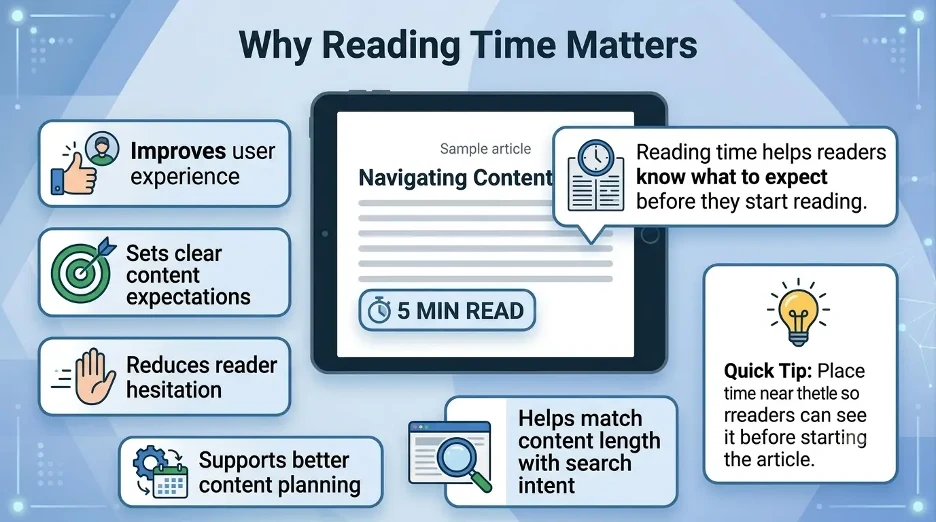
The amount of time it takes to read can make a difference when it comes to how your content is received. In the digital landscape where users are on the move, scanning and making decisions fast, estimated reading time can enhance clarity and minimize friction.
1. It Improves User Experience
If visitors are aware of the length of an article they will be able to choose whether to read it right now, save it for later, or skim it. This makes things easier and more enjoyable to experience because the content is more transparent and manageable.
A short 4 min read question can be used to motivate the user to begin reading. A longer “15 min read” label may provide them with an overview of what to expect.
2. It Sets Clear Expectations
Readers' time and attention are not all equal. Reading time gives them the opportunity to comprehend the depth of the information they are about to commit to.
For example:
- If it takes 2 minutes to read, it will just need a quick answer.
- If it took only 7 minutes to read, this is a medium explanation.
- If it takes 15 minutes to read, you can assume that this is a detailed guide or in-depth resource.
This can help lower bounce rates due to content that is either longer or shorter than anticipated.
3. It Supports Content Strategy
If you're a content creator, then you can use reading time as a balancing act to your publishing schedule. It is not always a good idea for a website to have lengthy guides or short posts. Reading time provides a real-life example of organizing content by depth.
These can include, for example:
- Quick answers by short posts.
- Medium length articles on education related subjects.
- Long-form guides of the competitive SEO keywords.
- In-depth tutorials on more complex topics
When writers monitor how long it will take to read their material, they optimize the length of the content to fit the user's search intent.
4. It Can Increase Engagement
Readers will be more inclined to begin an article if they understand it will not be too lengthy. An estimate of the time required for reading can eliminate hesitation and make content easier to digest.
Reading time is another indicator of value for long form content. Users who require in-depth information will likely be drawn to a detailed “12 min read” guide.
How Does a Reading Time Calculator Work?
The majority of reading time calculators utilize a basic formula:
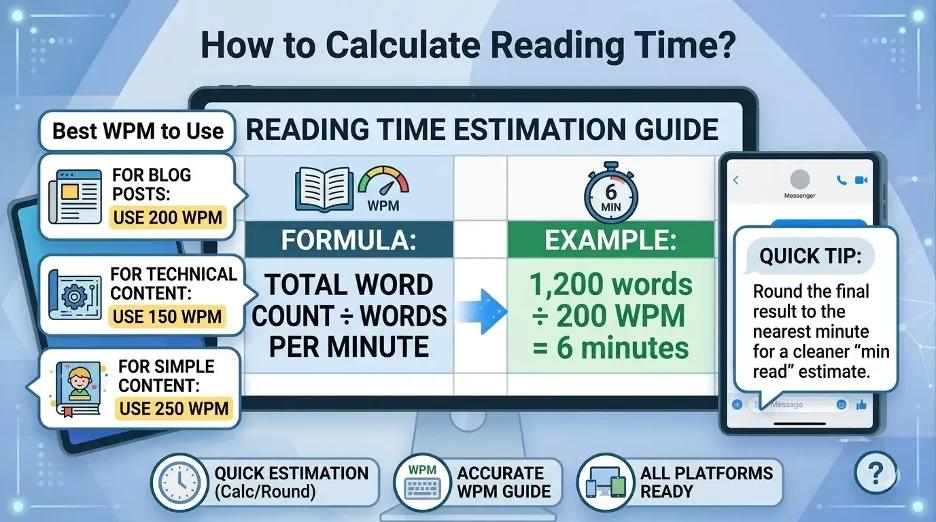
Reading Time = Total Word Count ÷ Words Per Minute
The most common average reading speed is between 200 and 250 words per minute. Most of the websites average 200 words per minute, as it would be a conservative estimate and would include pauses, scanning and comprehension.
Example Calculation
If you wrote 1200 words on your article and you have a typing speed of 200 words per minute:
1,200 ÷ 200 = 6 minutes
So, the estimated reading time is 6 minutes.
If you type 250 words a minute:
1,200 ÷ 250 = 4.8 minutes
In this instance the article will be rounded up to approximately 5 minutes.
Common Reading Speed Benchmarks
Reading speed can vary depending on the reader, content type, and difficulty level. Here are common benchmarks:
| Reading Type | Average Speed |
|---|---|
| Slow reading | 150 words per minute |
| Average reading | 200 to 250 words per minute |
| Fast reading | 300 words per minute |
| Skimming | 400+ words per minute |
| Technical reading | 100 to 180 words per minute |
For most blog posts and general web content, 200 words per minute is a reliable standard. For technical, legal, academic, or medical content, a lower reading speed may provide a more realistic estimate.For technical or research material, I decrease the speed to 150 wpm to make the estimate seem more reasonable and helpful to readers.
Best Formula for Calculating Reading Time
The standard formula is:
Reading Time = Word Count ÷ Average Reading Speed
However, a better calculator may also consider content complexity.
Basic Formula
Use this for general blog posts and articles:
Word Count ÷ 200 = Estimated Reading Time
Example:
800 words ÷ 200 = 4 minutes
Technical Content Formula
Use this for advanced, technical, or research-heavy content:
Word Count ÷ 150 = Estimated Reading Time
Example:
1,500 words ÷ 150 = 10 minutes
Fast Reading Formula
Use this when estimating for experienced readers or simple content:
Word Count ÷ 250 = Estimated Reading Time
Example:
1,000 words ÷ 250 = 4 minutes
How to Calculate Reading Time Manually?
Reading time can be determined by a few steps manually.
Step 1: Count the Words
Find the total number of words in your content. Word count is displayed automatically in most writing tools, CMS and document editors.
Step 2: Choose a Reading Speed
Standard content, use 200 words per minute. For complex content use 150 words per minute. For simple content, use 250 words per minute.
Step 3: Divide Word Count by Reading Speed
Apply the formula:
Total Words ÷ Words Per Minute = Reading Time
Step 4: Round the Result
When estimating using text only, images and videos are typically not included. If you are measuring the total time spent on content, however, you may want to add additional time for media.
Example:
950 words ÷ 200 = 4.75 minutes
Rounded result: 5 min read
Should Images and Videos Be Included in Reading Time?
Typical exclusions with text-only estimates are the images and videos. If you want to find out how much total content consumption time you spend, however, you need to add some additional content consumption time for media.
A common method is:
- Include 5-10 seconds per picture
- Incorporate full length of embedded videos
- Provide additional time for charts, tables, or interactive tools
For Example, an article that is 6 minutes to read plus a video embedded in it that is 3 minutes long may require a total of 9 minutes of estimated consumption.
Reading Time for Different Content Types
Different types of content may require different reading speed assumptions.
| Content Type | Speed | Use |
|---|---|---|
| Blog Posts | 200 WPM | General articles |
| News Articles | 200–250 WPM | Straightforward updates |
| Technical Guides | 150–180 WPM | Code and complex topics |
| Academic Content | 100–150 WPM | Research-heavy content |
| Emails/Newsletters | 200 WPM | Short updates |
| Speeches/Scripts | 125–150 WPM | Spoken delivery |
Best Practices for Displaying Reading Time
Keep reading time simple and consistent to make it useful.
Use a Standard Format
The most popular format is:
“5 min read”
You can also use:
Estimated Reading Time: 5 minutes
The shorter format is typically appropriate for blogs and article pages.
Place It Near the Title
The reading time should be presented before the reader begins to read. Common placements include:
- Under the headline
- Close to the author name
- Beside the publication date;
- On the top of the article card
Keep the Estimate Realistic
Don't read too quickly to make the content appear shorter. When you're providing an estimate, trust is built by being realistic.
Round Up When Needed
If the answer is 4.3 minutes, then it should be displayed as 4 minutes or 5 minutes, whichever is more convenient. Many websites round up to make sure they don't underestimate time.
Use “Less Than 1 Min Read” for Short Content
If it's very short content, don't display “0 min read.” For those that don't have a minute to read, use “Less than 1 min read” or “1 min read”.
SEO Benefits of Reading Time
While reading time itself doesn't directly influence rankings, it can help boost user engagement and experience, which is beneficial for SEO.
Better Click Confidence
Estimated reading time indicates to users what to expect. This can lead to a higher likelihood of them clicking and remaining on the page.
Improved Engagement
Having clear expectations lowers the chances for early exits. When readers know what you are going to be writing before they begin reading, they will be less inclined to abandon your article because it is too long .
Stronger Content Structure
Reading time helps writers to consider depth of content, formatting and readability. These are all important factors for improved SEO results.
Better Search Intent Matching
A brief question can be answered with a brief answer, or a more complicated query may require a thorough explanation. Reading time enables content teams to match the length of the articles to the searcher's intent.
How Reading Time Helps Content Marketing?
Reading time is a metric that can be used in content marketing to assist in planning, performance analysis and audience targeting.
If, for example, people engage more with short posts on mobile devices, you may choose to create more quick-answer articles. If long guides are effective in creating backlinks and conversions, you can put money into comprehensive resources.
Reading time also can be used to organize content funnels:
- Content of awareness: 2 to 4 minutes.
- 5-8 minutes: education information.
- 10+ minutes: decision and in-depth guides, tutorials.
It helps the marketers to develop a balanced content strategy.
How to Make Content Easier to Read?
The length of time it will take someone to read a content is determined by a reading time calculator, but the readability determines if they will continue reading or not.
Here are some ways to enhance readability:
- Write short paragraphs
- Use clear headings
- Avoid unnecessary jargon
- Use simple sentences with only one subject verb-object, and one adjective for each.
- Include examples as needed
- Divide large concepts into one or more steps
- Make comparisons using tables.
- Keep introductions focused
- Remove repeated points
- Use the right depth for searching.
Content should be of a sufficient length to answer the topic, but not longer than required.
Interesting Research Facts
Average silent reading speed is lower than commonly assumed:For adults who are proficient in English, the average speed is 238 wpm for non-fiction and 260 wpm for fiction.
Reading aloud requires a slower estimate:The estimate for reading aloud is slightly slower – average oral reading speed is approximately 183 wpm, which is significantly slower than the speed of silent reading.
Genre and difficulty affect reading time:Most adults take 175-300 words per minute (wpm) to read non-fiction, and 200-320 wpm to read fiction.
Technical content slows reading significantly:Text involving algebraic or technical material will slow reading by approximately 106 wpm.
Comprehension drops at very high speeds:In a recent reading-speed study, comprehension remained fairly constant until the highest speeds tested (405 wpm), at which point it decreased.
Frequently Asked Questions
1.What is a Reading Time Calculator?
There are a few ways to estimate reading time for a blog post.There are several methods for estimating reading time of a blog post.
2.Which of the two rates of word per minute (WPM) is better for reading time: 200 or 300?
For general content I like 200 WPM as it is a safer and more accurate estimate. 300 WPM is suitable for fast readers, but what's not suitable is that it makes reading time appear shorter than it actually is.
3.Is it OK to have images and videos during reading time?
If it's a simple reading estimate, then I just tally text. If there are videos or many images or charts on the page, I put in additional time to account for all content viewed.
4.Why does the estimate of my reading time seem out of whack?
The pace at which you read varies depending on the type of text, what you are reading for, and the content of the text. Articles tend to be read more quickly when they are simple, but they tend to be read more slowly if the content is technical and/or academic.
5.Which is the fastest rate of reading technical material?
Technical Content: 150 words per minute. This provides the reader with more time to absorb difficult vocabulary, examples, code or research-based explanations.
6.Is there any measure of how reading time affects the user experience and how to enhance it?
Yes. Reading time allows readers to know what they are in for before even reading a word and makes it easier for the reader to commit to the content.
How we reviewed this article:
Share this article