How Long Should a Meta Description Be?
Discover the perfect meta description length, its importance for SEO, and crafting clear snippets that entice more qualified clicks.
Quick Summary
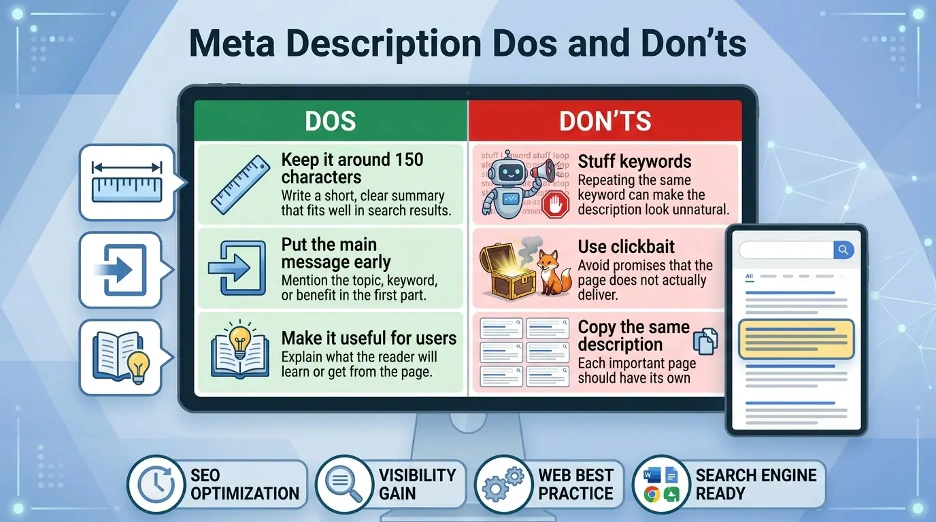
- The optimum length of a meta description is approximately 150–160 characters. This range will provide you with sufficient room to describe your page clearly and not run the risk of your snippet being cut.
- Put most critical information at the beginning. I suggest the main keyword and key benefit be the first 120 characters because Google might shorten the snippet on mobile or rewrite the snippet with a similar meaning to the query.
- Meta descriptions are not directly used for rankings. They can, however, impact organic click-through rate by allowing users to know what your page has to offer before clicking.
- Each significant page is to have a distinct description. Each blog post, product page, service page or landing page has a specific purpose and a custom meta description tells search engines and users what that purpose is.
- Great meta descriptions are informative, honest, and to the point. Keep the keywords, language and hyperbole to a minimum. I like writing descriptions that are congruent with the pages and that provide some reason for the user to visit.
What Is a Meta Description?
Meta description: It is the HTML tag that describes the content of a web page. It is very common to be displayed under the title of the page in search engine results.
For Example:
<meta name="description" content="Learn how long a meta description should be, why length matters, and how to write SEO-friendly descriptions that improve click-through rates.">
While not a direct ranking factor, meta descriptions may have an impact on organic click-through rates. The description will be able to say a lot about your page and why it is worth clicking on. From what I've seen and learned about optimizing web page content, a good meta description should give the user an immediate idea of what the page will be about and why it will be beneficial.
Ideal Meta Description Length
The optimal length of a meta description is:
- Desktop: 150–160 characters
- Mobile: 120–150 characters
- Safe range: 140–155 characters
- Maximum practical range: Around 160 characters
On most pages, try to keep the content to 150 characters. This allows you to share information without it being cut off and eliminates the risk of truncation. While you can use 150 characters as a representative number, make sure to keep in mind that search snippets might look different depending on the device.
The best general guideline is to include the “core” of the information in the first 120 characters. This allows you to maintain clarity of your message even if Google truncates the snippet on mobile devices.
Why Meta Description Length Matters?
Meta description length is important because there is limited space in search results. Search engines might truncate your description with an ellipsis if it's too long. It might not offer enough context for users to follow through and click it if it is too short.
An optimized meta description can:
- Make search results more readable
- Increase organic click-through rate
- Better match between user search intent and the match.
- Use the main keyword in a natural way.
- Establish realistic expectations prior to user's click
- Minimize the “noise” of irrelevant traffic from users seeking something different
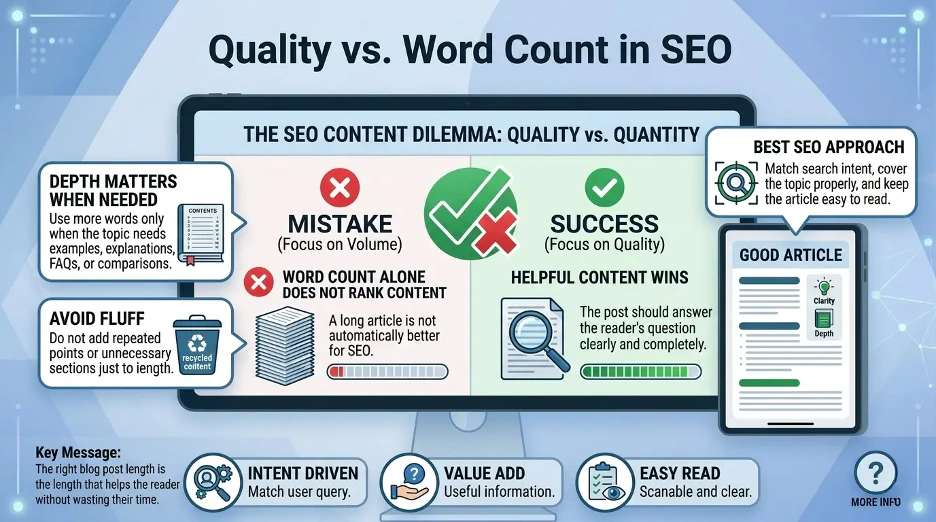
The length is not to be long enough to “fill up” to many characters. It's all about how to use the space. For SEO, I have seen that a well written and focused meta description tends to get more qualified clicks than a fluffy or general meta description.
Best Practices for Writing SEO-Friendly Meta Descriptions
1. Keep It Between 150 and 160 Characters
This is the most convenient range for most of the pages. It is good for search results on the desktop and provides sufficient space for a full sentence. The 3 points I think about when writing ‘Meta Descriptions’ are Accuracy, Clarity and User Benefit.
Example:
Good:
Discover the length of an ideal meta description, its importance and how to create one that is SEO optimized to boost click-through rates.
This description is straightforward, relevant and user goal-oriented.
2. Put the Main Keyword Near the Beginning
Describe the first part of the description using the primary keyword naturally. If your page is geared towards “meta description length,” you'll want to include that term in your opening.
Example:
Meta description length is important for SEO. Discover the best length of characters, best practices, and how to write descriptions that will get more clicks.
Avoid forcing keywords. Search engines and users both prefer natural language.
3. Match Search Intent
A meta description should convey what the searcher is looking for.
- For informational purposes, describe what the user will gain from the activity.
- If you are writing for a commercial purpose, focus on advantages, comparisons or solutions.
- Use features, use cases, or value propositions for product pages.
- If it is a service page, talk about the service, where it would be served, and what would happen.
If the page is a guide, the description should be educational sounding. If it's a product page it should be useful and action-oriented.
4. Make It Specific
General descriptions don't work very well. Try to steer clear of such language as:
We have top quality solutions to your needs.
Rather, tell about the page itself:
Discover the perfect length of a meta description, its examples and how to craft search snippets for better organic clickthrough rate.
Specific descriptions aid users to make their decisions quicker.
5. Include a Clear Benefit
A good meta description provides users with information about what there is to gain through the click.
Some advantages are:
- Learning a process
- Solving a problem
- Comparing options
- Saving time
- Avoiding mistakes
- Finding examples
The key to any better choice is to make a better decision.
For example:
Discover the optimum length of a meta description, pitfalls to steer clear of and some simple guidelines for crafting snippets that are more likely to get clicked.
This is because it communicates to the user precisely what they will obtain from the page.
6. Use Active Language
Active language is more straightforward and engaging for meta descriptions.
Weak:
In this article, you can read about what a meta description is.
Better:
Understand what comprises a good meta description that's short and sweet, concise yet informative, and catches more qualified clicks.
Active descriptions typically sound more helpful and effective.
7. Avoid Duplicate Meta Descriptions
All significant pages should have different meta descriptions. Having duplicate descriptions makes it more difficult for search engines and users to determine the differences between your pages.
As an example, the description of a blog post should not be the same as the description of a service page, as well as the description of a product page. The purpose of each page should be summarized on that page.
8. Do Not Overpromise
Your meta description should accurately convey the content of the page. Offers that misrepresent what they provide can lead to a higher bounce rate and a lower level of trust.
Avoid clickbait. A good description will be convincing, but not sensational. I avoid writing meta descriptions that would seem to promise something that isn't present on the page because once the user clicks the link it could make them less likely to trust the page.
Meta Description Length Examples
Blog Post Example
Title: How Long Should a Meta Description Be?
Meta Description: Learn the ideal meta description length, why it matters for SEO, and how to write clear snippets that improve organic click-through rates.
This is effective because it contains the keyword, explains the meaning of the word and is kept short.
Product Page Example
Meta Description: Buy lightweight running shoes that are comfortable, supportive, and ideal for everyday training sessions. Before purchasing, compare sizes, colors and features before purchasing.
This is a specific and helpful description for shoppers.
Service Page Example
Meta Description: Use a strategy tailored to your objectives to boost your rankings, resolve technical problems, and increase organic traffic with the help of expert SEO services.
This is to mark the service, outcome and value.
Local Business Example
Meta Description: Looking for a dentist in Austin? Schedule appointments for all family members at your local dental office for dental care, dental cleaning, dental whitening, and dental emergencies.
This involves the type of services, location, and purpose for services.
Should Every Page Have a Meta Description?
Custom meta descriptions are important for important pages.
This includes:
- Homepage
- Main service pages
- Product pages
- Category pages
- High-value blog posts
- Landing pages
- The pages that are optimized for organic search results. Pages optimized for organic search results.
Google may create a snippet from the content for low-priority pages. But, if the pages are relevant to your SEO plan, it's generally worth it to write a unique description.
Meta Description Checklist
Please be sure to review your meta description:
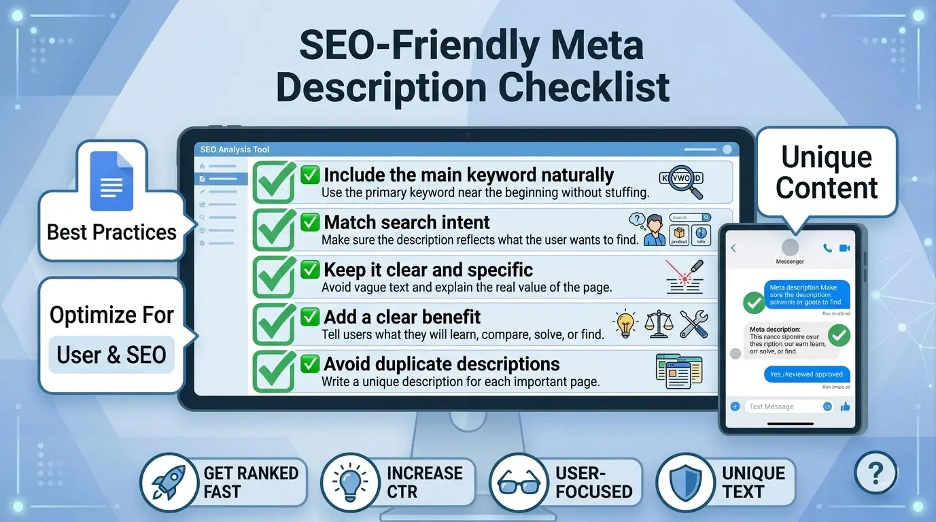
- Is around 150–160 characters
- Contains main keyword in its title
- Meets the purpose of the search on the page
- Summarizes the page to show its main idea.
- Provides users with a motivation to click
- Makes use of active and specific language
- Avoids keyword stuffing
- Is only found on the page that it's on.
- Makes the key point(s) up front
- Accurately reflects the content
I'd rather write meta descriptions for people first, search engines second, because users will determine whether or not they click. My experience shows that the shortest, shortest and most specific meta descriptions are the best. They provide a clear summary of the page, then naturally include the main topic and provide a good reason for the user to come to the page.
Interesting Research Facts
Full citations are in Sources below.
Organic CTR drops sharply by ranking position
Average CTR decreases dramatically when ranked on the top 3 results of Google: 9.28% for position #1 on Google, 5.82% for position #2 on Google, and 3.11% for position #3 on Google. Meta descriptions are particularly crucial for pages lower in the ranking.
Search engines may rewrite snippets
Google may use on-page text which better matches the user's search query, so position your most relevant keywords and value proposition up front.
Front-load important keywords
Utilize key words that are used at the start of a meta description – Keywords at the beginning of a meta description will be more important for search engines and easier to scan quickly by the user.
Source: Front-load important keywords
Use clear, simple language
Meta descriptions are brief and to the point, which is essential for SEO success, and using clear, simple language is well supported by the research.
Source: Use clear, simple language
Meta descriptions support first-page visibility
Clicks from beyond the top of Google's page rank are less than 2% — well written meta descriptions help your pages to be noticed in areas where it counts.
Frequently Asked Questions
1. Are there any strict rules on the number of characters for a meta description?
No. I use 160 characters as a good rule of thumb, and not a set rule. The length of the snippet that Google displays will vary based on the query, device and format of the returned results.
2. If my meta description goes over 160 characters what should I do?
Google could truncate and/or recraft the snippet if it's too long. Unless it interferes with the main message, it typically doesn't affect the rankings, but the main message should be seen early so that users can still read the page.
3. Should a meta description be short or not for SEO purposes?
Not always. An optimally sized meta description text can help, if it is comprehensible and explains the page. I like it when the description is short (120 characters) and includes strong verbs or nouns instead of weak words or repeated words.
4. Is Google always utilizing my meta description?
No. Google might extract text from the page if it better fits the query or take the meta description you provided. Describes, hence I keep the description accurate and closely related with content, that is why.
5. May I have more than one meta description on different pages?
I would not recommend it to be used for important pages. Describe each page differently to let users and search engines know about the uniqueness of that page.
6. Are meta descriptions directly impacting rankings?
No, Meta descriptions aren't a ranking factor. Yet I still write them because they can have a positive impact on the appearance of results and possibly influence the click-through rate towards the page.
7. Do I need to write a description for each page?
Optimises and creates custom meta descriptions for key pages such as blog posts, service, product, category, landing pages and more. Google can create the snippet for low-value pages.
8. Should meta description length be counted with spaces?
Yes. When measuring length, I count letters, numbers, punctuation and spaces using a character counter. Typically a good guideline for a description is 150–160 total characters.
How we reviewed this article:
Share this article