How Long Should a Title Tag Be?
Understand the perfect length for title tags for SEO, why titles are shortened, and how to create clear and clickable title tags that align with search intent.
Quick Summary
- A title tag or title attribute is a HTML element which sets the title of a webpage, which is usually displayed as the clickable title in the search results.
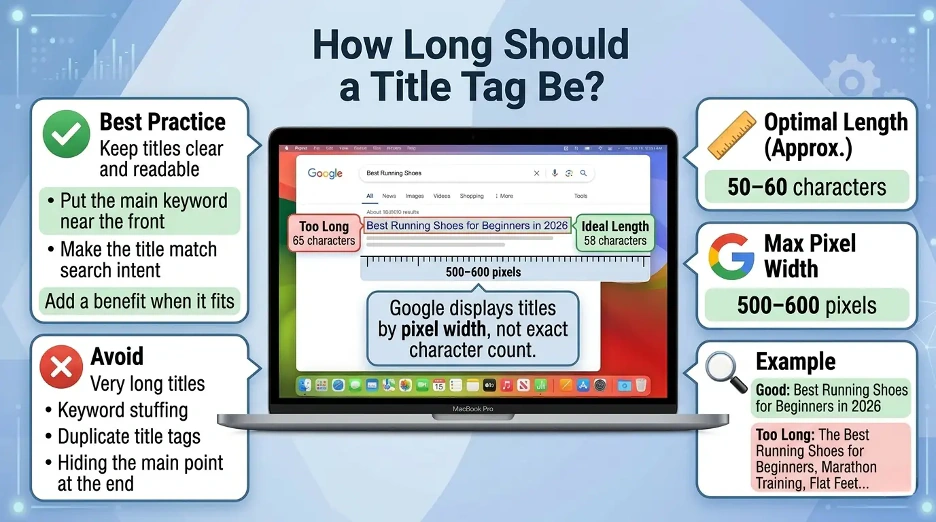
- Google actually displays titles by width (pixels) not length (characters) and the optimum length for title tags are 50-60 characters or about 500-600 pixels.
- Although the length of title tags is not directly a ranking factor, a well-crafted and meaningful title tag can enhance the relevance of the keywords, alignment of search intent, and click-through rate.
- Google might shorten or reword long titles, so it is ideal to have your most important keyword and value near the beginning of the title.
- The SEO title tag will have a clear purpose for clicking, should be unique and natural, with the keyword up front, and should be useful.
What Is a Title Tag?
HTML element that sets title of a webpage. It's frequently seen as the clickable headline in search engine listings, browser tabs and social preview.
For Example:
<title>How Long Should a Title Tag Be? SEO Best Practices</title>
The title tag is one of the most critical on page factors for SEO as it helps the search engines and users to understand the page content. It also impacts click-through rate, which may impact the performance of a page in organic search results.
The Ideal Title Tag Length
The optimal length of the title tag is:
50 to 60 characters
or approximately:
500 to 600 pixels wide
Search engines show titles depending on the width of the pixels, NOT the number of characters. This is important because some letters require more space than others. For instance, “W” has a larger width than “i”, and so two titles of the same size might be displayed in different ways.
However, character count is more convenient when creating titles. In most cases, titles of 50-60 characters are a good place to start. I would suggest making title tags be around 50 to 60 characters because I've found that easier to read and less likely to be cut off in the results of a search.
Is There a Maximum Title Tag Length?
There isn't a specific limit on the length of a title tag that search engines need that's mandated. It is possible to have a longer title tag than 60 characters. I'm not a stickler for 60 characters. If it's only a little bit longer but still useful and clear, it would be OK to keep it.
However, long title tags can be:
- Having a cut-off in search results.
- Rewritten by Google
- More difficult for users to read
- More like this keyword than the main keyword.
- Less effective in terms of click-through
If the most significant words are near the beginning of the title then there is the potential for a longer title to still perform well. However, if the title is too long, too repetitive, or not clear, it can lead to lower visibility in search results and engagement with the audience.
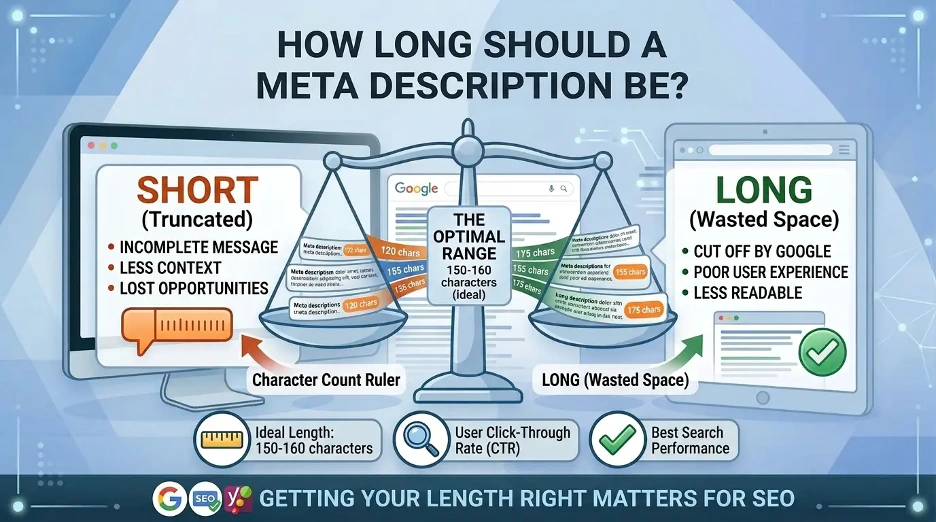
In search results, title tags that are too long will be shortened. This is usually shown with an ellipsis.
For example:
The Best Running Shoes for beginners, Marathon Training, Flat Feet...
The issue isn't just that the title is clipped. The larger problem is that the most compelling or significant aspect of the title might be missing.
It would be better if it said:
Best Running Shoes for Beginners in 2026
This version is shorter, clearer and easily understood on a first look.
Does Title Tag Length Affect SEO Rankings?
The length of the title tag isn't a simple factor of ranking, you might not find that a 55-character title tag ranks better than a 75-character one.
However, the quality of the title tags can influence the SEO results. A good title tag can assist with:
- Keyword relevance
- Search intent alignment
- Click-through rate
- Page topic clarity
- User expectations
Too short of a title may not provide enough context. Too long of a title can lose its focus or be cut off. The ideal title tag is lengthy enough to provide the page with explanation but is not so long as to become unreadable. Generally, I try to get the keyword in the front of the title tag, allowing users and search engines to determine the subject of the page without getting lost.
How to Write an SEO-Friendly Title Tag?
A good title tag isn't simply the correct length. It should also be relevant, specific and useful.
1. Put the Primary Keyword Near the Front
The results are quickly scanned for searchers. The main keyword should be used in the beginning of the page so that the user and search engines can easily grasp the subject of the page.
Weak example:
Prior to writing better tags, you need to know everything about them.
Better example:
What is the length of SEO titles?
2. Match Search Intent
Your title bar needs to be what the searcher is looking for.
The intent of the search query “how long should a title tag be” is informational. The user wants to know the answer rather than a sales page.
The following is a good title:
What should be the length of a title tag? SEO Guide
A bad title would be:
A key component of SEO is optimizing title tags. Optimizing title tags is an important aspect of SEO.
The second title is not related to the query.
3. Keep It Specific
Specific titles are more likely to be clicked than generic ones.
Weak example:
Title Tags Explained
Better example:
What's the optimal length for a page title?
The better version is geared toward a more precise question, and will likely draw in the right sort of clicks.
4. Avoid Keyword Stuffing
Avoid overusing the keyword unnaturally.
Bad example:
The title tag length should be kept to a minimum. Title Tag SEO: Keep the length of the title tag to a minimum.
Better example:
SEO is so intricate that it is crucial to adhere to best practices when creating your title tags.
When there is a lot of keyword stuffing, titles may appear like spam and this may lead to loss of trust. Keep the main keyword to one, with natural related words.
5. Add a Benefit When It Fits
A title tag should convey to the user why your page is worth clicking.
Examples:
- What's the ideal length of a title tag? Simple SEO Guide
- Title Tag Length: Best Practices to Avoid Truncation
- SEO Title Tag Length: What Works Best?
This allows readers to click with each book without making them too long.
6. Use Branding Carefully
Usually, adding a brand name will help, particularly on product pages, homepages and trusted publishers.
Example:
Define the length of the title tag | Brand Name
However, the brand name could get shortened if your title is already nearly 60 characters long. When creating content for blogs, it is better to start with the topic unless you have a very strong brand recognition.
7. Make Every Title Tag Unique
The title should be different for each significant page. If the title tags are duplicated, it can be difficult to determine which page is the most relevant for a particular search query.
For instance, it is not suitable to have the same title tag for all product pages on an ecommerce website.
Bad example:
Running Shoes | Brand Name
Better examples:
- Men’s Trail Running Shoes | Brand Name
- The brand name of the Women's Lightweight Running Shoes will be revealed in the next few days.
- Waterproof Running Shoes For Winter | Brands
Unique titles increase topical clarity and minimize internal competition. Each title tag is different as duplicate titles can cause confusion to search engines and users.
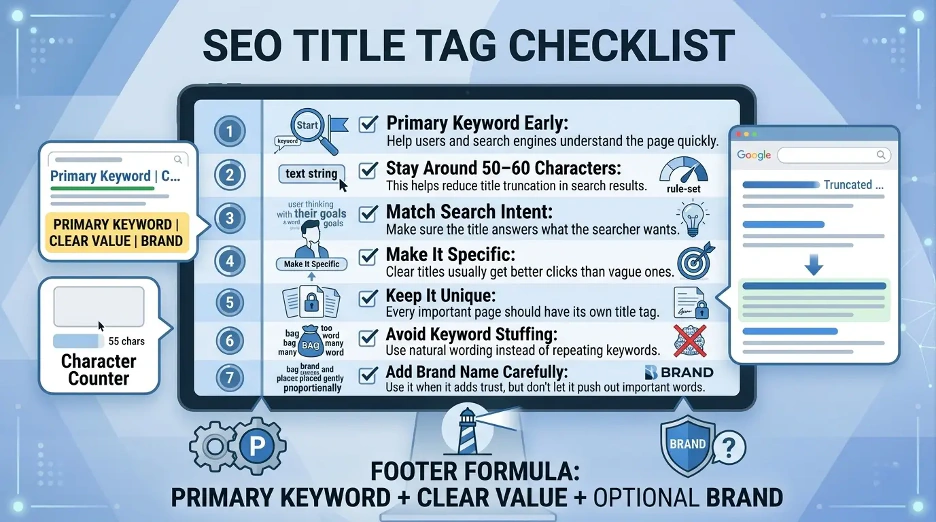
Best Title Tag Length Formula
Follow this easy formula for using the equation:
Primary Keyword + Clear Value + Optional Brand
Examples:
- The title tag length is considered to be one of the best practices in SEO.
- What's the right length for a title tag? Quick Guide
- Women's Hiking Jackets | Waterproof Outdoors Gear.
- Accounting Software For Small Businesses | Brand Name
This ensures that your title is relevant, search-friendly and stays clear.
Should You Always Stay Under 60 Characters?
No. This isn't a rule; it's a guideline.
However, if:
- The page topic needs more details
- The appropriate main keyword is included near the beginning.
- The title remains natural given the content.
- The additional words are a real value
- Do not lose important information due to truncation
But shorter titles tend to be easier to scan and less apt to be cut off or rewritten in the same title. One of the things I like to do when I look at title tags is I look at my title, first because I want to understand what the keyword is, the topic of the page, the benefit that someone's going to receive from this page, before truncating the title.
Interesting Research Facts
Full citations are in Sources below.
Use a 6–78 character title tag
Title tags should be within this range to aid in indexing, readability and on SERP. Titles not in this range may be shortened or reformatted by a search engine.
Source: Use a 6–78 character title tag
Place key phrases within the first 65 characters
The most important 1-2 words should be included in the first 65 characters so search engines can easily understand the topic of the page.
Avoid exceeding 78 characters
Titles with more than 78 characters will be more likely to get cropped in the SERPs and this may lower your visibility and click-through rate.
Source: Avoid exceeding 78 characters
Do not make titles too short
Very short titles (e.g. < 4 words) might not have sufficient semantic context to rank the page appropriately by search engines.
Source: Do not make titles too short
Put the target keyword in the first 2 words when possible
Users and search engines who are skimming through the results will be able to more easily understand the topic.
Source: Put the target keyword in the first 2 words when possible
Frequently Asked Questions
1. What makes a good title tag?
The ideal length of a title tag is 50-60 characters or about 500-600 pixels wide. This helps to minimize truncation in search results.
2. 60 characters is an absolute SEO rule?
No. This is a guideline, not a rule. If the title is still clear, helpful and contains the main keyword early in the title, then a longer title is okay.
3. Why does Google cut off my title tag?
Google uses pixel width, not character count to determine the title. If your title is less than 60 characters, it may be shortened in some instances, as wide letters require more room.
4. Why Google changed my title tag?
If Google believes that the title isn't very relevant to the content on the page, or contains too many keywords, is too repetitive, or isn't clear, they may change it.
5. Can I use my keyword in the beginning of the title?
Yes, when it is a natural sound. It makes it easier for users and search engines to grasp the content of the page by placing the primary keyword first.
6. Should I use my brand name in the title tag?
When it provides trust or clarity use your brand name. In the case of blog posts, it is the topic, rather than the brand, that is most important — unless it's a recognizable brand.
7. What if I shorten my Title Tag?
Too short of a title may not provide enough context. It should be long enough to spell out the page but not too vague.
8. Is it okay to have the same title tag on several pages?
No. Every important page should have a different title bar to enable search engines and users to know what makes this page different.
9. Which is the most suitable format of a title tag?
The format is: Primary Keyword + Clear Value + Optional Brand.
How we reviewed this article:
Share this article