What is the Ideal Blog Post Length for SEO?
Discover the perfect blog post length for SEO, its impact on rankings, and the best length according to search intent.
Quick Summary
- Most of the time, it's best to write blog posts between 1,200 and 2,500 words long; however, that's only a guideline.
- Of course, blog post length can also influence SEO indirectly, as longer content provides room to go into more depth about the topic, provides answers to questions that may be relevant, and includes examples that may be helpful.
- Short posts are ideal for simple questions, and longer pieces and pillar pages require more words to properly cover the topic.
- You can choose the number of words depending on the intention of the users searching, the level of the topic, the level of competition of the keywords, and the information that the reader wants.
- The quality of the material is more important than the length of the word count; each section should be informative, comprehensive, relevant, and understandable.
What Is the Ideal Blog Post Length for SEO?
For most SEO blog posts, the goal is to maintain a PPC score between:
1,200–2,500 words for informational-type blog posts.
This range will allow you to cover a topic adequately, add related subtopics, answer common questions, and use semantic keywords naturally. But it should not be considered a hard and fast rule.
The question that is not being asked is, “How many words should I write?” The more important question is, “How much information is needed for the reader to understand this topic?”
For a very specific question like “What is a meta description?” a 700-word article will suffice. Competitive topics, like “How to create an SEO strategy,” may require a 3,000-word guide. Word count is a suggestion, not a strict guideline for SEO. My primary focus is to provide the reader with a clear and comprehensive answer to the question.
Does Blog Post Length Affect SEO?
The length of the blog posts has an indirect impact on SEO.
A greater word count is likely to be successful as it can cover a topic in greater detail. May contain examples, definitions, related questions, comparisons, and internal links. This can make the page more relevant and useful on a topical level.
However, length is not a ranking factor. A longer article with ‘information’ will not beat a shorter article that provides a more helpful and succinct answer.
Search engines are seeking content that provides value to the searcher and meets the searcher's intent. This means that the optimal length of a blog post is the length that enables you to answer the query completely, clearly, and efficiently. I've seen a blog post that helps solve the problem of the reader working better for me than one with more words.
Recommended Blog Post Length by Content Type
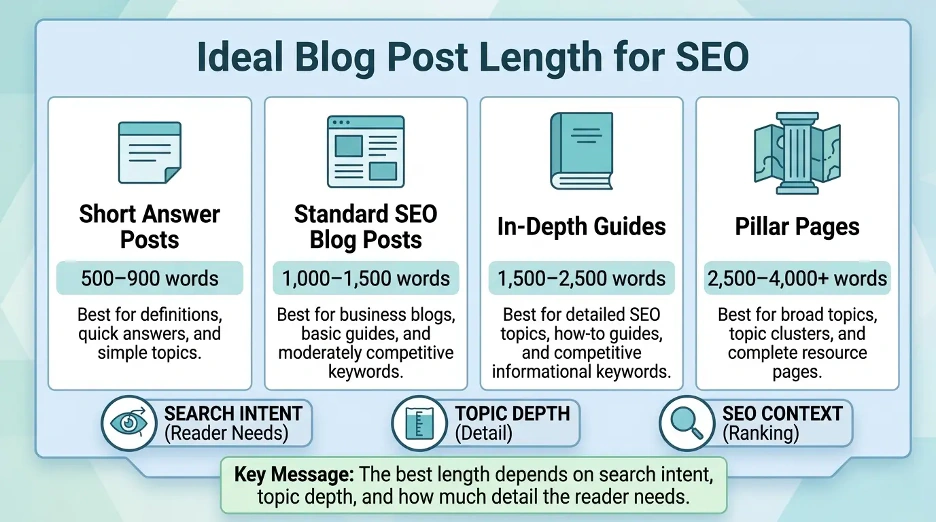
The word count for each type of blog post is unique. The ranges are provided here as a guideline.
1. Short Answer Posts: 500–900 Words
Short posts are good for simple, direct queries. It's typically a subject with a reader who wants to learn about it quickly: an explanation, a definition, or an answer. Use a free word counter to verify your post stays within range.
Examples include:
- What is keyword density?
- What is a “canonical” tag?
- What is the bounce rate?
For these posts don't add any additional sections simply to pad out the length. Give an answer, talk about the concept, use a quick example and move on.
2. Standard SEO Blog Posts: 1,000–1,500 Words
This is an excellent time frame for numerous business blogs. It is suitable for keywords and topics that are moderately competitive and require explanation, yet not a complete guide.
Examples include:
- How to write titles that are optimized for SEO.
- Benefits of blogging for small businesses.
- Avoiding common SEO mistakes. Common SEO mistakes to avoid.
You can typically have an introduction, a few helpful sections, examples, a FAQ section, and a definite conclusion at this length. Check your word count as you write to stay on track.
3. In-Depth Guides: 1,500–2,500 Words
This is typically the ideal range to use for competitive informational keywords. It provides you a chance to discuss the subject in detail without overwhelming.
Examples include:
- The perfect length of a blog post for SEO.
- This is an article on how to optimize your blog post for SEO.
- On page optimization is known as “Complete guide to on page SEO”.
The posts should be organized with headings, semantic keywords, internal links, examples, and answers to related questions.
4. Comprehensive Pillar Pages: 2,500–4,000+ Words
Pillar pages are comprehensive, authoritative content that is dedicated to a large topic. They are frequently incorporated into a topic cluster approach.
Examples include:
- The ultimate search engine optimization guide.
- The content marketing strategy guide is something you should read to get more information.
- This refers to a beginner's book on digital marketing. This can be a book for beginners on digital marketing.
These posts can be longer as they have subtopics that are discussed. But they need to be well organized. A long pillar page should contain a table of contents, descriptive headings, brief paragraphs, and links to other articles that contain content relevant to the pillar page.
How to Decide the Right Blog Post Length
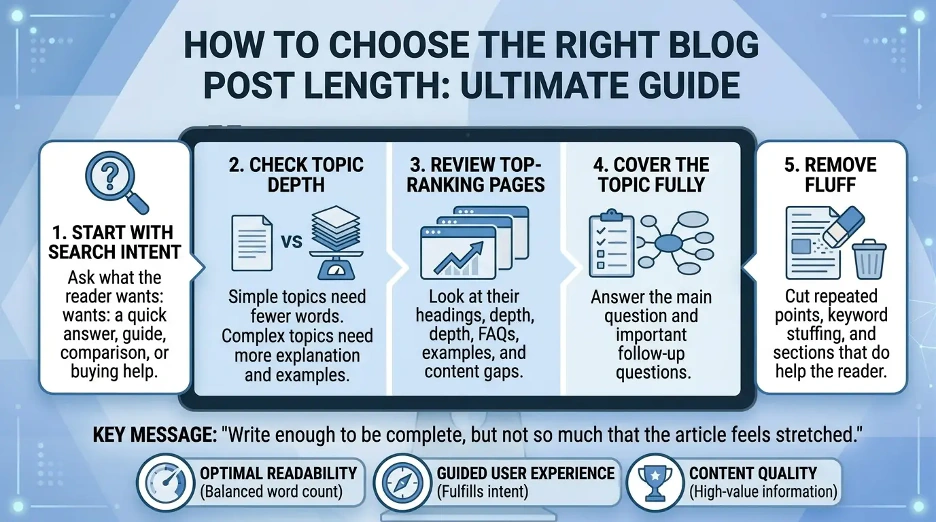
Optimizing for the right word count is reliant on the purpose of the search, the depth of the topic, and quality of competition. Here is a practical means of determining.
1. Analyze Search Intent
Search intent is the intent of searching.
Before writing, ask:
- Does the user want a hasty answer?
- Would the user like a step-by-step guide?
- Would the user like to see a comparison?
- Would the user like some examples?
- Does the user want to make a buying decision?
Sometimes, an informational request can require only 800 words. If you are comparing a commercial product, you might need 2,000 words or more since the reader expects your details, advantages/disadvantages, price, and suggestions.
2. Review the Top-Ranking Pages
Do some research on the term you want to rank for and learn about the pages that are already on the first page.
Look at:
- Average content length
- The terms included are headings and subtopics covered.
- Depth of explanation
- Use of examples
- FAQ sections
- Content gaps
Don't copy other competitors. Use them to know what searchers are looking for. You want to make a better, clearer, more useful version. I don't look at the word count alone when I'm reading other pages. I also consider the clarity of their presentation of the topic and the information they provide to help the reader.
3. Cover the Topic Completely
A blog post is good if it answers the central question and any important follow up questions.
In the case of a blog post length article, it should include:
- The suggested word count ranges are provided to help you write the assignment.
- Whether word count affects SEO
- By Blog Type, Content length
- Determine the appropriate length. Decide on the proper length
- Quality versus quantity
- Semantic SEO
- Common mistakes
- FAQs
These points are missing, and the post may sound incomplete even when it has a lot of words. Use a word counter to track your total as you add each section.
4. Remove Fluff
Content for SEO should be informative, but not a behemoth. The more you add, the less it is content.
Remove:
- Repeated points
- Generic statements
- Long introductions
- Unnecessary definitions
- Keyword stuffing
- The sections that are not search intent.
Short posts of 1,500 words are better than long posts of 3,000 words. A word counter helps you identify inflated sections quickly.
Quality Matters More Than Word Count
Great SEO blog posts aren't only lengthy. Are useful, clear, and well structured.
When writing a good blog post, it should:
- Address the primary question right at the beginning.
- Use clear headings
- Cover related subtopics
- Include practical examples
- Match reader's level of knowledge
- Escape the need for keyword stuffing by implementing natural variations of the keyword.
- Connect to other pages of the website. Connect to other relevant internal pages.
- Avoid filler content
- Be easy to scan
Search engines are more and more centered on providing useful information. This means that your article must be written first for the reader, and second, to be optimized for search. I do not like adding unnecessary words to make a post longer. I only add sections when they add value to the article for the reader.
Semantic SEO and Blog Post Length
The key takeaway from semantic SEO is that you have to cover a topic in a meaningful, contextual, and related manner. It's not about the repetition of the same keyword too many times.
If you're writing a blog post about the ideal blog post length, then you may use the following semantic keywords:
- SEO content length
- blog word count
- How many words are recommended for a blog post?
- Ideal blog post length
- Content length – SEO aspect.
- long-form content
- short-form content
- search intent
- topical authority
- content depth
These are the words that are used to help search engines grasp the full context of a page. These should be incorporated throughout the article, in context.
Including more semantic keywords in a longer blog post allows you to add more keywords, but these should not be forced in. The more words you can have in a blog entry, the better chance you have of including more semantic keywords, but since the keywords don't always belong in the blog entry, they shouldn't be placed in there. Use our free word counter to track your word count per page as you write.
Is Long-Form Content Better for SEO?
Whereas, if the subject needs a lot of depth, long-form content can be more beneficial in terms of SEO. It can drive you more long-tail keywords, gain backlinks and establish your authority.
Long-form content isn't always the best option, however.
Long-form content is best used when:
- There are many aspects to the topic.
- It's all about competition.
- The reader requires in-depth instructions
- There are numerous related questions:
- This post contains a topic cluster
For the short-form content, it's best to adhere to these guidelines when:
- The query is simple
- The reader is looking for a quick solution.
- There is little need to explain this topic.
- The page is optimised for a specific keyword
- The aim is to educate or give news in haste
Different types are different depending on the meaning behind the keyword.
Best Practices for SEO-Friendly Blog Post Length
There are some best practices for blog post length that you need to know.
Follow these best practices when selecting the appropriate length and optimizing for SEO:
- Work from the search intent upwards.
- Learn the highest ranking pages.
- Develop an outline before you start writing.
- Talk about the subject extensively and in an efficient manner.
- Use semantic keywords in a natural way.
- Include internal links to relevant content.
- Divide long sections into easier-to-read pieces.
- Answer common questions.
- Keep introductions short.
- Edit out repetition.
- The last article should be read as a completed product, rather than an extended one.
My method is straightforward: Identify reader intentions, address the topic in a sound manner, and edit out what's superfluous or repetitive. I always use a word counter at the end to check the final count before publishing.
Interesting Research Facts
Full citations are in Sources below.
Longer content is linked to higher Google rankings
Ziakis et al. (2019) reported that length of content is one of the factors that correlate to better SERP ranking on Google.
Successful blog posts have become longer over time
Bezovski/Bezhovski (2024) found that the average length of blog posts has increased over time, from approximately 808 words in 2014 to around 1,427 words in the more recent years.
Long-form content often performs better
Long-form content typically does better, with the rule of thumb being that content exceeding 2,000+ words is considered long-form content, and around 1,400–1,500 words is the average length of content that appears on the first page of Google.
Length helps because it supports depth and semantic relevance
Long content is beneficial due to the added value of depth and context: deeper content provides writers with more space to address related subtopics, synonyms, FAQs, and context that search engines can easily comprehend.
Source: Length helps because it supports depth and semantic relevance
Word count alone does not guarantee ranking
Google does not rank pages based solely on word count. Content should also be useful, relevant, well-structured, engaging and have Authority Signals like links.
Frequently Asked Questions
1. Is 600 words too short for a blog post?
Not always. If the topic is easy to answer, and the answer is thorough, a 600 word post may be helpful. If you want to learn more about the deep themes of SEO, a more detailed explanation may be required.
2. Do blog posts need to be 2,000 words to rank?
No. I don't follow the 2000 word rule. When it comes to depth and the topic requires some length, longer posts can be helpful.
3. Does Google rank longer blog posts higher?
Being longer does not necessarily mean you will rank higher. It's better to have a clear, helpful, complete article than a long post with fluff.
4. So what is the optimal word count for a typical SEO blog post?
For the majority of my informational SEO posts, I'll try to keep them in the middle of the range of 1,200 – 2,500 words. This provides sufficient space to cover the subject without “raining down on the reader” with too much information. Use our free word counter to check your count before publishing.
5. Do I need to add FAQs simply to bulk up my content?
No. As you can see, I only include FAQ items if they are in response to actual questions. Avoid having unnecessary FAQs that may make the article repetitive.
6. Can short-form content kill your SEO?
No. For simple topics, definitions, and direct questions, use short-form content. The trick is to provide a concise and to-the-point response.
7. How can I determine whether my blog posts are long enough?
I look at the post to see if it addresses the primary question and the important questions that follow. Typically the length is sufficient if the reader doesn't need to do another search. You can also use our free word counter and review the words per minute guide to estimate reading time.
How we reviewed this article:
Share this article