What Is SEO Targeting and How Can It Grow Your Traffic?
Discover how keywords, audience intent, audiences, and content strategy can help grow qualified organic traffic, and why SEO targeting is important.
Quick Summary
- SEO targeting brings the right traffic to your site via search instead of casting a wide net to catch any kind of traffic.
- Search intent is one of the most important components of good SEO targeting. If your content is relevant to what users are looking for - whether it's getting information, comparing products, seeking services, or products - your pages will be more useful and more likely to rank and convert.
- Targeted SEO doesn't just mean increased visitors; it means increased quality visitors: long-tail keywords, topics geared to your audience, and high-intent searches can all help draw a higher-quality crowd that is more likely to sign up, contact you, engage, or purchase.
- Keyword Mapping and Content Planning are part of a good SEO targeting strategy. So you should have a focused page for each significant keyword, with a purpose and funnel stage for each, which means no page duplication and helps your users at every step of their journey.
- Long-term organic growth can be achieved through SEO targeting, creating content topic clusters, enhancing internal links, updating content, and monitoring its performance.
What Is SEO Targeting?
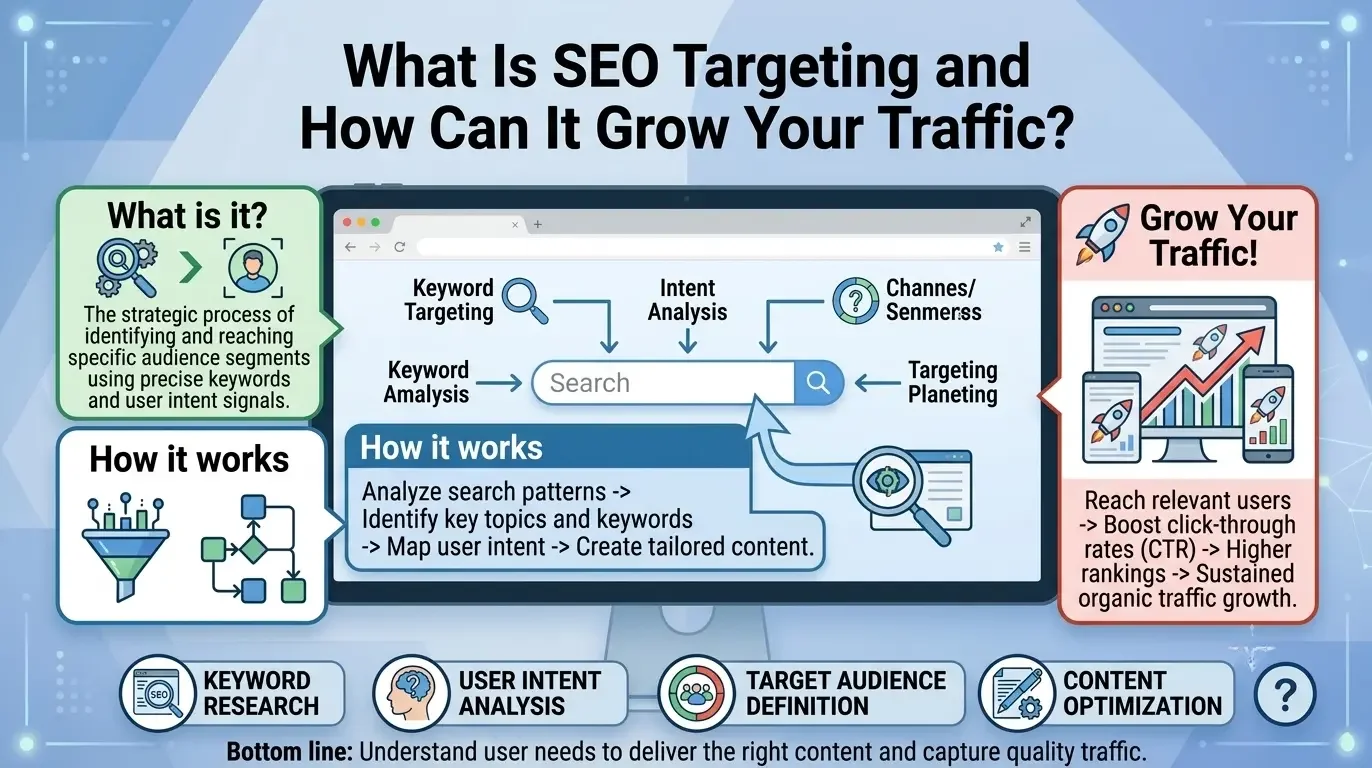
SEO targeting is the strategic endeavour of optimizing your website and content around particular search terms, user intents, audiences, locations, and the phase of the buyer's journey.
In simple words, it implies answering the question:
Who are we targeting in search, and what are they looking for?
Typically, SEO targeting involves:
- Choosing relevant keywords
- Understanding search intent
- Keyword mapping to the buyer journey.
- Producing content for target audiences
- Making pages relevant to their topic.
- Optimizing site structure and internal links.Enhancing the internal links and site structure.
- Monitoring rankings, clicks, conversions, and engagements
It isn't about increasing traffic numbers. The aim is to attract more highly targeted traffic. By choosing the right keywords, you can ensure your target audience can find you at the right time, when they need you.
For Example, a company that sells project management software does not necessarily want to target just general terms such as "productivity." Targeting a search by something such as "best project management software for remote teams", "how to manage agency projects", or "project tracking template for startups" may be a better SEO targeting strategy.
Those searches result in greater clarity of intent and a higher likelihood of attracting people who really need it.
Why SEO Targeting Matters?
If you don't target your SEO, it can become a guessing game. You can publish content, rank for some keywords, and generate traffic, but it cannot translate into business. You can produce content that doesn't target and result in leads, sales or true business growth. That's why it is always important to begin your SEO strategy with your audience and their search intent.
SEO targeting helps to provide direction to your strategy.
With the right searches, you can:
- Attract users who are actively looking for your solution
- Develop and create topical authority, that is, give people the sense of authority about your niche.
- Minimise efforts on unproductive keywords.
- Increase the conversion rate from organic traffic.
- Develop the content that's relevant to actual client inquiries
- Enhance and improve internal links.
- Reach more competitors in comparison to big websites
The goal of search engines is to provide results that are useful, relevant and trustworthy. SEO targeting enables you to create pages that align with your users' needs rather than what you think they need.
SEO Targeting vs. Keyword Targeting
While SEO targeting includes keyword targeting, it's not the same.
Targeting keywords are those words and phrases typed into search engines.
SEO targeting is a much wider thing. It takes all the factors into consideration when determining search, such as:
- Search intent
- Audience type
- Location
- Content format
- Funnel stage
- Topic depth
- Competition level
- Business value
For Example, businesses that do not sell email marketing tools do not need to focus on the term "email marketing". SEO targeting is more in-depth and asks:
- Does the searcher know the basics or is she a pro?
- Would they like a definition, a tool, a template or a comparison?
- Are they researching and/or interested in purchasing?
- What other types of questions does the content address?
- How can this page be improved upon over other results?
That's why modern SEO isn't all about keywords. It's all about significance, appropriateness, and functionality.
Main Types of SEO Targeting
1. Keyword Targeting
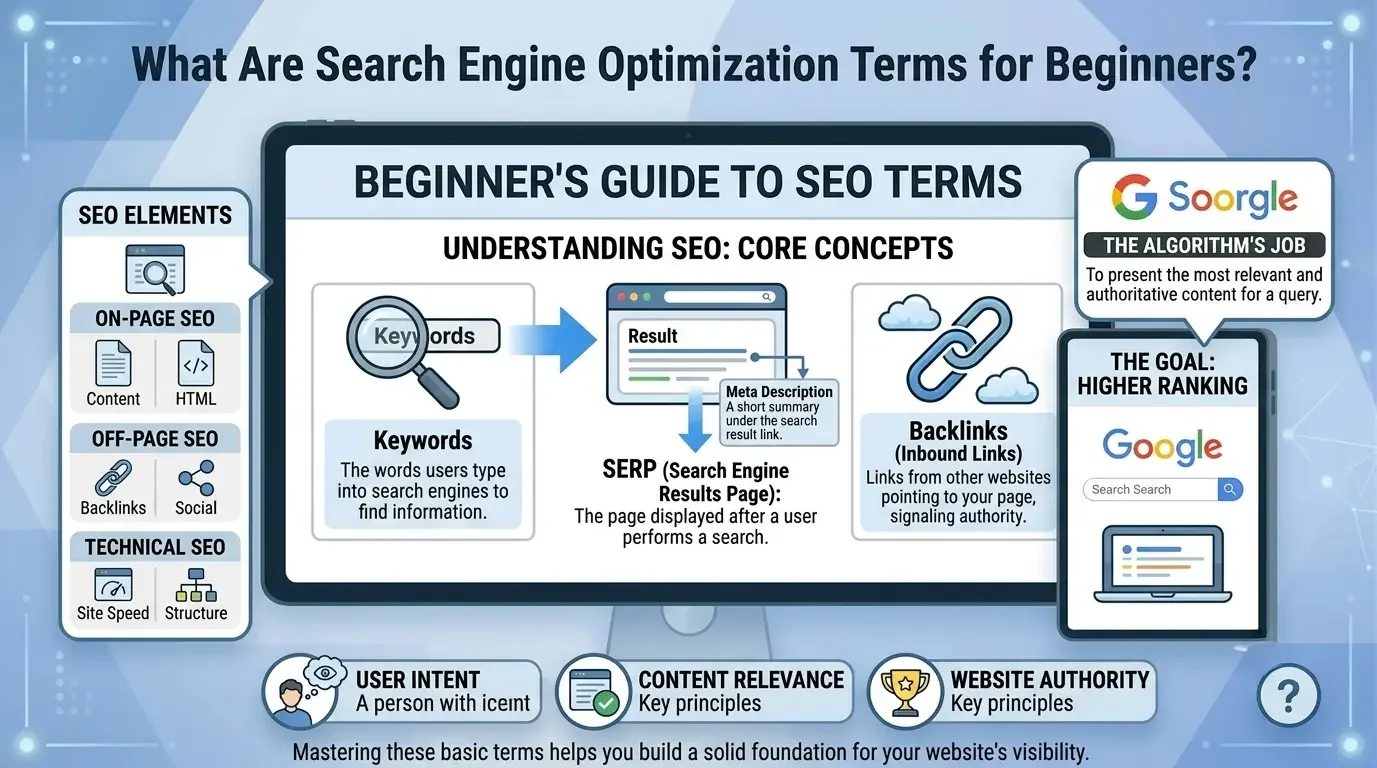
Keyword targeting is the first building block of SEO. It includes choosing keywords your target audience uses, and optimizing pages for those.
A good keyword targeting strategy includes:
- Primary keywords
- Secondary keywords
- Long-tail keywords
- Question-based keywords
- Entities and terms that can be linked to the current entity or term.
For Exaample, you can find words and phrases like search intent, keyword research, organic traffic, content optimization, and semantic SEO on a page that's targeting SEO targeting.
Long tail keywords are particularly desirable because they are more specific. While a keyword such as "SEO strategy for local service businesses" may not have as many search results as "SEO strategy," it may have a more qualified user base.
2. Search Intent Targeting
The reason for a search query is called search intent. There's no denying that comprehending intent is among the most crucial aspects of SEO targeting.
There are 4 types of search intent:
Informational intent: The user is looking to learn more.
For Example, "What is SEO targeting?
Navigate: The user is looking for a particular site or brand.
Google Search Console login
Commercial purpose: When the user is looking for something to buy.
Best SEO Tools for small businesses, for example.
Transactional intent: The user is prepared to make a transaction.
For Example, if you search for "hire SEO agency near me."
If you are not creating content for the keyword, it can be hard to rank or convert. For Example, a product page is not going to satisfy someone looking for "How does SEO targeting work?" The user is likely to require an educational article first. We help users find what they want by matching content to search intent. This will make your page more relevant, useful, and easy to follow, helping build trust.
3. Audience Targeting
Audience targeting is about who it is for the audience.
People can search the same word and want different results. A beginner looking for "SEO targeting" might want to learn a bit more about it, but a marketing manager may want a plan for an upcoming campaign.
To reach the audience, give the following definition:
- Their job or business
- Their knowledge level
- Their main problem
- Their decision-making stage
- The opposition or worries they might have
- The desired result they are seeking.
For Example, a SaaS SEO targeting guide might include topics like free trial signups, demo requests, product-led content, and competitor comparison pages. Local businesses will tend to pay more attention to Google Business Profile, local search terms, service pages, and reviews.
Your audience should think that the content was made for them. The better you understand their problem, the better you can develop content they can trust.
4. Location Targeting
For companies that cater to specific regions, location targeting is a key component.
Local SEO targeting can involve:
- City-based landing pages
- Service-area pages
- Local business listings
- The localized title tags and headings.
- These are reviews from customers in certain locations.
- Location-specific FAQs
A plumber in Austin, for instance, ought to focus on "emergency plumber" but also on a variety of other terms. Better phrases would contain Austin emergency plumber, 24-hour plumber Austin or water heater repair Austin, TX.
Website location targeting allows your website to appear in searches with local intent.
5. Funnel Stage Targeting
Not all searchers want to buy. Some are just learning, some are comparing, and some are ready to take action.
Creating content for each stage of the funnel is ideal for SEO targeting.
Top of funnel: Educational content.
For Example: "What is SEO targeting?"
Middle funnel: The middle of the funnel sees more content focusing on comparisons and solutions. More comparative and solution content.
For Example: SEO targeting vs PPC targeting
Bottom of funnel (B2F): pages that focus on conversion.
For Example: "SEO targeting services for B2B companies"
This is a great way to establish trust more quickly and drive conversions in the long run.
6. Semantic SEO Targeting
The fundamental idea behind semantic SEO is to target topics, context and meaning rather than just exact-match keywords.
Search engines are getting better at understanding relationships between words and concepts. This means that a good page should naturally address a topic without overusing a keyword.
Semantic optimization for SEO targeting can include:
- Covering related subtopics
- Answering common questions
- Using clear headings
- Incorporating terms and entities that are relevant
- Adding examples
- Structuring content logically
- The main page also contains a link to the supporting pages.
For Example, an SEO-targeted piece of content should also cover keyword research, search intent, audience targeting, content mapping, internal linking, and performance tracking. These concepts are related and help search engines and readers better comprehend the page.
How SEO Targeting Grows Your Traffic?
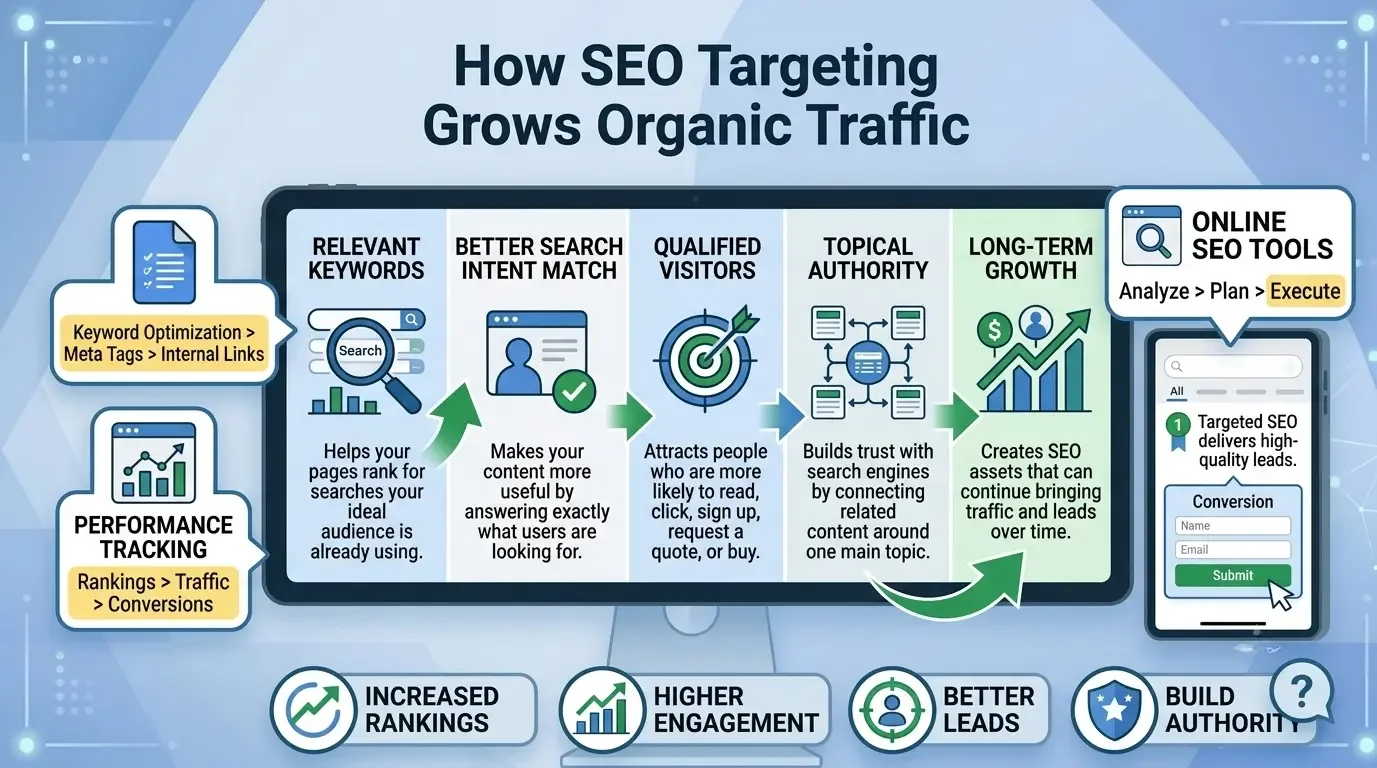
There are several ways SEO targeting can increase traffic.
It Helps You Rank for Relevant Keywords
The better you understand the target of each page, the more easily you can optimize titles, headings, content, internal links and metadata. This will make it more likely you will rank for keywords your audience is searching for.
Rather than produce generic materials, you produce pages with a specific purpose.
It Builds Topical Authority
It's not enough to publish one article on a specific topic. SEO targeting allows you to create groups of relevant content around main topics.
For Example, a site dedicated to SEO can develop a circle of content on "SEO strategy" including articles like:
- SEO targeting: What is it?
- The easiest way to learn how to do keyword research.
- How to understand search intent
- How to create topic clusters.
- SEO copywriting tips and tricks.How to optimize content for search engine optimization.
- Genuine traffic is crucial for the success of your social media campaigns.
As long as these pages are linked together with internal links, they reinforce each other's support for the site's topical authority.
It Attracts Better-Qualified Visitors
A larger flow of traffic is not necessarily a more desirable one.
These pages are linked together on the website, providing support and enhancing the site's topical authority.
If the visitors are not the right ones, it generates no leads.
By targeting SEO, you can attract traffic that's more likely to match your ideal customer profile. These visitors are more likely to read longer, click deeper, sign up or contact your business.
It Improves Content Relevance
It is easier to write and optimize a targeted page since it has a specific objective. You have identified the person(s) you are communicating with, what they need, and what you want them to do next.
This clarity enhances search functionality and user experience.
It Supports Long-Term Growth
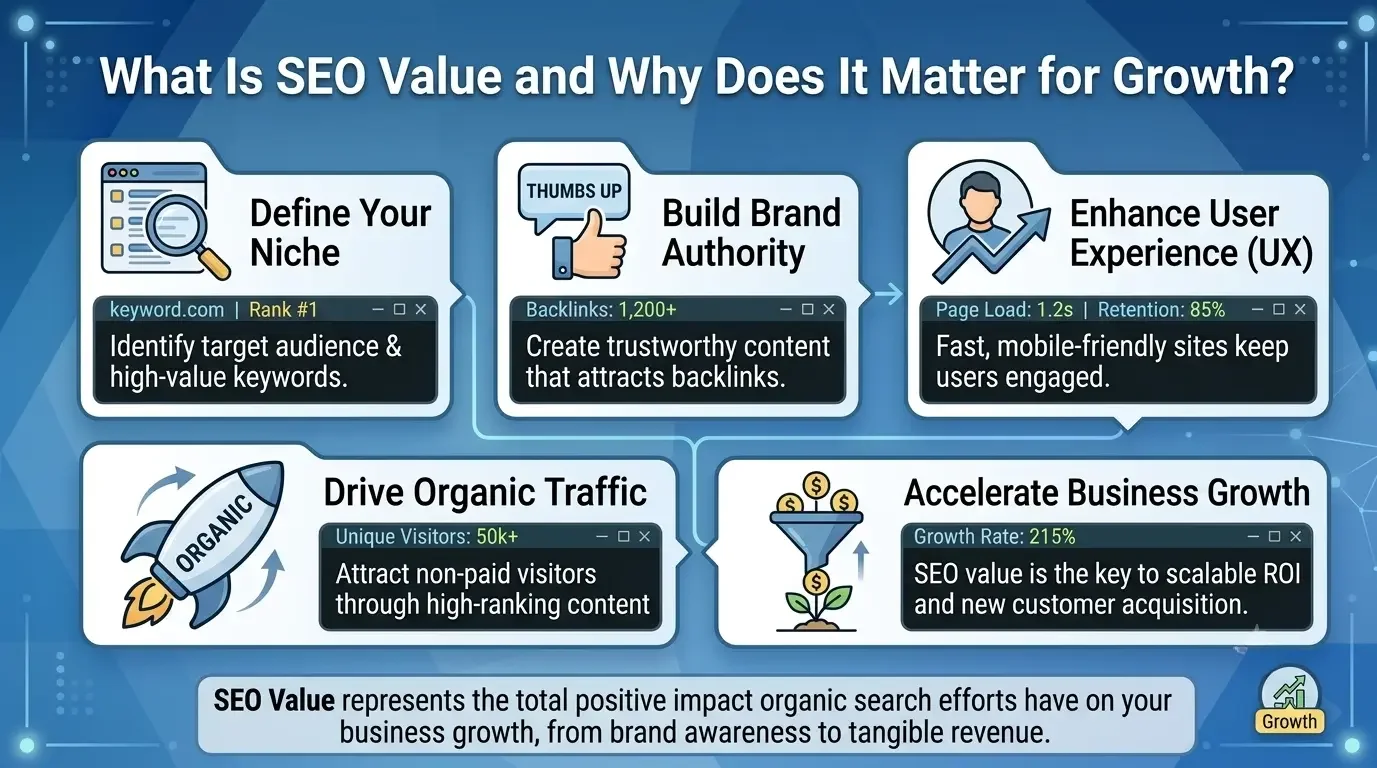
Paid traffic never ceases when your $$ stops. Your pages can continue to attract visitors through time if they're kept, updated and optimized to search demand.
SEO targeting enables you to create a repository of search-specific possessions that continue to generate traffic and leads.
How to Build an SEO Targeting Strategy?
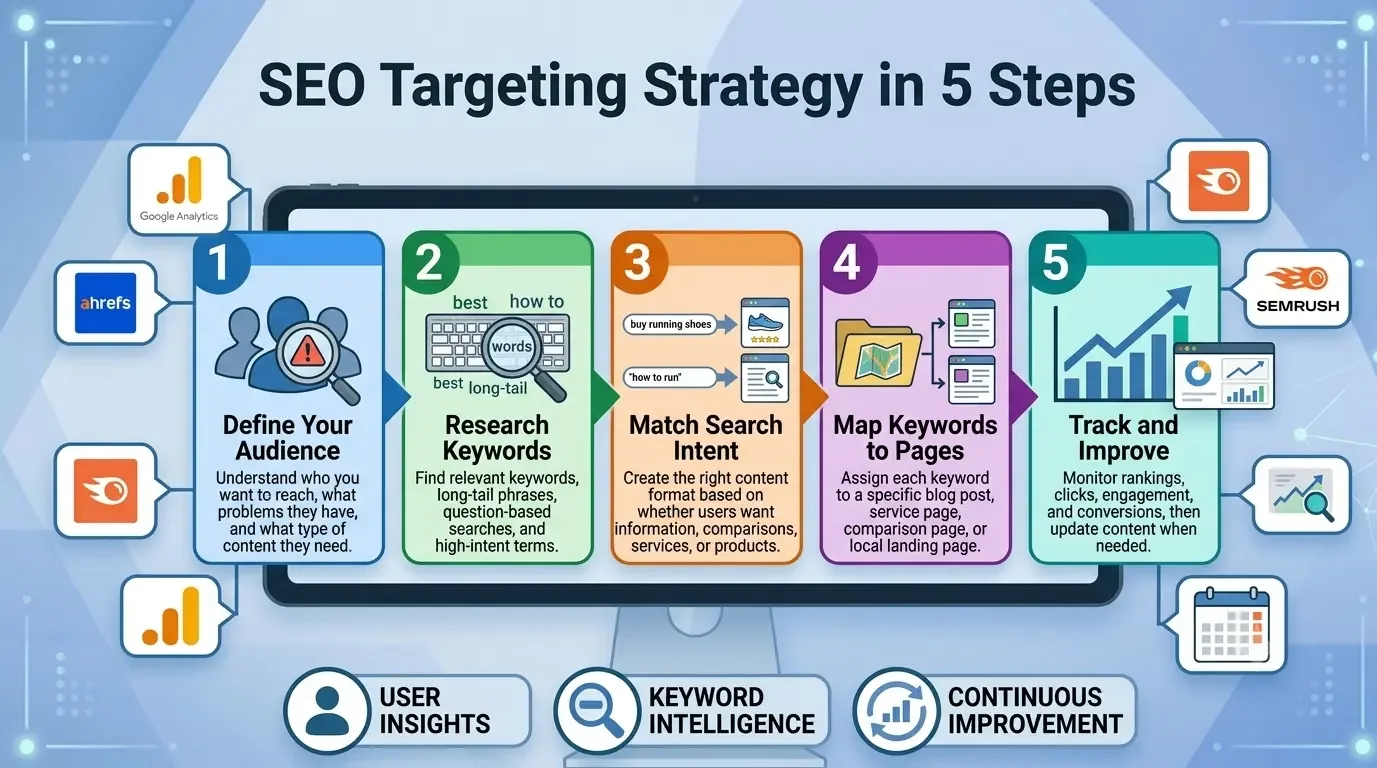
Step 1: Define Your Business Goals
Begin with the end in mind. Looking to generate more leads, product signups, calls, store visits, newsletter subscribers or sales?
Your SEO goals must be aligned with business value.
If you're looking for lead generation, you might want to focus on keywords that suggest they're looking for services, solutions, pricing, comparisons, or expert help.
Step 2: Identify Your Ideal Audience
Before picking keywords, determine who you'd like to target.
Ask:
- Who should read or buy the book?
- What is the issue they are attempting to resolve?
- What terms do they use when referring to this problem?
- How much do they know already?
- What factors would encourage them to believe your content?
This stops you from producing content that ranks but doesn't convert.
Step 3: Research Keywords and Topics
Research using keywords to determine what your audience wants.
Look for a mix of:
- High-intent keywords
- Long-tail keywords
- Question keywords
- Comparison keywords
- Problem-based keywords
- Keywords for products or services.
- If relevant, local keywords,
Never select keywords based on search volume. Think about the value of lower-volume keywords that have a high intent or relevance.
Step 4: Analyze Search Intent
While developing a page, check out what users expect from that search.
Analyze the present outcomes and question:
- Do the ranking pages include blog posts, product pages, category pages, or tools?
- Do users need a definition, a guide, a checklist, a comparison or a service?
- Are the top-ranking pages detailed?
- What is the context of the questions that are answered?
- What is missing, and what can you do to improve it?
This will help you decide on the type of content to post.
Step 5: Map Keywords to Pages
Each important keyword must have an explicit landing page.
Avoid targeting the same keyword with multiple similar pages. This can lead to keyword cannibalization, which means that your own pages will compete with one another.
A simple keyword map can consist of:
| Page Type | Example Keyword | Intent | Goal |
|---|---|---|---|
| Blog post | What is SEO targeting | Informational | Educate |
| Guide | SEO targeting strategy | Informational/commercial | Build authority |
| Service page | SEO targeting services | Transactional | Generate leads |
| Comparison page | SEO targeting vs PPC targeting | Commercial | Support decisions |
| Local page | SEO targeting agency in Chicago | Local/transactional | Capture local leads |
With keyword mapping, you can ensure that your SEO strategy is well organized and that there is no duplication.
Step 6: Create Content That Fully Answers the Query
Useful content is the key to good SEO targeting.
Your content should:
- Provide a clear answer to the main question.
- Cover related subtopics
- Use headings that are appropriate to the user.
- Include practical examples
- Avoid keyword stuffing
- Explain what steps to take next
- Be easy to scan and understand
Not all content is created equal, and the longest isn't necessarily the best. It's the content that best meets the searcher's intent.
Step 7: Optimize On-Page SEO
After writing content, optimize key on page elements.
Focus on:
- SEO title
- Meta description
- URL slug
- H1 heading
- H2 and H3 headings
- First paragraph
- Internal links
- For each time an image is used, provide an alternative text.
- When applicable, use schema markup.
Incorporate the main keyword in the relevant places, but not in every sentence.
Step 8: Build Internal Links
Internal links connect relevant information and guide users and search engines to other relevant information.
Strategically use links from high-ranking pages to important target pages. Connect within the same topic cluster on related articles.
For instance, an SEO targeting article might connect to pages on keyword research, technical SEO, content optimization, link building and SEO audit.
Employ descriptive anchor text. Avoid using 'click here' and replace that with a text such as 'keyword research guide' or 'content optimization checklist'.
Step 9: Measure Performance
It is important to consistently track SEO targeting efforts.
Track metrics such as:
- Keyword rankings
- Organic clicks
- Impressions
- Click-through rate
- Average position
- Engagement rate
- Conversions
- Assisted conversions
- How much money or how many leads are you generating?
Traffic alone isn't the answer. It's better to have some qualified traffic than a lot of irrelevant traffic. Traffic is not an accurate measure of SEO. Consider whether your visitors are taking meaningful action, such as reading more pages, signing up, calling or requesting a quote.
Step 10: Refresh and Improve Content
SEO targeting isn't a one-time activity. Search habits, rivals and business goals evolve.
Update content when:
- Rankings decline
- Search intent changes
- Information becomes outdated
- They get better results from the competitors when they write more compelling content.
- New questions appear
- Your product/service is different.
Sometimes it's much quicker to update existing pages than to make them from scratch.
Common SEO Targeting Mistakes
Targeting Keywords That Are Too Broad
The advantage of using broad keywords is that they can generate high search volume, but they are generally more competitive and have a lower conversion rate. Certain keywords are more likely to yield good results.
Ignoring Search Intent
Even a well-written page can fail if it isn't what the searcher is looking for. Always match content to purpose.
Creating Multiple Pages for the Same Keyword
If there are too many similar pages, it can confuse search engines and negatively impact performance. Assign each page a different function.
Optimizing Only for Search Engines
The purpose of SEO targeting is to enhance the user experience, not to game search engine rankings. Content should be helpful, understandable, and credible.
Forgetting About Conversion
If it's not for a reason, organic traffic is worthless. Include relevant calls to action, internal links, forms, product links or next-step content.
SEO Targeting Example
Now, let's say you have an accounting software company that sells to freelancers.
An ineffective SEO strategy would include targeting broad keywords such as:
- accounting
- invoices
- bookkeeping
A better SEO targeting strategy would be to target more specific searches like:
- Business accounting software for freelance professionals
- How to track freelance income?
- Best invoicing software for freelancers and self-employed people.
- Freelance Tax Deduction Checklist
- Bookkeeping tips for freelancers
These keywords are more related to the audience, their issues, and the business's product.
The company could then build a content cluster consisting of educational guides, comparison pages, templates, and product-led articles. This can then attract relevant visitors and encourage them to register.
Best Practices for SEO Targeting
You can obtain better results from SEO targeting by following these principles:
- Begin with your audience's needs, not just the keywords.
- Match each page with a specific search query
- Target long-tail keywords for targeted traffic
- Create topic clusters rather than individual posts.
- Don't repeat keywords for the sake of it, but rather for meaning.
- Link pages together with internal links
- Maintain accurate, useful and up-to-date content
- Analyze conversions, rather than traffic
- Enhance existing pages prior to developing too many new ones.
Targeting is most effective when the strategy aligns with the content and user experience.SEO targeting is most effective when it's directed towards real humans, and not just search engines. By knowing your audience's needs and providing content that truly adds value, you can establish trust, improve your rankings and gain more organic traffic.
Interesting Research Facts
Full citations are in Sources below.
First-page rankings capture most traffic
The websites that get ranked on the first page of Google get 71.33% of all the organic search traffic.
SEO adoption boosts traffic
Companies that implemented SEO saw a 40% increase in organic traffic.
Top 3 rankings get the most clicks
58.4% of SERP traffic comes from the top 3 positions.
SEO is a leading traffic channel
Many digital channels are not as effective as organic search it generates as much as 53% of website traffic.
Search captures purchase intent
89% of customers use a search engine to research products, services, or businesses before making a purchase.
Frequently Asked Questions
1. What is SEO targeting in simple terms?
SEO targeting involves selecting the right keywords, audience, location, and search intent to ensure that your content is seen by those who are searching for it.
2. SEO targeting is the same as keyword targeting?
No. Keyword targeting does not take user intent, audience type, funnel stage, content format or value of the business into consideration, whereas SEO targeting does.
3. One keyword or many keywords on a page?
One main keyword is adequate for a page, but other keywords, questions, and subtopics can be included as long as they share the same search intent.
4. How to find the right keywords to target?
Select keywords relevant to them, with intent, not too competitive, and with value to the business. Don't just look for products with lots of searches.
5. What is the reason for getting impressions but no clicks?
Generally, this indicates that your page is ranking in search results, but your title, meta description, ranking position or search intent may need to be improved.
6. How does search intent impact SEO targeting?
Search intent is your indicator of what the searcher is looking for. Providing the appropriate content structure to meet the intended purpose is a great way to improve your page rank and boost your conversion rate.
7. Is there a need for local businesses to target SEO?
Yes. It's important to use keywords and phrases that are specific to the city, service area pages, local FAQs, reviews, and location-specific search terms in your local marketing.
8. Which of the following is true about internal links and SEO targeting?
Internal links link similar pages together, lead users to other helpful information and let search engines know the structure of your site and what it is about.
9. How often is often enough to update targeted SEO content?
Update content as necessary if rankings fall, if search intent changes, if competitor pages get better or if information is outdated.
How we reviewed this article:
Share this article