What Is SEO Value and Why Does It Matter for Growth?
Discover the meaning of SEO value, its importance, how to measure and enhance organic traffic, trust, conversions and ultimately business growth.
Quick Summary
- The true business benefits of your website's organic search results are reflected in SEO value, such as visibility, traffic, trust, engagement, leads, and sales.
- It is not simply more visitors that help draw in the right people who are more likely to convert; it is the qualified visitors.
- We develop SEO value with beneficial content, keyword relevance, search intent, technical performance, backlinks, and a smooth user experience.
- SEO value can be quantified using organic traffic, keyword ranking, CTR, engagement, conversions, lead quality, revenue and more.
- To boost SEO value, outdated information ought to be updated, enterprise-centric keywords ought to be targeted, internal linking ought to be strengthened, technical SEO ought to be improved, and trustworthy information ought to be created.
What Is SEO Value?
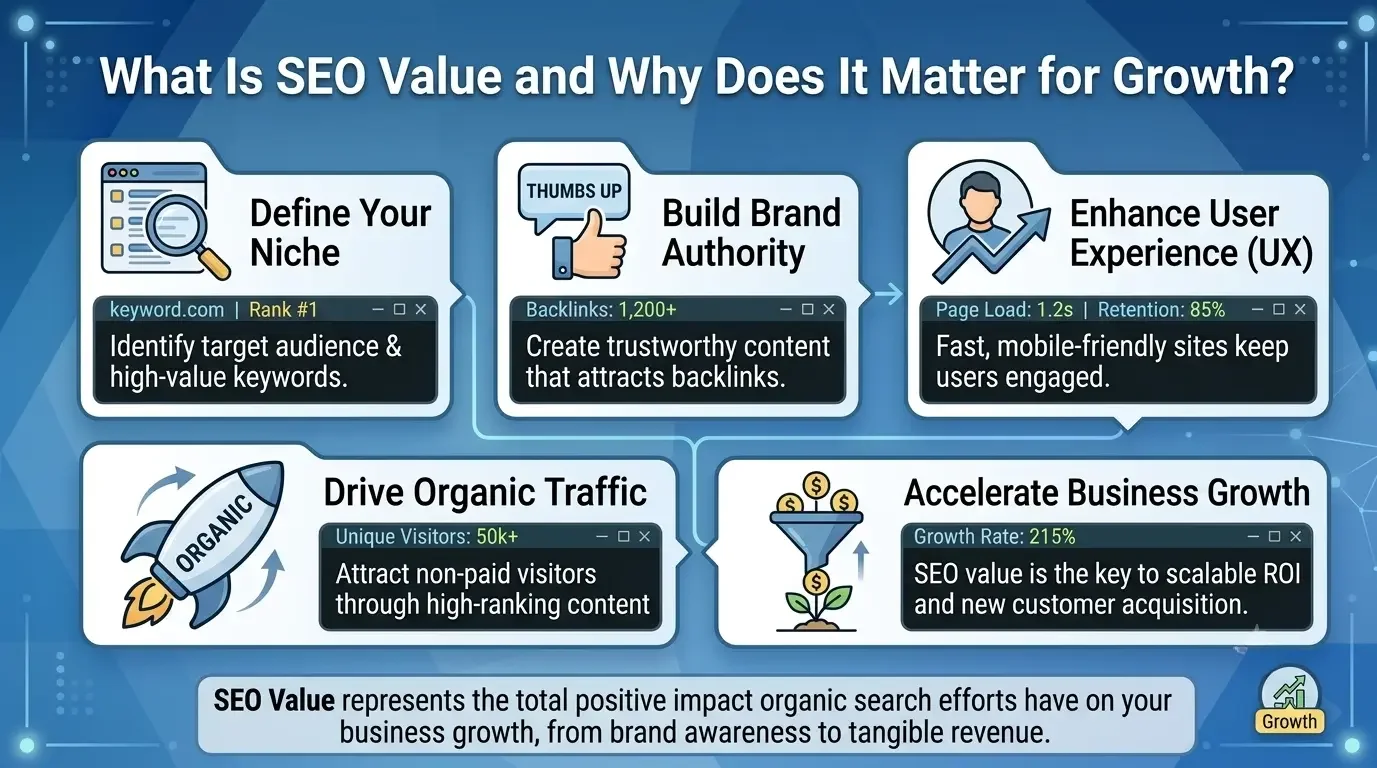
The value a website gains from being optimised for search engines and users is known as the website's SEO value. It encompasses visibility, traffic, trust, engagement, and conversions resulting from high search rankings for targeted keywords.
SEO value is a straightforward answer to a single question:
What's the value of the business impact of organic search?
SEO content on a page does more than drive clicks. Fulfils a clear purpose, matches search intent, offers useful information, and aids the user to take the next step. It might be reading another article, subscribing to a newsletter, getting a quote, taking a demo, or even making a purchase.
SEO value may be derived from a variety of sources, such as:
- Improved ranking for keywords relevant to the site.
- Increased organic traffic
- Increased click-through rates from search results.
- Improved brand visibility
- Stronger topical authority
- More backlinks and referral signals
- Increased engagement, decreased bounce rates
- Increased organic traffic
When content, technical performance, user experience, and business goals align, the SEO value is greatest. In this guide, we'll see how you can view SEO value from a practical business perspective. We want you to understand the importance of using organic search to attract the right visitors, build trust, and drive real growth.
Why SEO Value Matters for Growth?
This is why SEO value is important – organic search is one of the most cost-effective and scalable growth channels. Search engines are intended to help people find answers, make comparisons, solve problems, or get ready to purchase. When you rank in such instances, you are given a direct opportunity to make a decision.
There are several ways a website with a high SEO value can help grow.
1. It Increases Long-Term Organic Visibility
Search visibility is among the most apparent indications of SEO worth. Having a page rank for keywords that are important to you puts your brand in front of users who are already looking for the type of products, services or expertise you offer.
This visibility builds up over time. If your page is useful, accurate, and continues to meet search intent, it can drive traffic for months or even years after it's created.
This gives growth-oriented companies an edge in the long term. As opposed to paid campaigns, SEO creates a sustainable traffic lane that can continue to drive leads, awareness and sales.
2. It Attracts Qualified Traffic
Not every traffic is the same. Thousands of visitors may come to a website, but it may not have much impact on the business if they are not the right audience.
The quality of traffic is the key to SEO value. The aim is not just to target high-volume keywords. The aim is to compete for keywords that are relevant to your ideal customers and align with their interests.
A software company, for instance, might be more inclined to rank for the phrase, "best project management tool for agencies," than for the general term, "project management." The first one has a clearer intent and will be more engaging for users, bringing them closer to making a decision.
Organic traffic is also valuable because those who are looking for it are already looking for something you can solve, a question you can answer, or a problem you can solve.
3. It Builds Brand Authority and Trust
Users tend to equate high ranking with credibility. If your website consistently ranks for key keywords in your niche, you're presenting yourself as an expert and trustworthy source.
This is where topical authority becomes important. An in-depth, clear and consistent site will be viewed as a trusted resource. Search engines also use several signals to determine whether a website contains valuable, reliable information.
Content designed to demonstrate expertise, answer real questions, and guide users throughout their journey has strong SEO value. This can build your brand's credibility and increase customer loyalty compared to other brands. If you can publish clear, useful and accurate content, people will have a reason to trust your brand. We feel that great SEO content doesn't just rank; it should guide your audience to make better decisions.
4. It Improves the Customer Journey
SEO isn't all about driving traffic to your website. It also assists in navigating them through the customer journey.
Users have varying intent when they search. Some are in the process of learning about a problem. Others are proposing answers. Some are willing to pay. With a strong SEO strategy, content is developed at every stage.
Common stages include:
Awareness: User is aware of a problem or subject.
Consideration: Customer(s) are comparing solutions, tools, services, or approaches.
Decision: Users are ready to take action; they need proof, pricing or trust signals.
Once your website has optimised content at all stages, it will be easier to convert visitors. This is beneficial for your site, as it contributes to overall SEO value, since organic search plays a role in the entire growth journey.
5. It Reduces Dependence on Paid Advertising
Paid advertising can be effective, but it will require ongoing investment to maintain momentum. After campaigns, traffic typically declines significantly.
SEO works differently. It takes time and effort to develop, but as long as it is there, organic rankings can continue to provide value without paying for each click. This is a great way to make SEO a strong marketing tool to improve marketing efficiency.
This is not to imply that SEO is utterly free. Needs strategy investment, content investment, technical optimisation investment, link building investment, and maintenance investment. But over the long haul, it can mean big returns, as good pages can deliver more remnant visits and conversions.
6. It Supports Higher Conversion Potential
Organic traffic can turn into leads, which can be incredibly powerful for SEO value. If your page ranks well but does not help your users take action, your business value is limited.
Conversion-focused SEO aligns search intent with action. This implies that each significant web page must have a function. Information pages can prompt consumers to follow links to other information or to subscribe to an e-mail list. Users might be encouraged to seek a consultation on service pages. Product pages can lead users to purchase.
The following are the key elements of SEO content that can boost conversion value:
- Successful answers to the user's primary question.
- Strong internal links
- Useful call-to-action phrases.
- Check out reviews, case studies, or certifications.
- Fast loading speed
- Mobile-friendly design
- Simple page structure
The alignment of search visibility and conversion optimisation makes SEO a direct growth driver.
Key Factors That Create SEO Value
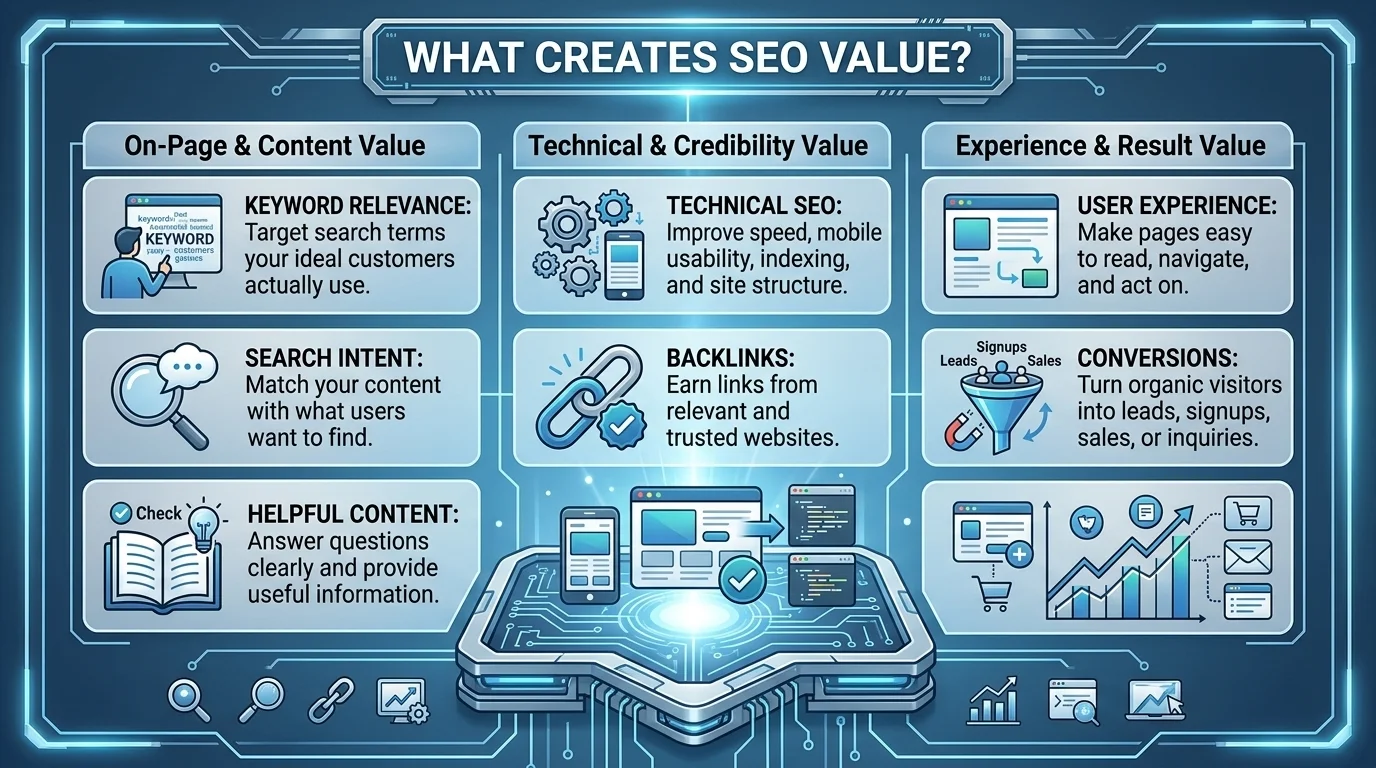
There are a few interrelated factors that contribute to the value of an SEO. Focusing on a single component of a project rather than the others generally yields smaller results.
Keyword Relevance
But while keywords are still important, contemporary SEO isn't about stuffed-up pages with exact phrases. It's all about the topics, questions and purpose behind those keywords.
The keyword you choose should be relevant to your readers and your business, and feasible given your site's ranking. The optimal keywords tend to be a compromise between search volume and conversion rates.
Search Intent
Search intent is the motive behind a user's search query. If someone is looking for "what is SEO value," they want an answer. People who look up "SEO agency pricing" are likely to be one step nearer to hiring an SEO agency.
SEO value means being able to match the search intent. Content that doesn't meet your users' expectations won't be well ranked or achieve high conversion rates.
Content Quality
It's clear, helpful, original and complete enough to answer the user's question, and of high quality. It should not be fluffy, repetitive, or general advice.
Most good content that has a good SEO score typically includes:
- A clear main topic
- Well-organised headings
- Practical explanations
- Related subtopics
- Internal links to useful pages
- Up-to-date and correct information
- Applying appropriate, contextually suitable terms.
The aim is to provide the user with content better than any other page out there.
Technical SEO
Technical SEO helps search engines navigate, index, and understand your site. Technical problems can make it impossible for search engines to access even great content properly.
Important technical SEO factors:
- Fast page speed
- Mobile usability
- Clean URL structure
- Secure HTTPS connection
- Proper indexing
- XML sitemaps
- Structured data
- Addressing broken links and redirections.
Technical health keeps and strengthens your website's SEO.
Backlinks and Authority
Backlinks are links that are provided for your pages by other websites. They can help develop authority, particularly from relevant, trusted sources.
But the quality of backlinks is more important than quantity. Several high-quality backlinks from trusted sites in your niche can be more beneficial than numerous low-quality ones.
Mention, useful content, expert information, and regularity in your topic area are also sources of authority.
User Experience
Search engines are looking for pages that enrich the user experience. If visitors leave rapidly if a page is slow, confusing, or unhelpful, the page may not work very well.
User experience helps boost the SEO value of your website by ensuring that visitors can easily access information, trust your branding, and make a decision.
The following are important aspects of user experience:
- Clear navigation
- Readable formatting
- Fast loading pages
- Mobile-friendly layouts
- Helpful internal links
- Minimal distractions
- A clear call to action is present.
SEO and user experience should go hand in hand, not against each other.
How to Measure SEO Value?
It is necessary to monitor beyond ranking to grasp SEO value. While rankings are helpful, they don't indicate the complete business impact of organic search. When evaluating SEO value, it is essential to consider more than just rankings. It is suggested to use organic traffic, engagement, conversion, and lead quality in conjunction to understand the true impact of SEO efforts.
Some of the most significant SEO value metrics are:
Organic Traffic
The number of visitors to your website from unpaid search results is called organic traffic. When you see an increase in organic traffic, that's definitely a good indicator of rising visibility.
But always, traffic must be analysed in terms of relevance and conversions.
Keyword Rankings
Keyword ranking helps you determine the position of your pages in the search results for the desired keywords. Rankings show the improvement or deterioration in visibility for important topics, helping you understand whether your SEO strategy is working.
Pay attention to keywords that are important to your business, rather than the most popular ones.
Click-Through Rate
Click-through rate refers to the number of times your result is displayed in search results, and the number of times people click it. If you're having a low click-through rate, it could be that your title tag or meta description is not compelling enough. Optimising titles and descriptions can boost traffic without impacting page ranking.
Conversions
One of the key measures of SEO value is the number of conversions. Conversions can be any action taken by your visitors, such as purchasing a product, completing a form, calling your business, requesting a demo, downloading or signing up for a newsletter. Direct traffic that converts brings direct value to the business.
Revenue or Lead Value
If it is an e-commerce or lead website, revenue or lead value is a better measure of SEO performance. Organic search is driving high-quality leads or sales, directly contributing to growth.
Engagement Metrics
Engagement metrics are useful for indicating if your content is useful to users. Some of these could be the average engagement time, pages per session, scroll depth, and return visits. If your article receives a lot of engagement, it likely means it meets your users' needs.
Backlink Growth
Backlink development indicates whether other web pages consider your information valuable enough to link to. Relevant backlinks can boost future authority and ranking.
How to Increase SEO Value?
Optimising the SEO value needs a strategic approach. The aim isn't to post unthinkingly. The aim is to enhance the overall quality, relevance and performance of your website.
1. Target Keywords With Business Intent
Select keywords that relate to people's needs and your business goals. Awareness keywords can help you build awareness, whereas commercial and transactional keywords can improve conversion rates. Both are part of a balanced SEO strategy.
2. Build Topic Clusters
Topic clusters help search engines and users by conveying a sense of your expertise. A topic cluster typically consists of a single pillar page and multiple supporting pages that address subtopics of the main page.
For example, a business website that writes about SEO might produce a pillar page titled "SEO strategy" and articles on keyword research, technical SEO, on-page SEO, link building, and SEO reporting.
This creates more internal links, depth and topical relevance.
3. Update Existing Content
There are already pages on many websites with untapped SEO potential. It may be quicker and more efficient to update existing pages rather than creating new ones.
Changes could involve:
- Adding missing subtopics
- Improving clarity
- Refreshing outdated information
- Optimizing headings
- Strengthening internal links
- Improving title tags and meta descriptions
- Incorporating improved CTA's
Frequent updates to the content help maintain rankings and boost performance.
4. Improve Internal Linking
Internal links connect related pieces of content for users to find, and structure your website for search engines. A well-implemented internal linking structure can share authority to key pages, enhance crawlability and help to maintain users on the website for a longer time.
Write descriptive anchor text that describes what the link page is about.
5. Optimise for Search Intent
Before developing or editing a page, review the expectations users have for what they are looking for when they search for the target keyword. Check out what types of content have good rankings. Is it a guide, a list, a comparison, a product page, a service page, or a definition?
Then develop content that ranks higher than competitors' for that intent.
6. Strengthen Technical Performance
Technical SEO issues can reduce the value of your content. Periodic audits can help uncover issues such as slow pages, broken links, duplicate pages, crawl errors, and indexing issues.
A technically robust site will have a greater chance of each page performing well.
7. Create Content That Earns Links
If you're able to get links from other sites, it's probably because your content is original. This could take the form of research, statistics, expert commentary, a template, a detailed guide, tools, or unique insights.
The more helpful and informative your content can be, the more likely you are to earn links.
SEO Value vs SEO Traffic
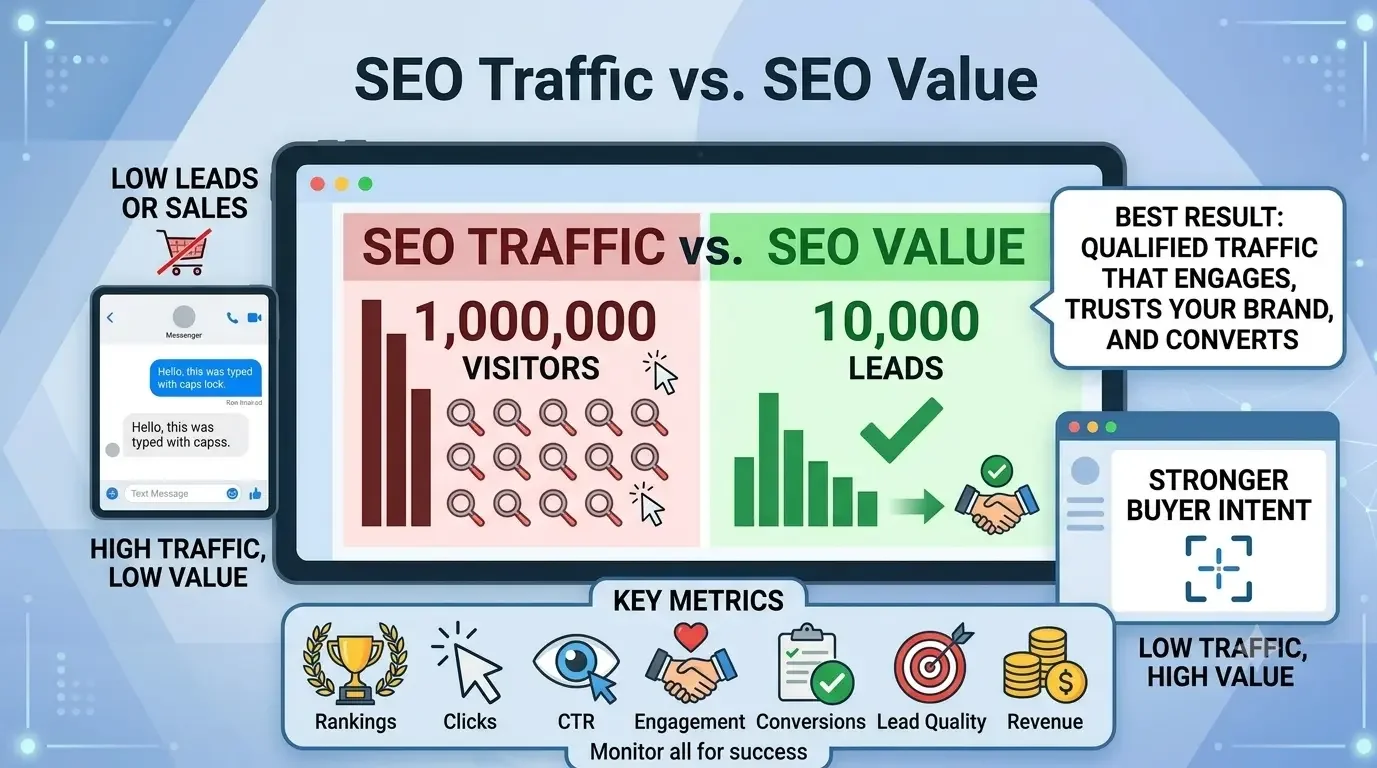
There is a relationship between SEO traffic and SEO value, but they aren't the same.
SEO traffic is the number of organic search users who visit your site. The value of each of those visitors to your objectives is known as SEO worth.
If the first page receives 1,000 visitors each month, with no visitors converting, it may not generate as much business as a second page that receives 200 visitors monthly and converts qualified leads. That's why traffic volume should not be the only measure of success for growth-focused SEO.
The top SEO tactics are all about attracting the right visitors and getting them to take worthwhile actions.
Common Mistakes That Reduce SEO Value
There are several pitfalls to doing a successful SEO:
A common error is focusing on keywords simply because of their popularity. If it doesn't match with your audience or business, then the traffic might not convert.
Another error is providing thin content that is similar to what is already available online. Search engines and users will love really useful content.
Technical issues can also hurt the SEO value. Good content can't rank well if it's slow, has indexing issues, or broken links.
Lastly, many businesses don't relate SEO to conversion strategy. It's good to be seen highly, but the page needs to lead the user on to the next step.
Interesting Research Facts
Full citations are in Sources below.
First-page rankings create the most SEO value
71.33% of organic search traffic is captured by websites on the first page of Google, and our SEO value relies heavily on that position.
SEO can increase traffic and revenue
A study by retail SME review revealed that with robust SEO, website traffic can rise by up to 30%, CTR by 20%-40%, and revenue growth by 25%.
Search often starts the buyer journey
Over 85% of online transactions start with a search – we could be impacting the buyer before they compare or buy.
Top-three rankings matter most
It's estimated that 60%-86% of users click the top three organic results, which means that the highest SEO value is likely to be found by climbing past the first page and into the top three.
Organic results build stronger trust
Over 77% of users will trust links found naturally on the page more than sponsored ads, and SEO is not just about traffic.
Frequently Asked Questions
1. What is the worth of SEO?
SEO value refers to the results you can expect from your website with regard to organic search traffic, leads, conversions, trust and revenue.
2. In essence, is SEO worth the same as organic traffic?
No, organic traffic indicates the number of visitors to your site, and the value of SEO indicates how much it contributes to your business growth.
3. What is the value of an SEO?
There are a number of ways to measure SEO value: rankings, clicks, CTR, organic traffic, engagement, conversions, lead quality, revenue, and more.
4. So does content really provide SEO value?
Yes. It's helpful content that delivers SEO value by meeting search intent, answering questions, establishing trust, and directing users to the next action.
5. Are backlinks still relevant?
Yes, but quality is more important than quantity. Suitable backlinks from reputable sites can boost authority, referral traffic, and ranking potential.
6. So why is traffic being directed to a page without any conversions?
A page can be the wrong audience, the wrong keywords, with no trust signals, and have no next action.
7. Is it possible for a page to have a high SEO score if it does not have a high amount of traffic?
Yes. Yet a low-traffic page could be useful if it attracts qualified traffic more likely to convert into leads or customers.
8. Does social media traffic contribute towards the SEO value?
Social traffic isn't a replacement for SEO, but it can help improve visibility, brand awareness, referral traffic and engagement.
9. What causes sharp declines in rankings?
There are a number of reasons why rankings might decline, including algorithm updates, technical problems, ageing content, more competitive sites, loss of backlinks, and shifting search intent.
10. What are ways to boost the value of my website with SEO?
To boost SEO value, one can focus on selecting better keywords, enhancing content, updating old pages, fixing technical issues, and adding more compelling calls to action.
How we reviewed this article:
Share this article