What Is the Best Paragraph Word Count Guide for SEO?
Know the ideal length of paragraphs for SEO, how shorter, concentrated paragraphs enhance mobile UX, readability and content performance.
Quick Summary
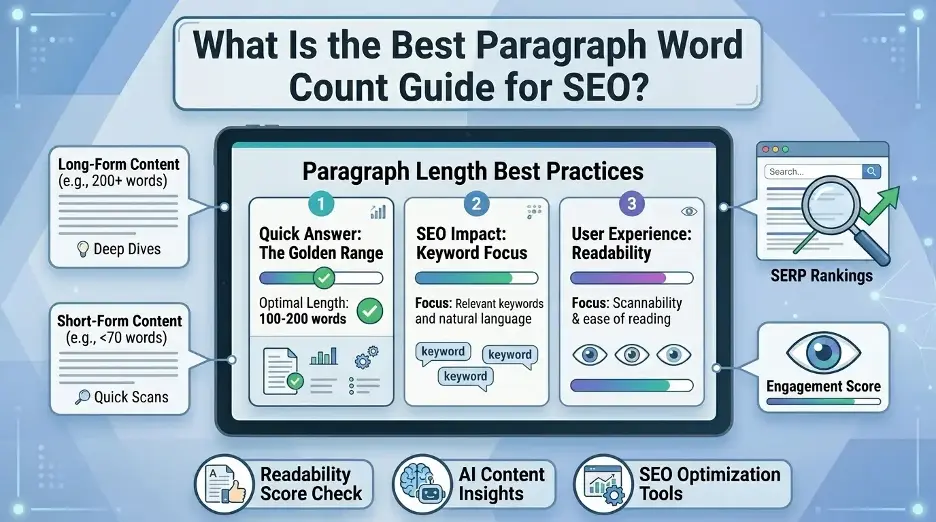
- For blog posts, consider paragraphs that are 40-100 words; for landing pages and product descriptions, aim for shorter lengths around 20-60 words to maintain the message's clarity and directness.
- While paragraph length isn't a direct SEO ranking factor, it does play a role in how readable, engaging, mobile friendly and findable a page is, and thus can impact a page's ranking.
- The shorter the paragraph the better the user experience, as online readers don't read from the top to the bottom of a page but scan first.
- The one idea rule is paramount, rather than exact word count. There should be one distinct point explained in each paragraph. When having a definition, benefit, example and tip all in one paragraph, this is generally best broken up into smaller paragraphs.
- SEO paragraphs must provide the answer and incorporate clear sentences, keywords that are relevant and not forced into the text, and lend clarity and flow to the reader.
The Ideal Paragraph Word Count for SEO
For most SEO content, use this simple guide:
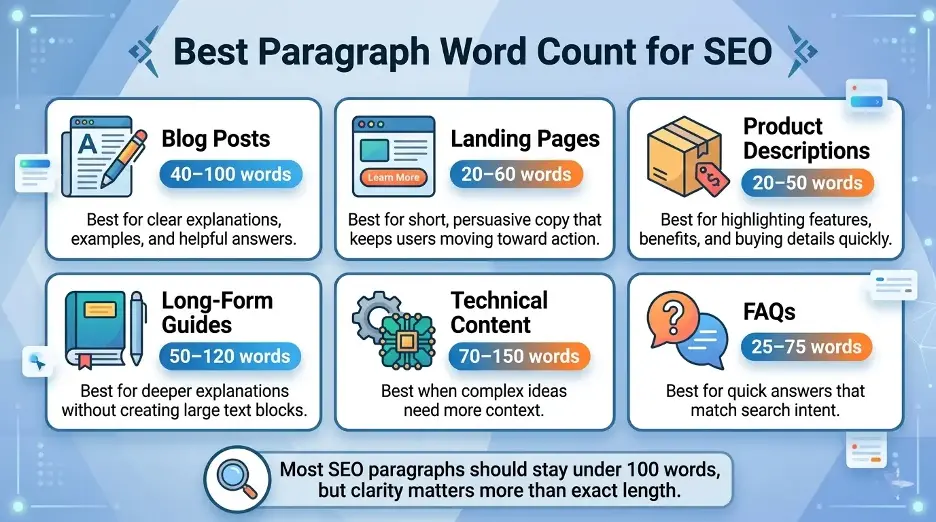
| Content Type | Recommended Paragraph Length |
|---|---|
| Blog posts | 40–100 words |
| Landing pages | 20–60 words |
| Product descriptions | 20–50 words |
| Long-form guides | 50–120 words |
| Technical explanations | 70–150 words |
| Introductions | 30–80 words |
| FAQs | 25–75 words |
Generally, a paragraph is only about 100 words long. Long paragraphs are OK if the topic requires a greater explanation, but should be readable and centered on a single point.
When a paragraph exceeds 150-200 words, consider if it contains more than one idea. If it does, divide it in half.While I use paragraph word count as a guide to readability, it's not a hard SEO rule. The aim is to guide readers along the text and get them the answers they are seeking without being overwhelmed.
Does Paragraph Word Count Directly Affect SEO?
Unlike other factors like title tags, crawlability, internal links, content relevance, or others that directly affect performance, paragraph word count does not directly affect SEO rankings. Having 75 words in each paragraph doesn't help the page rank higher.Despite all of that, the length of paragraphs can still impact your SEO performance due to the effect it has on visitors' behavior.
Short paragraphs with only one idea per paragraph allow readers to:
- Quickly scan the page.
- Read the gist of a story quickly
- Stay engaged longer
- Find answers without frustration
- Read on mobile devices
These signals are important because SEO is inherently linked to search intent. Those who arrive at a page and are overwhelmed right off the bat are less likely to read, click, share, convert, and trust the content.I don't want you to try to use the same number of words for each paragraph. Rather, I consider the explanations of each paragraph to be one idea, and whether the reader understands the subject more quickly.
Why Shorter Paragraphs Often Work Better for SEO
Online readers don't read each and every word on a website from top to bottom. The majority of users are scanning first. Headings, bold phrases, short sections, lists, examples, and direct answers are all things that they are searching for.
This will be easier to do with shorter paragraphs.
Long passages of text may be hard to read before they begin. This is particularly the case on mobile – a 100 word paragraph can look longer than it is on desktop.
The content flow is also enhanced with shorter paragraphs. They provide natural pauses, aid in the separation of ideas, and help to make complex information more digestible.
Clarity, not density, is more important for SEO writing. A short paragraph that answers the question is better than a long paragraph that evokes the question.
Best Paragraph Length by Search Intent
The right paragraph word count depends on the purpose of the page. Different search intents require different content formats.
| Content Type | Best Paragraph Word Count | Best Use |
|---|---|---|
| Informational content | 40–100 words | Explaining definitions, examples, steps, and FAQs clearly |
| Commercial content | 30–80 words | Comparing tools, services, features, benefits, and drawbacks |
| Transactional content | 20–60 words | Keeping product, service, and landing page copy direct |
| Technical content | 70–150 words | Explaining complex ideas with enough context and clarity |
The One-Idea Rule for SEO Paragraphs
The one-idea rule is followed by the best SEO paragraphs, which explain one main point in each paragraph.
This is more significant than a particular word count.
Do not give a definition, explain a benefit, compare two methods, and provide an example in one paragraph. This generates friction and makes it more difficult to understand.
The following is a better structure:
- The purpose of paragraph 1 is to define the concept.
- Paragraph 2: Describe why it is important
- Paragraph 3 Replace the given word with an example.
- Include a practical suggestion in paragraph 4.
This will make it easier for search engines and readers to understand your content and improve readability.As a rule, I take an objective look at SEO content and split paragraphs when they contain too much information. This helps the content be more easily understood, more valuable, and more reliable.
How Paragraph Length Supports Semantic SEO?
Semantic SEO is not keyword repetition but more about comprehensiveness and clarity. Length of paragraphs is important because well-structured paragraphs help to organize related ideas.
For Example, if you were writing an article about paragraph word count for SEO, you should discuss the following concepts:
- SEO readability
- Search intent
- User experience
- Content structure
- Mobile readability
- Scannability
- Heading hierarchy
- Blog formatting
- Dwell time
- Content quality
- Featured snippets
- On-page SEO
Each idea in relation should be put to its own line. It helps the article to be balanced and avoids repetition.
Avoid stuffing the same keyword phrase (paragraph word count for SEO) into each section, but rather use natural variations like SEO paragraph length, ideal paragraph size, readable content, or short paragraphs for web writing. ”
Recommended Paragraph Structure for SEO
A good SEO paragraph typically consists of three elements:
- A clearly stated topic sentence.
- A useful explanation
- A connection or bridge sentence (also called a supporting detail).
Example:
“Short paragraphs make it easier for your content to be read by search engines and are easier to scan for readers, which means they will likely stay on your page and continue reading — particularly on mobile devices, where large blocks of text can be intimidating.
This paragraph is effective because the introduction of an idea is followed by an explanation of that idea and a statement that ties the idea to user behaviour.
How to Know If a Paragraph Is Too Long?
A paragraph is probably too long if:
- It appears as a single paragraph on a mobile.On a mobile it will appear as if it is a single paragraph of text.
- It supports two or more central ideas
- It has a number of examples
- It has over five sentences
- The reader needs to reread it in order to grasp the meaning.
- It is used to postpone the response to a search query
A paragraph is not necessarily too long if it is over 100 words. Transparency only becomes an issue if length detracts from it.
Ask yourself, "Will this be easier to understand if I break it up into smaller paragraphs?
If your answer is yes, divide it.
How to Write SEO-Friendly Paragraphs?
When writing paragraphs for SEO use the following best practices:
Start With the Answer
Don't make readers work too hard. If the heading is a question, write your answer in the first sentence or first paragraph of the text.
For Example, if you're writing an article with the title “What is the ideal length of a paragraph for SEO?”, begin with the suggested range.
Keep Sentences Short
Clear sentences are best in shorter paragraphs. Even a 70 word paragraph can be difficult to read when it is a single sentence.
Try to have an equal amount of short and medium sentences. This is for rhythm and to ensure the content is natural.
Use Headings to Break Up Ideas
Help readers who understand the structure of the page by using headings. They also provide search engines with additional context regarding the subject.
Utilize H2s for large sections and H3s for supporting points. Don't use heading titles just to style the text. The headings ought to be a meaningful introduction to each section.
Add Lists When Needed
When there are a number of points in a single paragraph, convert it to a list. Lists make information more easily scan and digest.
Use lists for steps, examples, benefits, mistakes and checklists.
Avoid Keyword Stuffing
Using the same key word in each paragraph is unnatural. Could also diminish trust.
Place the main keyword in significant locations like the title, introduction, one or two headings, and of course throughout the article. Then back it up with appropriate terms.
Write for Mobile First
Most paragraphs appear longer on mobile devices. What looks good in a paragraph on the desktop might be a huge block on a phone.
Check your content on mobile devices before publishing. Use subheadings and shorten paragraphs, if the page seems too heavy.
Best Paragraph Word Count for Blog Posts?
The word count of a paragraph for a blog post is between 40 and 100 words.
Blog readers are looking for useful information and want it fast. They can be looking at answers from multiple pages of search results, and you want your content to feel easily accessible as soon as you start reading.
Shorten paragraphs in introduction for momentum building. When describing key ideas, use slightly longer paragraphs in the body. Winding up at the end with shorter, more succinct paragraphs that summarize the takeaway.
Even if it is a subject with a lot of information, a good blog post should flow easily.
Best Paragraph Word Count for Landing Pages?
The ideal paragraph word count for landing pages is 20-60 words.
The value of landing pages needs to be conveyed rapidly. You should make visitors understand what you provide, why it is important and what to do about it.
The main reason for this is that long paragraphs can diminish conversions due to slower page experience. Keep sentences short, use powerful subheadings, highlight the benefits, and include a call to action.
Best Paragraph Word Count for Long-Form SEO Content?
When it comes to long-form SEO content, consider employing a variety of paragraph lengths.
The guide should not consist of very short paragraphs. This can be a turbulent ride. It should also therefore be free of long blocks of text.
Variation is the best option:
- Define and transition with short sentences.
- Use medium paragraphs to explain.
- Utilize lists to deliver more than two ideas.
- Explain complex concepts using examples
- Provide summaries after difficult passages.
This helps maintain readability of longer content and avoids over-simplifying.
Practical SEO Paragraph Checklist
Make sure you check your content using this checklist before publishing:
- Is there one main idea per paragraph?
- Do most of the paragraphs range from 40 to 100 words?
- Do long paragraphs; are they necessary and easy to follow?
- Do the answers appear at the start of each section?
- Do headings make sense and are they helpful?
- Does the material flow well on mobile devices?
- Do the keywords appear in a natural way?
- Are terms used in related ways used without stuffing?
- Do lists help clarify?
- Is the page relevant to the search intent?
If yes, your paragraph structure is SEO-friendly.
Interesting Research Facts
Shorter paragraphs reduce reader fatigue
Scientific writing guidance recommends dividing dense articles into smaller paragraphs to reduce fatigue and improve readability.
Readers process short blocks faster
A reading-rate meta-analysis found that adults read non-fiction at roughly 238 words per minute.
Complex text can lower comprehension
Research shows that higher text complexity can reduce oral reading fluency and free recall.
Font size and spacing affect online readability
Web readability research found that larger font size and default line spacing can support understanding.
Structured formatting improves comprehension
A meta-analysis reported that structured presentation improves reading comprehension for expository texts.
Frequently Asked Questions
1.Are there any negative implications of word count in paragraphs for SEO?
Word count of paragraphs is not directly related to the rankings. It indirectly helps in SEO by making content easy to read, scan and understand.
2.So how many words should a paragraph have for SEO?
A good rule of thumb is that the ideal length for SEO content is 40-100 words per paragraph. Short paragraphs are more appropriate for landing pages, product pages, and FAQs.
3.A 300-word page is considered thin content?
Not always. If it delivers the search intent succinctly in a short space, it may do more harm than good to have a long page just to meet word limits.
4.For SEO, is it better to have long blogs or short blogs?
Longer posts can get favorable ranking if the subject requires depth. However, the length of the content is not enough if it is repetitive, unclear, or is difficult to read.
5.Does each section need to be a specific number of words?
No. The length of the section should be determined by the purpose of the section. Landing pages, FAQs and introductions are generally short and succinct.
6.When is it appropriate to break a paragraph?
Divide paragraphs into more than one if it contains more than one idea, is too long for reading on a cell phone, or demands too much effort for the reader to see the point.
7.Are long articles still readable?
Yes, but most readers scan first. Long articles should have clear headings, short paragraphs, lists, examples and direct answers, so as to keep the users interested.
How we reviewed this article:
Share this article