How Does Book Page Count Compare to Word Count in Writing?
Understand word count vs page count, estimating book pages and how formatting affects final book length.
Quick Summary
- Word count is the actual word count of your manuscript. It provides you with a sense of content, regardless of the book's format.
- The number of pages will be subject to formatting options such as trim size, font size, margins, spacing, chapter breaks and images.
- An average rate is 250 words per page. A book that is 50,000 words in length is typically 200 pages; the actual number may differ.
- Word count is more accurate than page count, so it's typically the metric used by editors, agents and publishers when evaluating a writer.
- There's still word limits for publication. It impacts on your printing expense, the width of the spine, pricing, reader's expectations and the appearance of your book.
Word Count vs. Page Count: What Is the Difference?
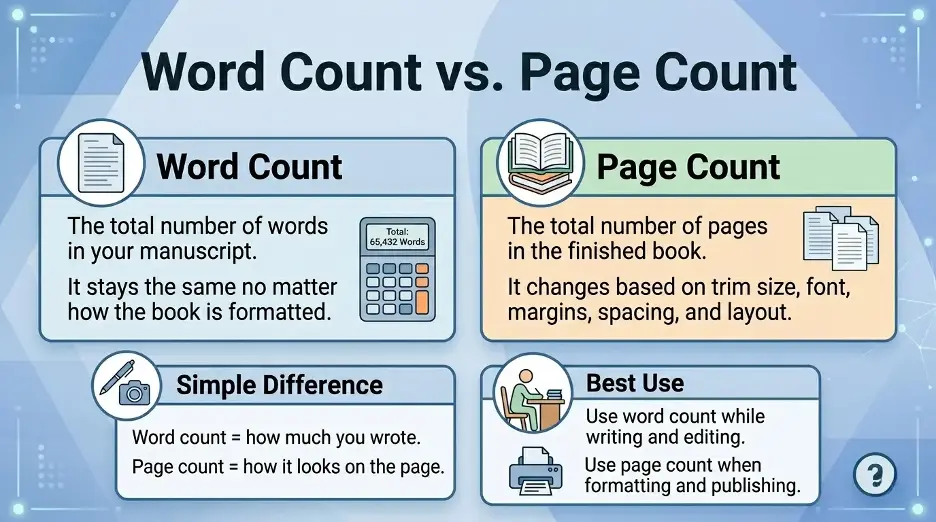
Word count refers to the total word count of a manuscript. It will not change in size. Whether it's a paperback, ebook, large print edition or double spaced draft, there's 60,000 words in a 60,000 word manuscript.
Page count: How many pages will be in the completed(book) or formatted book. It is flexible, and relies on design choices of page size, font, line space, margins, chapter breaks, and interior layout.
In simple terms:
Word count is the length of writing. A page count records the number of page turns that the writing requires.
This is why two books with the same number of words can differ in number of pages.The word count is the first thing we consider when estimating the length of a book; it isn't what is supposed to be there, it's how much there is.
Why Does Word Count Matters More Than Page Count?
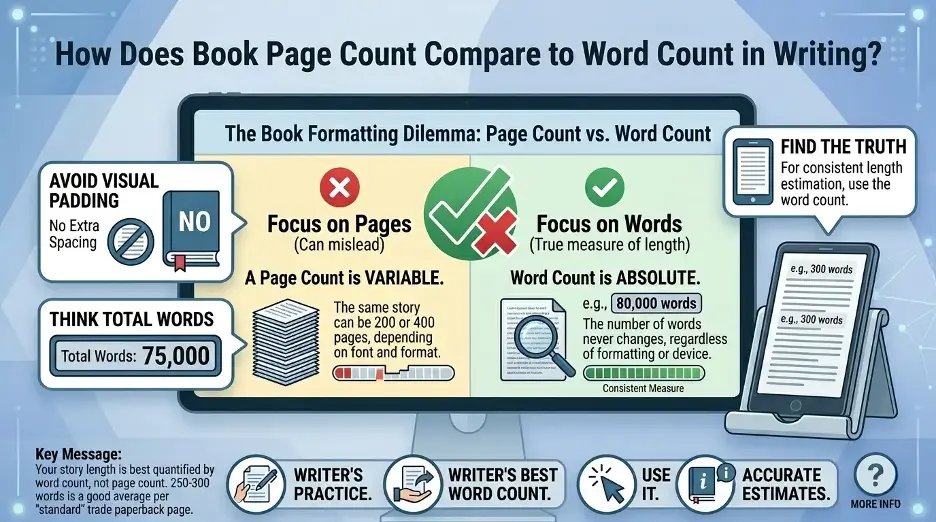
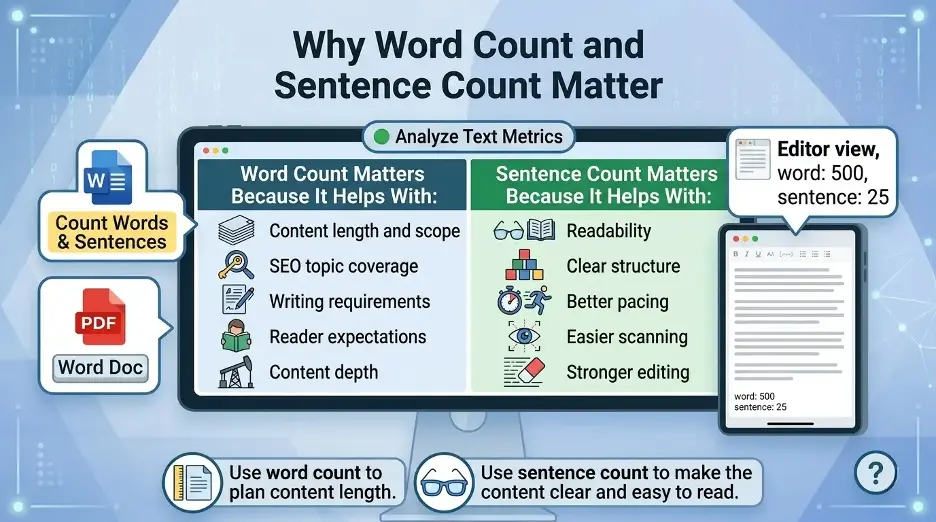
Word count is the most common method of measuring a book's length in writing and publishing because it provides a better understanding of what the book really contains.
Word count is used by editors to calculate editing time and charges. It's utilized by literary agents to determine if a manuscript lives up to genre expectations. It helps publishers determine print volume, price, production and market positioning.
Page count may be helpful for print books, but isn't as consistent. A manuscript can be 300 pages in MS Word and 240 pages when it is professionally typeset. The layout is new, but the content remains the same.
Because of this, writers should monitor word count during the process of writing and only use page count for formatting and publishing.
Average Words Per Page in a Book
The number of words per page in a completed book page is typically 250 to 300 words per page, but this is just a rough average.
With a traditional novel or nonfiction book, 250 words a page is a handy rule of thumb. The actual number of participants, however, will vary based on the format used.
The following is an approximation.
| Word Count | Approximate Book Pages |
|---|---|
| 20,000 words | 80 pages |
| 40,000 words | 160 pages |
| 60,000 words | 240 pages |
| 80,000 words | 320 pages |
| 100,000 words | 400 pages |
These estimates are based on about 250 words per page. They are suitable for rough planning and should not be viewed as "page counts".
How to Convert Word Count to Page Count?
Here's a simple formula to estimate pages in a book from word count.
Word count ÷ 250 = estimated book pagesFor example:
50,000 words ÷ 250 = 200 pagesIt can be a helpful beginning to novels, memoirs, self-help books, business books, and general nonfiction.
If you're using a denser layout, you may consider going with 300 words per page:
50,000 words ÷ 300 = about 167 pagesIf you are looking for a larger layout, you may want to go with 200 words per page:
50,000 words ÷ 200 = 250 pagesDepending on the format, the same 50,000 word manuscript might be considered a 167-page, 200-page or 250-page book.
What Affects Book Page Count?
There are a few design and formatting options that affect the page count. These factors may add or subtract words from a book without altering the number of words.
1. Trim Size
This is the actual physical size of the book. A smaller book size generally means a larger number of pages, as it will have fewer words per page.
For Example: A 5 x 8 inch paperback will typically contain more pages than a 6 x 9 inch paperback with the same number of words.
2. Font Size and Font Style
The larger the font, the more pages you'll need. A smaller font decreases it. Also, font style is important because certain typefaces will require more horizontal space.The 12-point book will be longer than the 10-point book.
3. Line Spacing
Line spacing has an impact on the height of text on a page. Increased line spacing results in a more readable layout and more pages, though.This is why a double-spaced manuscript is much longer than the book that's printed.
4. Margins
A wider margin will decrease the width of the text area, and increase the number of pages. Smaller margins may fit more words on a page; however, it can be more difficult to read the book.The goal of professional book formatting is to ensure the book is easy to read while being page efficient.
5. Chapter Breaks
In most books, there is a new page at the start of each new chapter. A few chapters may also begin at the bottom of the page. The design decisions in these instances add pages particularly in books with numerous short chapters.
6. Dialogue and Paragraph Length
Dialogue tends to produce more white space and so fiction with dialogue will often have fewer words per page.If the text is dense (nonfiction, academic writing, technical), it may be more words per page as paragraphs are longer and more condensed.
7. Images, Tables, and Charts
Books that contain illustrations, charts, tables, worksheets or pull quotes typically have fewer words per page. These components require taking up space and adding to page count.Often used in textbooks, children's books, workbooks, cookbooks, and instructional nonfiction.
How Many Words Are in Different Types of Books?
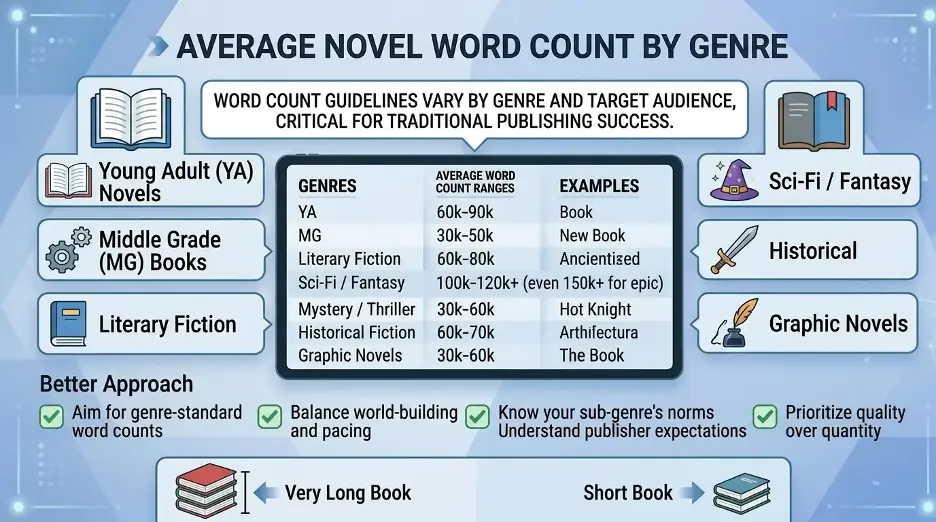
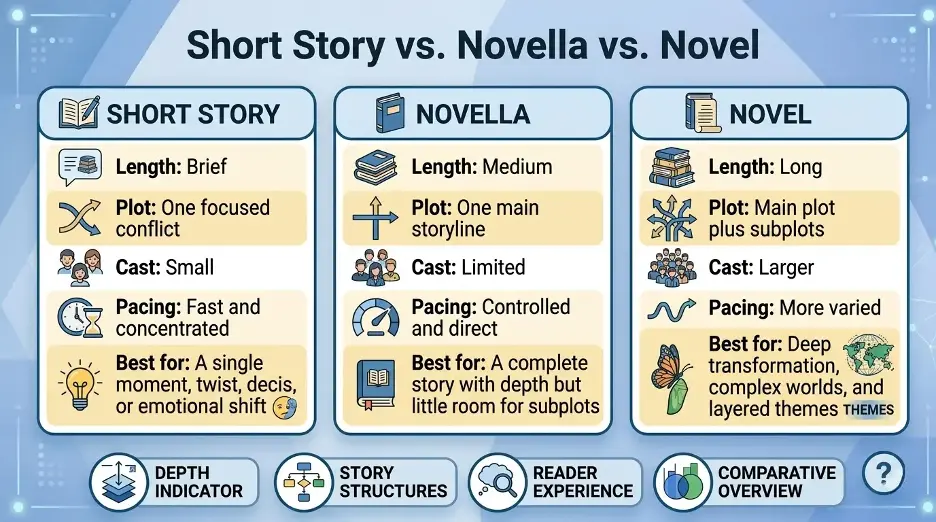
The length of a book can vary according to genre, reader, and purpose. There are no rules, but each category has a general range of word count.
| Book Type | Typical Word Count |
|---|---|
| Novels | 70,000–100,000 words |
| Novellas | 20,000–40,000 words |
| Short Story Collections | 40,000–70,000 words |
| Memoirs | 60,000–90,000 words |
| Self-Help Books | 40,000–70,000 words |
| Business Books | 40,000–80,000 words |
| Academic and Technical Books | Varies widely |
| Children’s Books | Under 1,000–50,000 words |
For broader genre planning, compare this with our word count in pages guide.
Ebook Page Count vs. Print Page Count
The number of pages on an ebook is not as predictable as the number of pages in a print book. Users can adjust font size, orientation of screen, line spacing and settings of the device. Consequently, ebook pages can be easily moved.Chapter 15 on one device could be 25 chapters on another.As a result, ebook platforms typically employ location numbers or reading progress percentages or estimated page counts rather than set pages.Word count is a more accurate length indicator for ebooks.
Why Page Count Still Matters
Although Word count is more relevant to writing and editing, page count is important in publishing and reader expectations.
Page count affects:
- Printing costs
- Spine width
- Retail pricing
- Reader perception
- Shipping weight
- Book design
- Category expectations
Very short print books can be too costly if they have too few pages. Printing costs are exponentially higher for a very long book, as are competitive pricing.For self-publishing writers, page count is particularly crucial because print-on-demand services will sometimes depend upon the number of pages for production costs.When self-publishing, page count can impact your printing expense, your book's price, and your readers' perceptions of the value of your book.
How Many Pages Should Your Book Be?
Your book needs to be the length of what is required to please the reader and to fit into your genre.Pads should not be used in a book to make it any length. Multiple chapters, repetition and explanations not needed can diminish the reading experience.The book should neither be too short for its promise nor be too long. Content should come across as complete if readers expect a full tutorial, full story or a thorough explanation.
The important question is not “How many pages should my book be?” but:
How many words am I going to need to provide the appropriate reading experience?
After the word count has been correct, page count can be altered via professional formatting.
Practical Word Count to Page Count Examples
Below are some examples based on the assumption of 250 words per page:
30,000 Words
A 30,000-word book is about 120 pages. The short nonfiction, novellas, lead generation books, and short guides are good sizes for this length.
50,000 Words
A 50,000-word book is about 200 pages. It is an average length for a practical non-fiction work, memoirs, short novel, and self-help book.
70,000 Words
A 70,000-word book is about 280 pages. This length is good for most full-length novels and nonfiction books.
90,000 Words
A 90,000-word book is about 360 pages. In longer novels, detailed memoirs and in-depth nonfiction, this is common.
120,000 Words
A 120,000-word book is about 480 pages. While this may be fine for epic fantasy, historical or complete nonfiction, it is a long time for many other genres.
Common Mistakes Writers Make With Page Count
Many writers overemphasize length prematurely in the writing process. This can result in making poor decisions, including putting filler material in the document, or removing valuable text just to make up for a number of pages.
Another common error is assuming the page count for a book when it is being printed in Microsoft Word. Don't assume a draft document is as close as a professionally formatted book.
Alternatively, writers can compare their manuscript to published books, ignoring trim size, font, margins and layout. Book 2 can be the same length as 1, but still have a very different amount of words.
The best way to do this is to write by the word count and then revise for quality before counting the pages during formatting.
Best Way to Plan Your Book Length
Start with your genre and audience. Analyze the expectations of readers of other similar books. Set a word count range next and then set a word count goal for pages.
For Example, you may choose to write between 45,000 to 60,000 words for a self-help book. For those who are creating a full-length novel, you may want to shoot for 70,000 to 90,000 words.
Once you've written and edited and formatted your article, it is easier to give an accurate estimate of the total number of pages.
The intelligent process is as follows:
- Decide on your musical style and audience.
- Find out how many words an average sentence contains.Look up the average number of words per sentence.
- Establish a realistic goal for words.
- Draft/revise the manuscript.
- Format the book.
- Check the last page count.
- Change layout as necessary.
It maintains the concentration of the writing, but also provides for professional book design.We suggest you pay attention to achieve the optimal word count first, and after formatting, to cut page count if necessary.
You can use the free word counter while drafting and then compare the final draft with word count vs character count if formatting requirements include character limits.
Interesting Research Facts
Full citations are in Sources below.
Page counts can misrepresent workload
The number of pages can be misleading because of formatting options used like font, page size, spacing, margins, and graphics. The more reliable measure of scope, production effort and cost is word count.
Sentence length varies by genre
The mean length of sentences is 24.23 words for non-fiction and 12.81 words for mystery/detective fiction (Brown Corpus analysis). More dialogue (shorter sentences) generates more white space, which results in more pages.
Source: Sentence length varies by genre
Dense layouts average about 380 words per page
However, it is common to see an informed consent document be about 380 words long, which corresponds to an average of 8,333 words per page or 21.8 pages in total for Emanuel & Boyle's study of 21 documents.
Word-to-page ratios affect reading speed
Adults read about 260 wpm for fiction and 238 wpm for non-fiction. Readers will turn a page at a rate of 250-300 words per printed page, so the pace of a book can be accelerated or decelerated by the way it is formatted.
Best-seller patterns are measurable, not guaranteed
Quantitative research reveals that there are patterns that bestsellers in YA have, including page count, point of view, structural elements, and more. These benchmarks serve as a useful signal in the market but should be used for positioning and not creativity.
Frequently Asked Questions
1.How many pages is 50,000 words?
If we assume the 250 words per page for a book, then 50,000 words equates to approximately 200 pages.
2.The word count on a Microsoft Word document is the same as that of a book page count?
No. The number of pages shown in your Microsoft Word file is only a draft view. Book Pages may vary after formatting.
3.On an average page of a book, how many words are there?
The average number of words per page in most books is 250 to 300, depending upon the trim size, font and margins.
4.Why is word count more important to publishers than page count?
Using word count allows publishers to get a more accurate count of how long your manuscript really is.
5.Is it okay to use the page count as a gauge of my writing?
Yes, but word count will be more accurate. When you change the formatting, the page count may change.
6.Why is my book longer after formatting?
If you use larger fonts, wider margins, chapter breaks, images, tables or additional spacing, your book could be longer.
7.How can I determine the actual number of pages my book will be?
The only way is to look at the finished print piece. Any page count is only an estimate prior to formatting.
How we reviewed this article:
Share this article