Sentence Count vs Word Count: What Is the Difference?
Understand the difference between sentence count and word count and its impact on readability, SEO, content length, and quality.
Quick Summary
- Word count refers to the length of the content: It indicates the number of words in a text and can help determine the length, brevity or conciseness of a piece of writing.
- Sentence count indicates content structure: It indicates the number of sentences used and whether the content is easy to read or too dense.
- The length of the content is indicative of how much information it will contain, and can help with SEO planning, but should not be longer than necessary for the purpose or intent of the search.
- Readability and flow are improved by sentence count.
- Word count and sentence count complement each other: Word count can be used to manage length; sentence count can be used to help with clarity, pacing and overall quality of the writing.
What Is Word Count?
Word count is the number of words in a text. Measures content length.
For example:
The cat was resting on the cat mat.
There are 6 words in this sentence.
The word count is typically used in:
- Blog posts
- Essays
- Articles
- Product descriptions
- Books
- Academic assignments
- Social media posts
- SEO content briefs
- Freelance writing projects
The number of words is used to determine the extent of detail in a piece of writing. A 300 word article typically would be short and straightforward, whereas a 2,000 word article could go into more depth.
What Is Sentence Count?
The number of sentences in a text. It refers to the number of sentences or ideas that have been completed in the text.
Period, question mark and exclamation mark are typical sentence ending punctuation.
For example:
The cat is on a mat. It looked sleepy.
This text has two sentences.
The number of sentences can give you insight into the structure of writing. It can give you a clue as to whether your writing consists of long, complicated sentences or short, direct sentences.
Sentence Count vs Word Count: The Main Difference
The biggest difference is that:
Word count is a measure of length. Sentence count is a measure of structure.
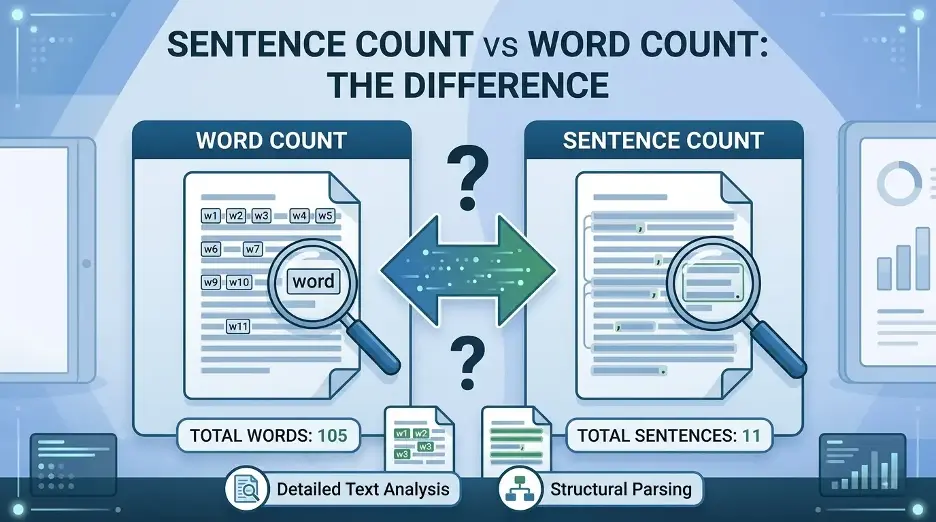
A 100 word text might have:
- 3 long sentences
- 5 medium sentences
- 10 short sentences
The same number of words, but a different reading experience.
A simple comparison:
| Metric | What It Measures | Main Purpose |
|---|---|---|
| Word count | Total number of words | Measures content length |
| Sentence count | Total number of sentences | Measures content structure |
| Average sentence length | Words divided by sentences | Measures readability |
For example, in the same way, the longer a 500 word article is, the shorter each sentence will be. This might sound like a lot of information. The average sentence length of a 500-word article with 25 sentences is 20 words; this is typically easier to read.
Why Word Count and Sentence Count Matter
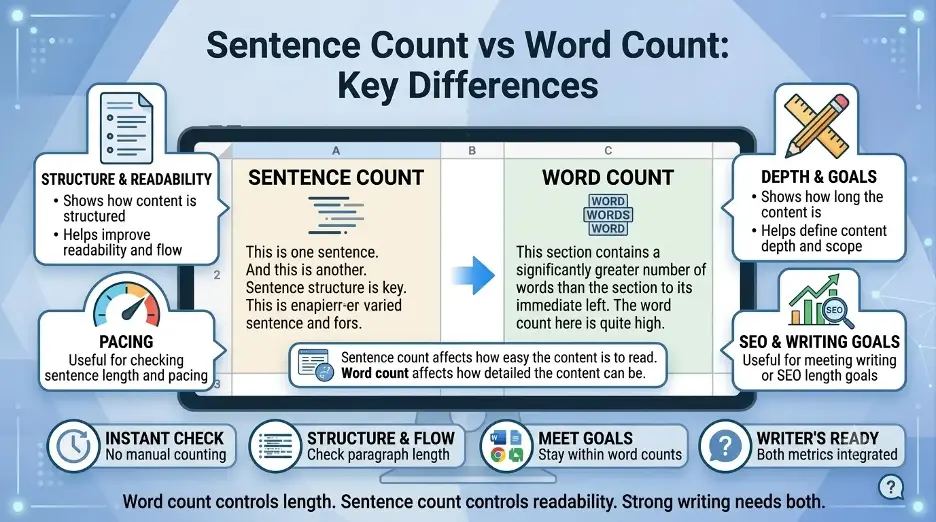
| Aspect | Why Word Count Matters | Why Sentence Count Matters |
|---|---|---|
| Writing requirements | Word count helps writers meet specific length requirements, such as a 1,000-word essay, a 1,500-word blog post, or a 500-word landing page. | Sentence count helps writers structure content properly by showing how many complete thoughts are included. |
| Content depth | A higher word count allows more room for examples, explanations, comparisons, definitions, and FAQs. | A balanced sentence count helps organize ideas clearly without making the content feel too dense. |
| SEO planning | Word count helps estimate how much detail is needed to cover a topic based on search intent and competition. | Sentence count supports readability, which improves user experience and makes content easier to scan. |
| Reader expectations | Word count helps match the content format to reader intent. A short guide should be quick to read, while long-form content should provide deeper value. | Sentence count affects pacing. Shorter sentences create clarity and speed, while longer sentences allow more detailed explanation. |
| Readability | Word count alone does not guarantee quality. Content should be long enough to answer the topic without adding filler. | Sentence count helps improve readability by breaking complex ideas into clearer, easier-to-follow parts. |
| Editing and flow | Word count helps identify whether content is too short, too long, or missing important details. | Sentence count helps spot structure problems, such as overly long sentences, crowded paragraphs, or choppy writing. |
| Main benefit | Word count defines the length, scope, and depth of the content. | Sentence count improves clarity, flow, pacing, and overall readability. |
How Sentence Count and Word Count Work Together?
It is best to use a combination of sentence count and word count.
Here you get the average sentence length from the relation between them:
Average sentence length: total number of words/number of sentences
For example:
If the article is 600 words long, and the sentences are 30, then:
600 ÷ 30 = 20 words per sentence
This averages out to 20 words per sentence.
This number gives you an idea of how readable your content is. Online writing tends to be easier to read if clear, direct and not loaded with ideas.
Example: Same Word Count, Different Sentence Count
Check out these 2 examples.
Example 1: Low Sentence Count
The importance of writing clearly is that readers do not have an unlimited amount of time to spend reading, and they are likely to skim the information and decide whether to read on based on the first few sentences. Writers should, therefore, use simple words, a logical organization, and sentences that do not overwhelm the reader.
This example has one long sentence.
Example 2: Higher Sentence Count
Being able to write clearly is of great importance. People don't have a lot of time to read. Many people skim content prior to selecting whether to read it. Hence simple words, logical structure and clear sentences should be used by writers.
In this version, there are four shorter sentences.
The second version is easier to read but the message remains the same.
Which Is More Important: Sentence Count or Word Count?
Both are equally valued at times. They are used for different purposes.
In cases where length matters, word count is more important. This includes anything from essays and articles, reports, book chapters and SEO content briefs.
When readability is important, sentence count is more important. This covers the content found in Web copy, blog articles, emails, landing pages, and educational articles.
If you are writing most pieces, you'll want to take both into account. Word count lets you know if you're on track. The number of sentences will help you to gauge if that content is readable.
Sentence Count vs Word Count in SEO
In SEO, both sentence count and word count can influence content quality, but they do not work as ranking factors in a simple, direct way.
| SEO Factor | Role in SEO | Key Point |
|---|---|---|
| Word count | Helps cover a topic in enough detail based on search intent. | Write enough to answer the query fully without adding filler. |
| Sentence count | Improves readability, flow, and user experience. | Clear, concise sentences help readers and search engines understand the content better. |
Best Practices for Using Word Count
Word count is not a target.Do not use word count as an objective target.
Recommended practices:
- Adjust word count to match the topic's depth.
- Don't put filler words in to fill up the content.
- Use a full cover search to completely cover the search intent.
- Illustrate with examples where appropriate to enhance understanding.
- Keep introductions concise.
- Eliminate duplications when editing.
- Have each section have a function.
A good article isn't just lengthy. It is comprehensive, unambiguous and helpful.
Best Practices for Using Sentence Count
Sentence count will help you to be clearer and more flowing.
Recommended practices:
- Divide long sentences into shorter sentences if necessary.
- Avoid using sentences with more than one idea.
- Avoid using only long sentences and/or short sentences.
- Don't use all the same length sentences.
- Be alert to paragraphs that consist of a single long sentence.
- Read the material aloud to check for flow.
- Connect ideas together in a natural way, using transitions.
Writing sounds smooth and not mechanical due to good sentence structure.
How to Check Sentence Count and Word Count
Sentence Count and Word Count can be accessed via:
- A word processor (Microsoft Word or Google Doc)
- Online word count tools
- SEO writing tools
- Grammar checkers
- Readability analyzers
- Content editing platforms
For most tools, total words are displayed by default. Others include sentence count, paragraph count, character count and average sentence length.
Practical Example
If you were to be creating a blog post and used the following metrics:
- Word count: 1,200 words
- Sentence count: 60 sentences
- Sentence length: 20 words on average
This is typically a readable format for web content.
Now compare this:
- Word count: 1,200 words
- Sentence count: 25 sentences
- The average length of sentences is 48 words.
This version might be difficult to see due to the lengthy sentences.
The same word count, but a different sentence count changes the reading experience.
Ideal Sentence Length and Word Count
No one word count is right for every piece of writing. Ideal sentence range, ideal word range – depends on audience, purpose, topic, and format.
When writing online in general:
- Short sentences are helpful for clarity.
- Medium sentences can be used for explanation.
- Use of long sentences is to be used with caution.
- It's important paragraphs are easy to scan.
- Word count should be on par with the search intent of the topic.
Rather than looking for a specific amount, check to see if the content is complete, readable and helpful.
Interesting Research Facts
Sentence length has dropped over time
Public speaking data suggests sentence length decreased from around 45 words in 1789 to 14 words in 2017.
Long sentences strain working memory
Research on sentence processing shows that readers can process ideas more easily when they are organized in shorter sentences instead of longer multi-clause sentences.
Plain language favors 15-20 words per sentence
Plain-language research favors average sentence lengths around 15-20 words and recommends avoiding very long sentences when possible.
Sentence length affects readability scores
Readability models show that sentence length regularly contributes to comprehension and perceived difficulty.
High word counts reduce vocabulary diversity scores
As text length increases, repeated words appear more often, which can reduce type-to-token ratio vocabulary diversity scores.
Frequently Asked Questions
1.Does word count is a ranking factor in SEO?
Word count does not affect the ranking of a page. The most important is the content that completely satisfies the intent of the person searching.
2.So, how many words are in a blog post?
Blog posts should be as long as necessary to cover the topic thoroughly. Simple questions can require less in terms of words, and broad topics more.
3.When writing for a grade, do I need to pay more attention to word count or flow?
Write the flow of the story first. While a target word count is beneficial, it should also be natural, clear, and helpful.
4.Are sentences longer or shorter than normal?
Yes. Content is easier to read when the sentences are not too long, but typically is easier to understand when the sentences are shorter.
5.In word count, do headings and titles count?
Depending on the requirement. Always review guidelines when trying to complete an academic project or client project. In SEO content, headings are typically considered page content.
6.What is one word?
Most tools do not count contractions, hyphenated words and numbers in the same way. Use a trustworthy word counter and abide by the guidance of your instructor, client, or platform.
7.Are there more words than sentences?
No. Both matter. Use word count to manage length and depth and sentence count to enhance structure, clarity and readability.
8.Can a short article be a successful article?
Yes. A short article can rank if it provides a clear answer to a specific question that is better than the longer, less useful articles.
9.Is there a word count requirement?
Word counts typically matter in school and contest projects and assignments, as well as in client projects and assignments. If not specified, do not exceed or go below the specified range.
How we reviewed this article:
Share this article