
Word Count vs Character Count: What's the Difference?
Understand the distinction between word and character count, when to use each, and why both matter for SEO, writing, and online content.
Quick Summary
- Word count is the number of words in a text. Use it for blog posts, essays, articles, reports, and other content that requires length and depth.
- Character count counts each letter, number, symbol, punctuation mark, and space. Use it when writing for limited spaces such as meta titles, descriptions, forms, ads, and social media posts.
- The main difference is what each one counts: word count measures words, character count measures every individual character including spaces.
- Word count is better for measuring content depth and completeness. Character count is better for ensuring text fits within platform limits.
- Use our free word counter to check both counts before publishing.
What Is Word Count?
Word count is the number of words in a text. For example, the sentence Word count matters has 3 words: Word, count, and matters.
Word count is used when the focus is on the length, depth, and structure of written material. It helps assess whether a piece of writing is too short, too long, or appropriately detailed for its purpose.
Common Uses of Word Count
- Blog posts
- Essays and assignments
- Articles and research papers
- Book chapters and manuscripts
- Product descriptions and website pages
- Reports and cover letters
- Speeches and SEO content briefs
For example: a teacher might ask for a 1,000-word essay; a content editor might request a blog post of 1,500 words; a publisher might set a minimum word count for submitted manuscripts. In these cases, the goal is not just to fill space—it is to guide the depth of the writing.
What Is Character Count?
Character count is the total number of characters in a text. A character can be a letter, number, punctuation mark, symbol, or space.
For example, Hello! has 6 characters: H, e, l, l, o, !. The word Hi there has 8 characters including the space, or 7 without it.
Common Uses of Character Count
- Meta titles and meta descriptions
- Social media posts and SMS messages
- Online forms, usernames, and passwords
- Headlines and search ads
- App store descriptions and email subject lines
- Database fields
Character limits apply whenever content must fit within a specific space or be accepted by a platform with a defined field length.
Word Count vs Character Count: The Main Difference
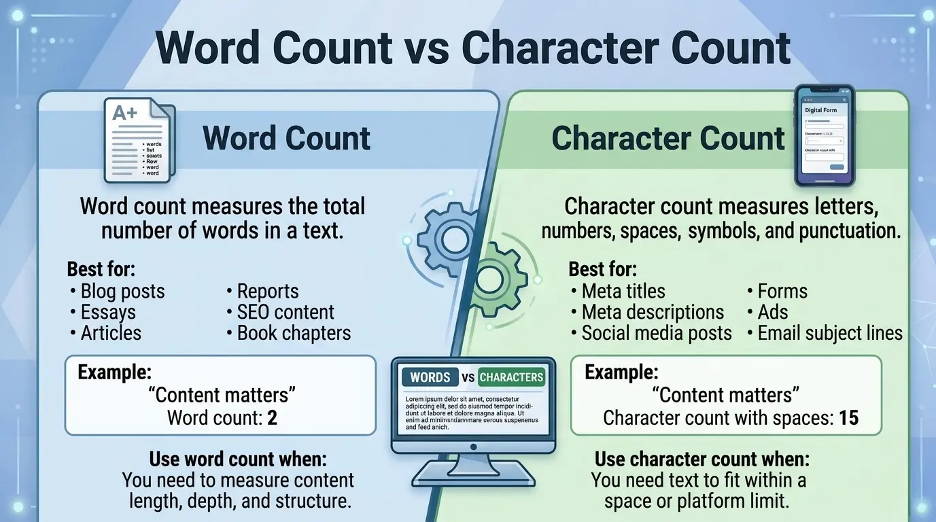
Word count measures words. Character count measures every individual character. A single word can contain multiple characters. For example, the word content is 1 word but 7 characters.
Here is a side-by-side comparison:
| Text | Word Count | Character Count (with spaces) |
|---|---|---|
| SEO writing | 2 | 11 |
| Content matters | 2 | 15 |
| Write better blogs | 3 | 18 |
| Word count vs character count | 5 | 29 |
Word count is better for measuring content length and detail. Character count is better for measuring space requirements and platform compatibility.
Character Count With Spaces vs Without Spaces
There are two ways to count characters:
- Characters with spaces — includes letters, punctuation, numbers, symbols, and spaces. Example: Good writing = 12 characters.
- Characters without spaces — includes letters and punctuation only, no spaces. Example: Good writing = 11 characters.
Platforms with strict text limits—such as social media sites and form fields—usually count spaces as characters, because a space still takes up a character slot. Always check which method a platform uses before finalising your text.
Why Does Word Count Matter?
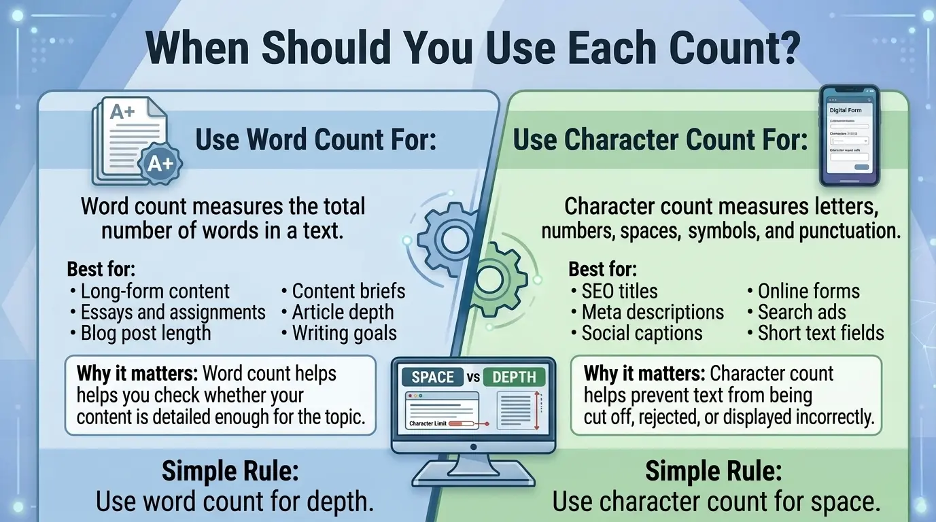
Word count determines how much information you can provide and how deeply you can explain a topic. A 300-word piece can introduce a subject but may not cover it in detail. A 1,500-word blog post gives room for definitions, examples, comparisons, and practical tips.
For SEO, word count should align with search intent. A brief question might need only a short answer. A complex topic benefits from a longer, more detailed breakdown. The goal is not to write a higher word count for its own sake—it is to convey a clear and complete message.
Why Does Character Count Matter?
Character count matters because platforms have space limitations. A meta title that is too long may be cut off in search results. A social media post that exceeds the limit cannot be published as written. A form field may reject text that is too long.
In SEO, character count is critical for elements that appear in search results:
- Meta title tags
- Meta descriptions
- URL slugs
- Headings and schema fields
- Image alt text and search ad copy
A well-sized title and description is easier to read and can improve click-through rates in search results.
Word Count and Character Count in SEO
Both metrics serve different purposes in SEO. Word count helps align content with search intent. Character count helps titles and descriptions display correctly in search results.
Word Count in SEO
Search engines rank content that meets user search intent. In many cases this means having enough words to cover the topic properly. But quantity alone does not guarantee high rankings. An article that is too long, repetitive, or padded with weak explanations will not perform well. A short article can still rank well if it answers the query clearly. Write enough words to address the topic fully without padding.
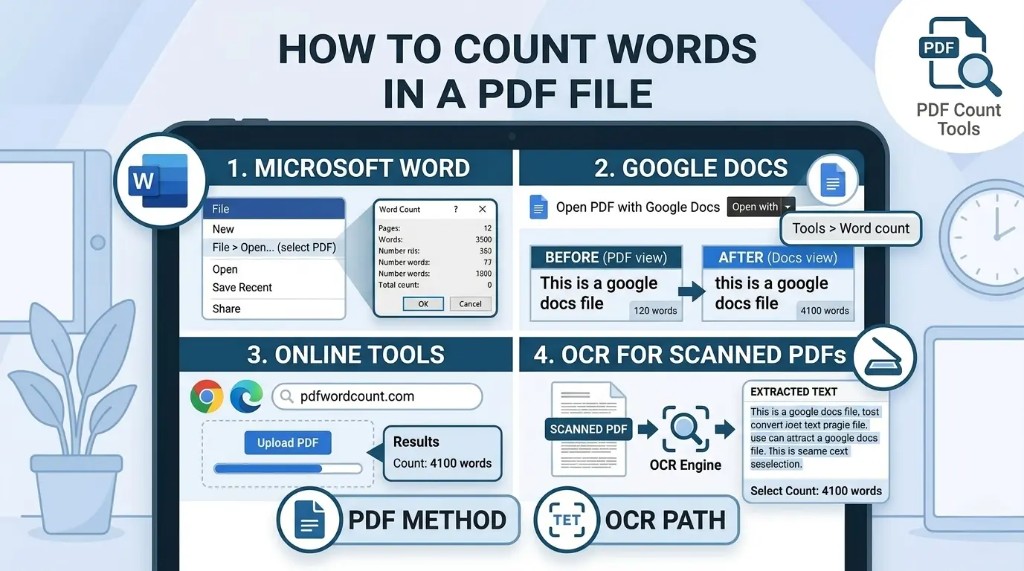
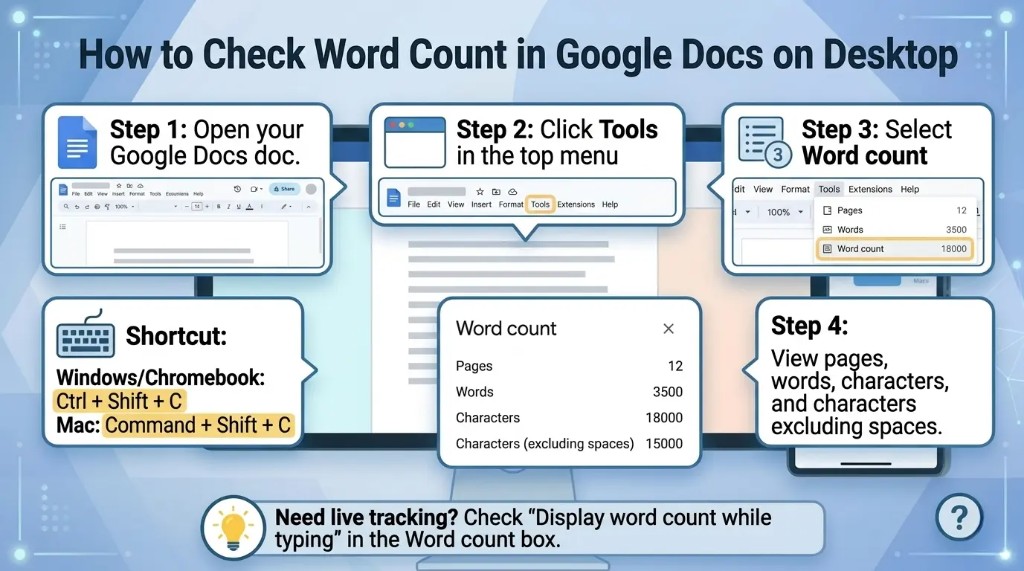
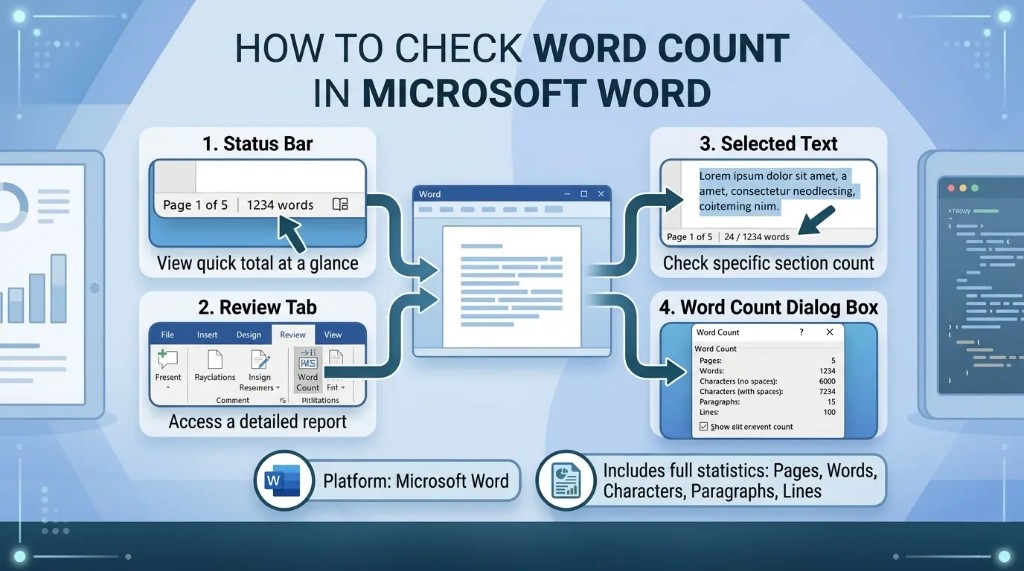
For more on measuring word count across tools, see our guides on word count in Google Docs and word count in Microsoft Word.
Character Count in SEO
Elements in search results or with display limits are measured in characters:
- SEO title tags
- Meta descriptions
- Page headings and URL slugs
- Product titles and structured data fields
A title tag should be short enough to display in full in the search engine results page. A meta description should be clear and concise enough to act as an effective click-through booster.
Examples of Word Count vs Character Count
Example 1: Short Sentence
Writing improves clarity.
- Word count: 3
- Character count with spaces: 24
- Character count without spaces: 22
Example 2: Blog Title
Word Count vs Character Count: What's the Difference?
- Word count: 8
- Character count with spaces: 53
- Character count without spaces: 46
Example 3: Meta Description
Understand the difference between word count and character count and when to use each and why both are important for SEO, writing and online content.
- Word count: 30
- Character count with spaces: 165
This is a good length for a meta description—clear, concise, and informative.
Social media platforms enforce character limits to ensure posts fit their format. A post with hashtags or a link could exceed the limit even if it is only 20 words long. For social media writing, character count is more significant than word count. However, word count still affects readability. For shorter posts, write a message that is easy to scan.
Word Count vs Character Count in Academic Writing
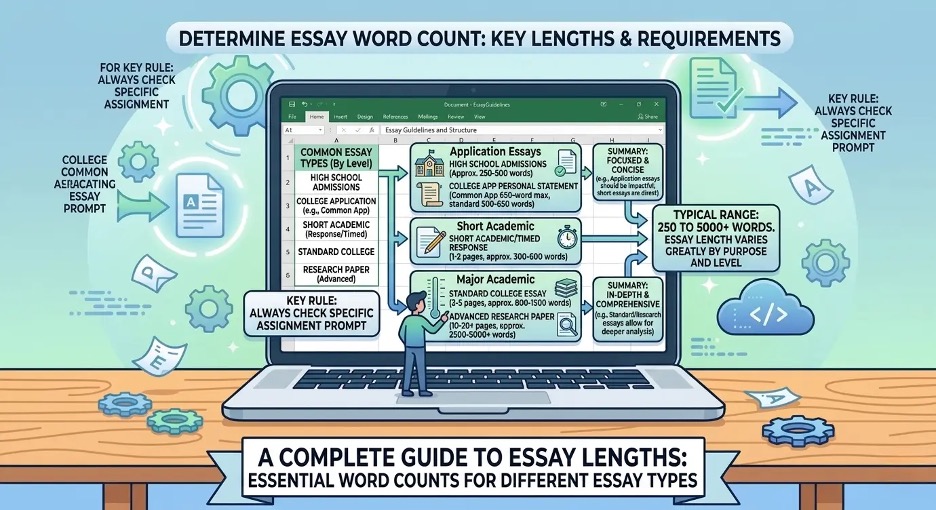
Academic writing is primarily governed by word count. Assignments, research papers, dissertations, and essays typically carry a minimum and maximum word count. This helps institutions regulate the expected level of analysis.
A 2,000-word essay must be more developed than a 500-word response. Writers should provide explanations, evidence, and arguments within the specified length. Character count still applies in academic writing for abstracts, titles, keywords, and online submission forms. For essay-specific length guidance, see our essay word count guide.
Word Count vs Character Count in Professional Writing
Both metrics appear regularly in professional writing. Business reports may carry a word-length limit. A resume summary, LinkedIn headline, email subject line, or product description may need to be constrained in character length. Use word count to control content quality and character count to control how content displays in its publishing format.
Is Word Count More Important Than Character Count?
Neither is universally more important. The right metric depends on the goal of the writing:
- Word count is more important for blog posts, articles, essays, and guides where depth and completeness matter.
- Character count is more important for meta descriptions, social media posts, ads, and forms where space is limited.
Strong content often requires consideration of both. Write enough words to cover the topic, then check character counts for any elements that will appear in restricted spaces.
Best Practices for Using Word Count and Character Count
- Match word count to the purpose of the content—do not add words just to reach a target.
- Check character count for all SEO titles and meta descriptions before publishing.
- Count spaces when writing for platforms with absolute character limits.
- Keep headlines and meta tags short and to the point.
- Focus on being clear, not lengthy.
- Consider whether content will be read on mobile or desktop when display matters.
- Use a word and character counter to verify both counts before publishing—do not rely on manual estimation.
Good writing is not about the highest count. It is about the right amount of text to communicate effectively.
Interesting Research Facts
Full citations are in Sources below.
Short word counts can be unreliable
Lexical diversity metrics for texts under 500 words are highly variable. Greater consistency is typically observed at the 1,000–2,000 word range, making shorter texts less reliable for measuring vocabulary breadth.
Word-count tools may calculate differently
Microsoft Word and online submission systems can differ in how they count punctuation, hyphenation, and spaces, which can cause discrepancies and issues with academic or professional submissions.
Character limits change writing style
Twitter's expansion from 140 to 280 characters demonstrated how tight limits drive more abbreviations, contractions, and word omissions. Looser limits changed how users expressed themselves.
Character length reflects text complexity
In automated text analysis, the average number of characters per word is used to measure writing style, academic tone, and complexity—making character-level metrics useful beyond just space limits.
Better writing does not always mean more words
Research on writing revision shows that stronger essays are often improved with little change in length. Writers improve quality through clearer phrasing, better organization, and conciseness—not by adding words.
Frequently Asked Questions: Word Count vs Character Count
1. Do I need to fit within the word or character count limit?
Follow whichever limit the instructions specify. If it says 500 words, use word count. If it says 1,500 characters, use character count.
2. Do spaces count as characters?
Yes—in most online forms, SEO fields, and social media platforms, spaces are counted as characters.
3. How can my character count be high if I have a low word count?
Long words, spaces, punctuation, numbers, and symbols all add characters even if there are few words in the text.
4. Is character count more important for meta descriptions?
Yes. Meta descriptions must fit within display limits in search results, making character count the more relevant metric.
5. Which is preferable for essays—word or character count?
Word count is more important for essays as it governs the expected length and depth of the answer.
6. Can I exceed the character limit if my word count is below the limit?
No. When there is a character limit, stay within it—text that exceeds the limit can be cut off or rejected entirely.
7. Can AI tools provide accurate word and character counts?
Not always. Use a dedicated word and character counter to check your final work rather than relying on AI-generated counts.
8. What should I check before posting online content?
Check both. Use word count for content length and character count for titles, descriptions, forms, and social media posts.

Word Count vs Character Count in Social Media